
 an you normally scan a small part at home without an engineering degree? When Elegoo released their very first 3D scanner, the M1 Ultra, maker workshops everywhere faced a very practical question about whether a budget-friendly device can actually replace bulky wired setups without driving you crazy, as testing over the past couple of weeks showed.
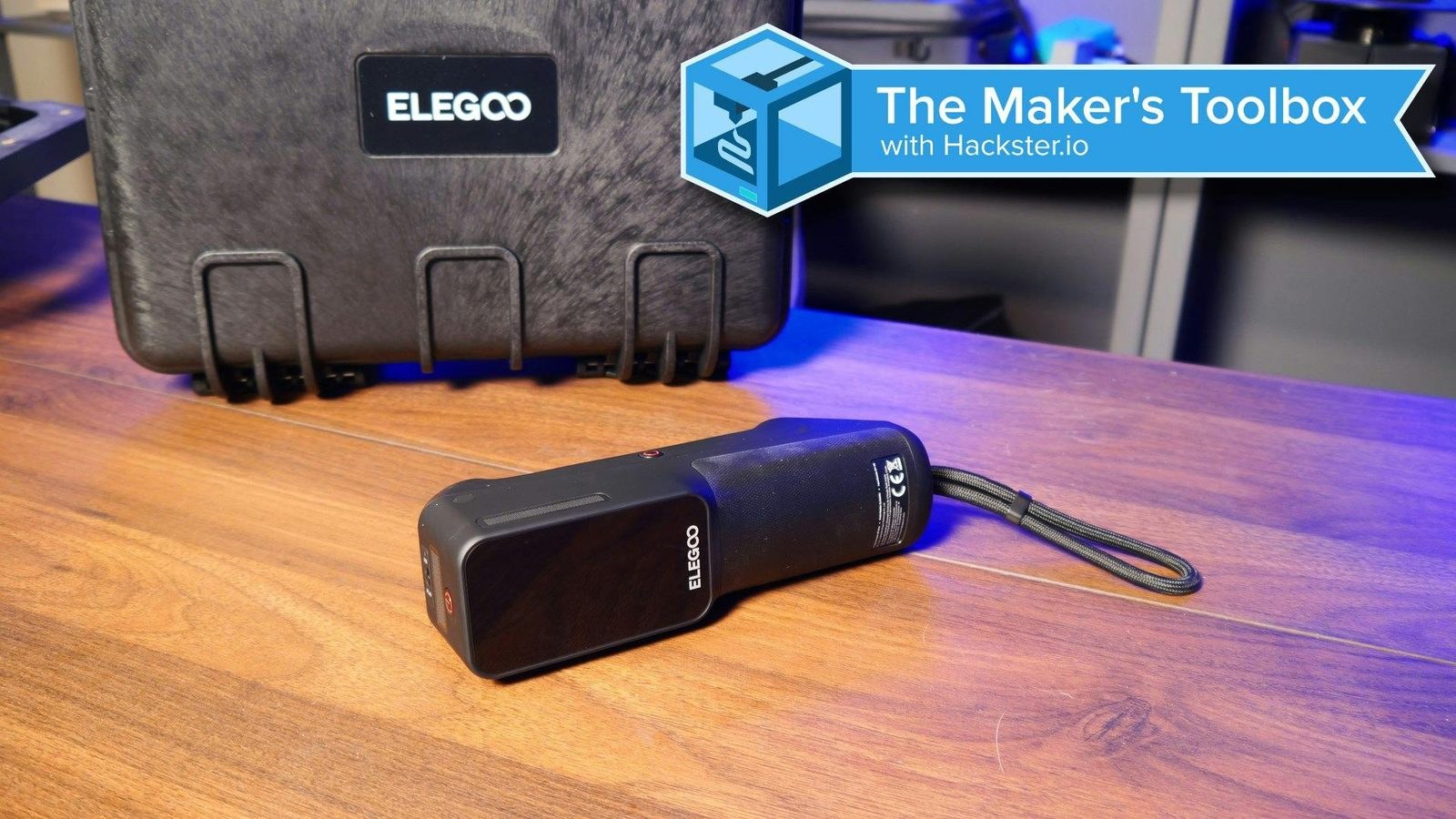
Elegoo brings its familiar low-cost playbook to 3D scanning, but untethered convenience and lasers require a reality check. The Elegoo M1 Ultra is a battery-powered 3D scanner that can operate untethered by connecting to a PC over Wi-Fi, while also supporting wired use through a USB-C cable. With a battery installed, it weighs 511 grams, and the package comes with two 4,800mAh batteries, each featuring a USB-C port for charging. Inside the housing sits an 8-core CPU running at 2.0GHz, driving a built-in 3-inch touchscreen that helps you manage operations without being chained directly to a desktop port.
Unboxing and the Setup Routine
The build quality of the Elegoo M1 Ultra itself is solid, utilizing a soft-touch plastic body with rubber grips that gives the scanner a balanced, premium weight in the hand.
The calibration only took a couple minutes and it went smoothly.
Getting started usually involves a frustrating calibration routine with other hardware, but the M1 Ultra keeps it painless by letting you point the device at the provided glass calibration board while moving it according to the software instructions.
Laser Tracking and Real-World Limits
For mechanical parts, blue line scanning serves as the primary method, utilizing crossed lines for large objects, parallel lines for medium objects, and single lines for maximum detail in deep holes. This approach requires tracking markers, which are little stickers placed across the object; a workshop collaborator named Yuriy, known as "Laser3DCNC," built a turntable covered in markers specifically to make this process convenient enough that smaller objects do not even need extra stickers applied.
However, the scanner has clear boundaries where performance dips. Small protruding elements, shiny or transparent materials, and tight holes cause tracking issues, meaning something like a Raspberry Pi only yields a scan good enough for a rough enclosure design rather than a precise replica. Transparent parts like a shower knob are initially invisible to both blue laser and infrared modes until you apply a coating of 3D scanning spray or dry shampoo to give the hardware something it can actually read.
What This Means for Your Workshop
Skeptics may point out that a wireless scanner is still tethered to a computer running Elegoo Scan software over Wi-Fi within local range, and tricky surfaces still demand messy scanning sprays. The scanner delivers solid resolution ranging from 0.05 to 2mm with a volumetric accuracy rated at 0.02mm + 0.06mm/m multiplied by length across a scan volume spanning from 5 by 5 by 5 millimeters up to 4,000 by 4,000 by 4,000 millimeters. If you need to capture organic shapes without markers, the infrared structured light mode handles it without stickers, while the dual 4,800mAh batteries keep you untethered during extended scanning sessions. For home makers tackling mechanical parts and willing to prep shiny surfaces, Elegoo delivers a capable tool, provided your workstation stays within Wi-Fi reach.
What it signals
Eliminating cable clutter and tedious calibration saves preparation time, yet the Elegoo M1 Ultra still leaves the user wrestling with the physical limits of optical scanning. While the integrated screen and two swappable battery packs remove the need for a wall tether, the hardware remains bound to a steady local Wi-Fi connection and the desktop Elegoo Scan utility. Moreover, capturing transparent fixtures or the intricate pin headers of a Raspberry Pi still forces the user to blanket surfaces with tracking stickers or coat parts in dry shampoo. The true untethered freedom of this 511-gram handheld ends the moment it steps out of local Wi-Fi range.