
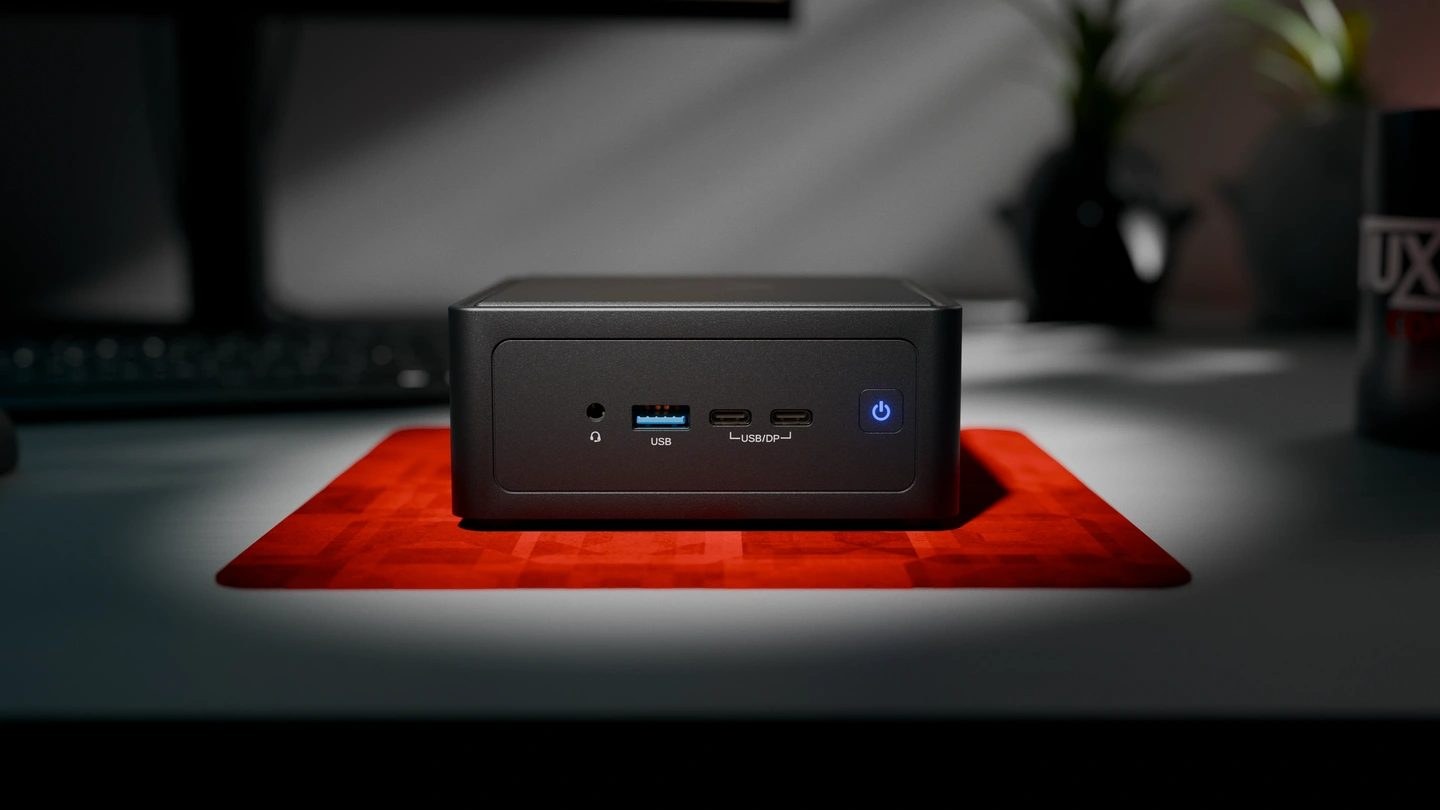
 f you are sick of massive desktop towers taking up half your desk, this little machine offers a full-fledged workstation that you can literally hide behind your monitor using a standard mount.
Power and compactness rarely get along without a catch, but they somehow managed to cram a desktop-grade processor into this kilogram-heavy chassis. Granted, the starting price of $1,640 before taxes makes you count every gigabyte and seriously wonder if a Linux mini-PC is worth triple the price of a standard build.
Inside sits an Intel Core Ultra X7 358H processor — a Panther Lake chip featuring 4 performance cores, 8 efficient cores, and another 4 ultra-low-power cores. It can boost up to 4.8 GHz and packs 18 megabytes of Level 3 cache for quick data access. Graphics are handled by the integrated Intel Arc B390 chip with 12 graphics cores, which easily handles casual games at high Full HD resolution and can output video to four 4K monitors simultaneously.
You can go all out on RAM here: two SO-DIMM slots support up to 128 gigabytes of DDR5-7200 memory in dual-channel mode, and both slots are easily accessible for replacement. For storage, you get two M.2 slots — one fast PCIe 5.0 x4 slot and a second PCIe 4.0 x4 slot, letting you stack up to 10 terabytes of total storage. Four screws on the bottom cover grant full access to the guts, meaning you can swap out the RAM, both solid-state drives, and the wireless module with your own hands.
Connections and Ports
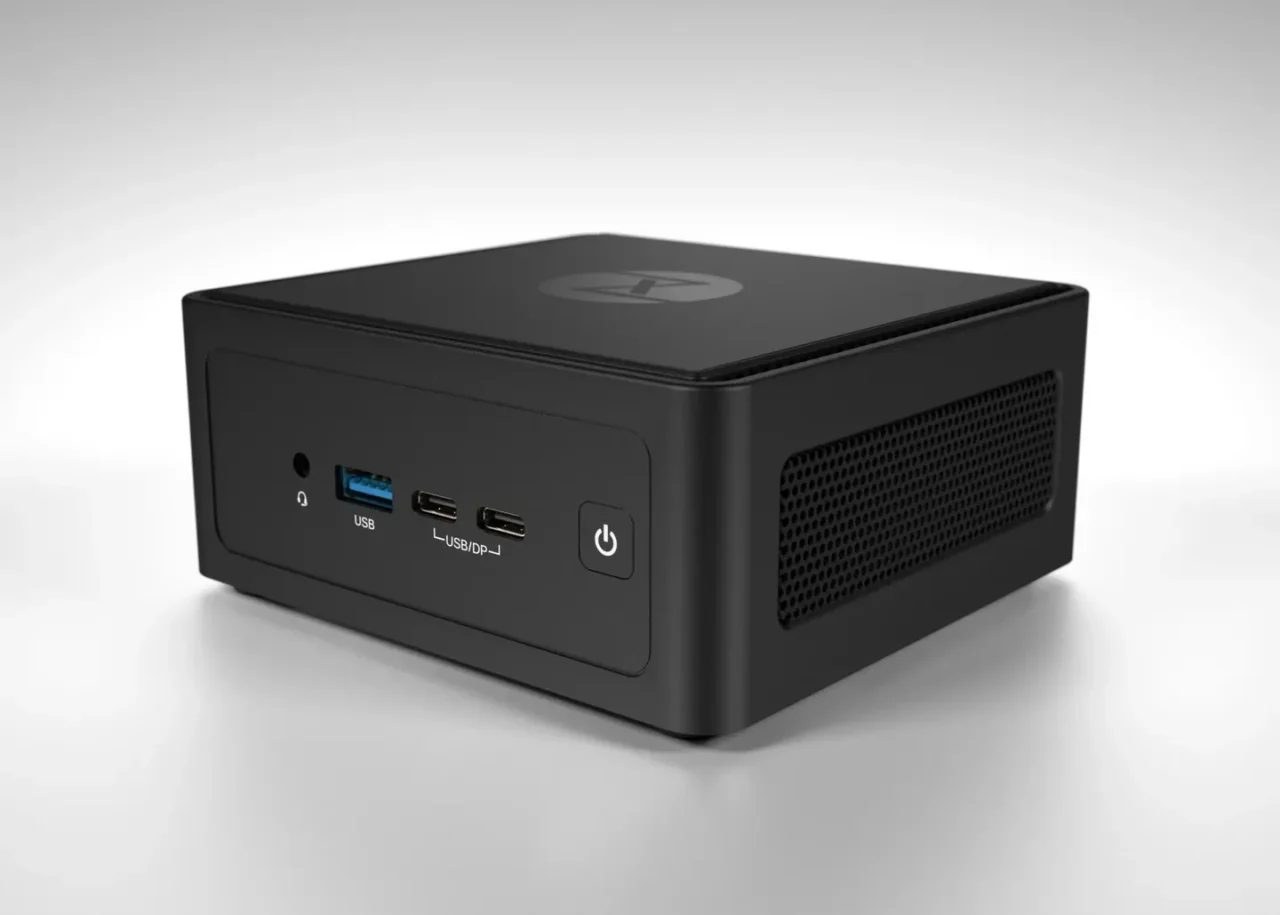
Up front, you will find a USB4 port with DisplayPort 2.1 video output, a USB-C 3.2 Gen2x2 port with DisplayPort 1.4a support, a standard USB-A 3.2 Gen2 port, and a combo headphone jack. Hiding in the back are two more USB-A ports, two HDMI ports, a security lock slot, and two 2.5-gigabit ethernet ports. Wireless connectivity comes via modern Wi-Fi 7 and Bluetooth 6.0, and the whole thing is powered by a 120W power supply.
Most mini-PCs ship with Windows, while Linux gets slapped on as an afterthought, but the Nano Pro Gen15 completely flips the script. It ships with proprietary TUXEDO OS based on Ubuntu featuring a user-friendly KDE Plasma desktop, or with pure Ubuntu — everything is already fully configured. The company's proprietary WebFAI utility installs other OS versions just like the factory default, and the video drivers are baked right into the Linux kernel, so the Arc B390 graphics work straight out of the box with zero fiddling.
A 128-gigabyte RAM headroom gives this little guy a second career. Such an amount of memory lets you run artificial intelligence locally on the device using integrated graphics and simple apps like LM Studio.
Mid-range models run snappy, while all your prompts stay inside your computer instead of flying off to someone else's cloud servers on a subscription basis.
Pitfalls and Price
Under Linux, the HDMI ports operate in version 2.0b and top out at 4K at 60 frames per second. One has to ask: is it even worth bothering with Linux setup if you need high refresh rate displays?
The Nano Pro Gen15 starts at $1,640 before taxes in the official TUXEDO store, but that base configuration gets you a measly 16 gigabytes of RAM and a 500-gigabyte drive. Pre-orders are already open, and shipments kick off in mid-November 2026. If you need a quiet Linux workstation that's easy to upgrade yourself and you are willing to live with port limitations — this thing fully earns its keep.
The catch
Does an out-of-the-box open-source setup justify paying a steep premium for a miniature desktop? Tuxedo solves the driver headache around the Intel Core Ultra X7 358H processor while keeping the memory and storage fully accessible for upgrades. The contradiction is that paying extra for pre-tuned hardware still forces users to accept compromises like restricted HDMI display bandwidth.