
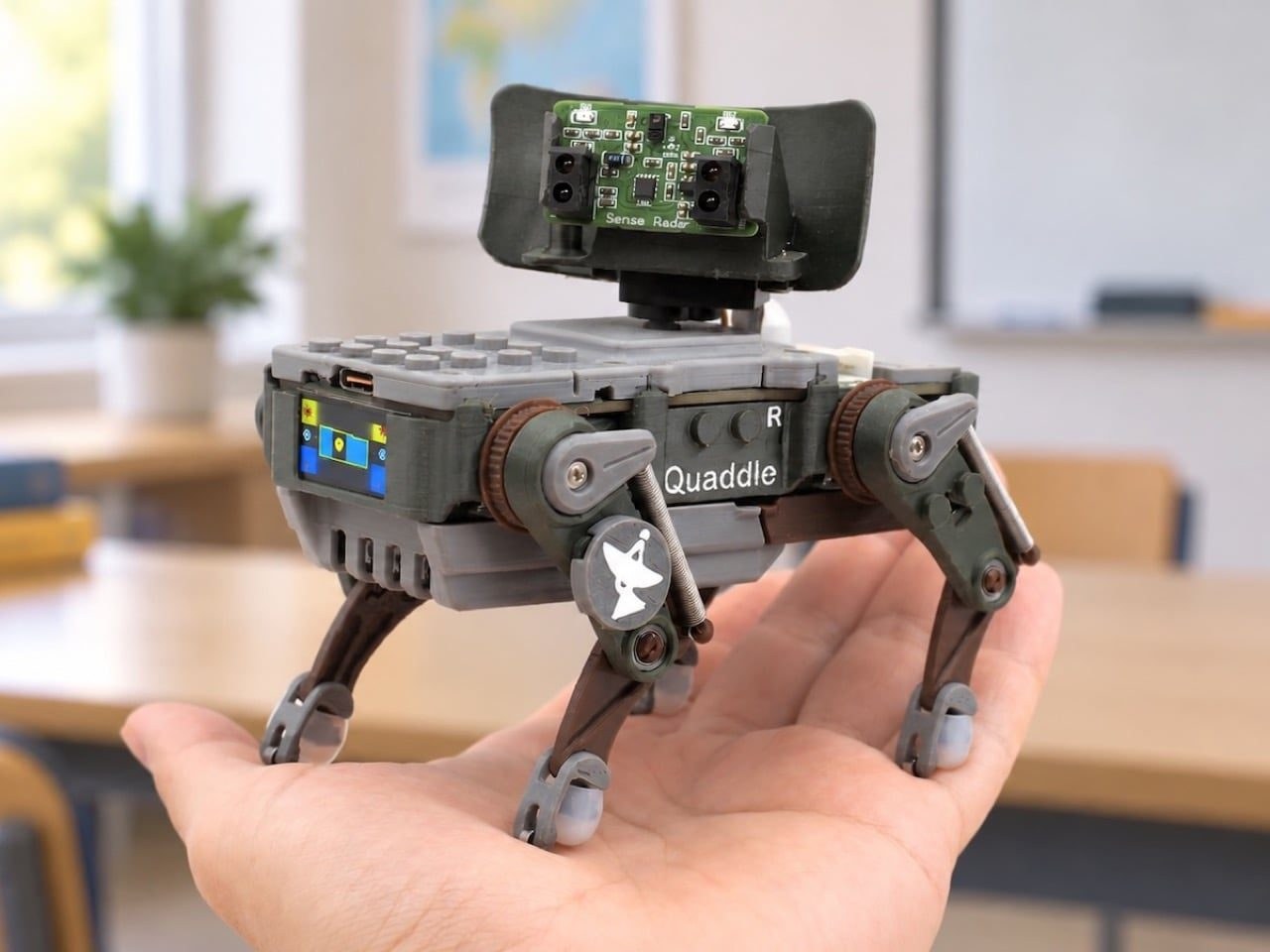
 f you want a mechanical pet that does backflips without costing thousands of dollars, you usually have to settle for something clumsy or dangerous to your furniture. Petoi has spent nearly a decade shrinking Boston Dynamics-style tech down to desk size, shipping more than 30,000 robots to over 60 countries since Dr. Rongzhong Li started the company in his dorm lab in 2016. Now they are trying a radically different mechanical trick to cut the price tag down.
Quaddle is a palm-sized robot dog that weighs about 6 ounces, snaps together without screws, and handles walking, gliding, spinning, and backflips using just four servos. Prices for Quaddle start at $179.
Springs instead of motors
Petoi calls the spring-loaded linkage on Quaddle the MinDoF leg. Instead of wasting weight and battery life on heavy independent motors for every single joint, the design relies on mechanical geometry first developed in the 1870s by Russian mathematician Pafnuty Chebyshev to turn simple rotation into a clean stride. As the servo swings the upper leg, the linkage automatically folds the knee up and straightens it again, turning one rotating shaft into a proper step. Inside, the Buddy and Scout models split their processing across two ESP32-S3 microcontroller chips.
Quaddle uses a swappable Nokia-format phone battery of the BL-5C shape.
Quaddle ships with the bigger 1,800 mAh BL-10C cell, directly solving the eternal problem of cheap hobbyist robotics: proprietary batteries that die forever in three years and cost a fortune to replace.
How much it costs and what is in the box
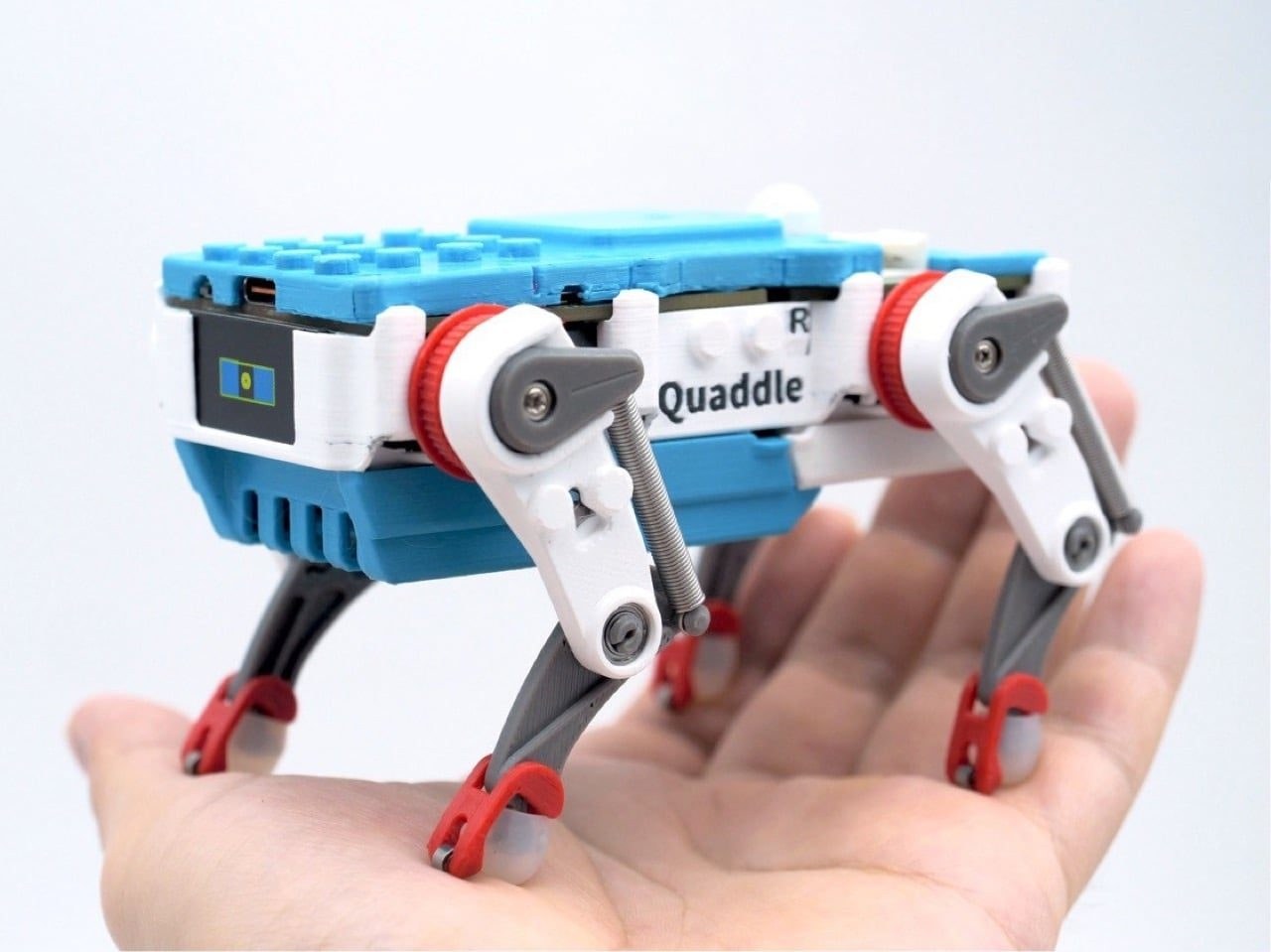
The entry-level Builder PLUS is priced at $179, while the Buddy tier costs $219, and the top-end Scout model reaches $269. Deliveries for Quaddle models start in December.
Is it worth spending $179 on a pocket robot if you have to assemble it and tinker with the code yourself? If you view it as a ready-to-use smart home controller out of the box, you will be deeply frustrated. But if you want an open-source sandbox that runs on cheap, swappable batteries you can find at any kiosk, it lowers the barrier to entry lower than anything else on the market this winter.
Side by side
Four servomotors instead of a dozen complex actuators turn a quadruped robot from a costly research platform into an accessible desktop project. Choosing an easily replaceable BL-10C battery over proprietary power packs prevents the device from becoming e-waste once the original cell degrades. Relying on classic nineteenth-century mechanical geometry kept the starting price down at $179, shifting the burden of motor hardware limitations onto the onboard microcontrollers. Will Petoi keep hobbyists engaged after December deliveries once the novelty of Chebyshev linkages meets the real-world limits of just four servos?