
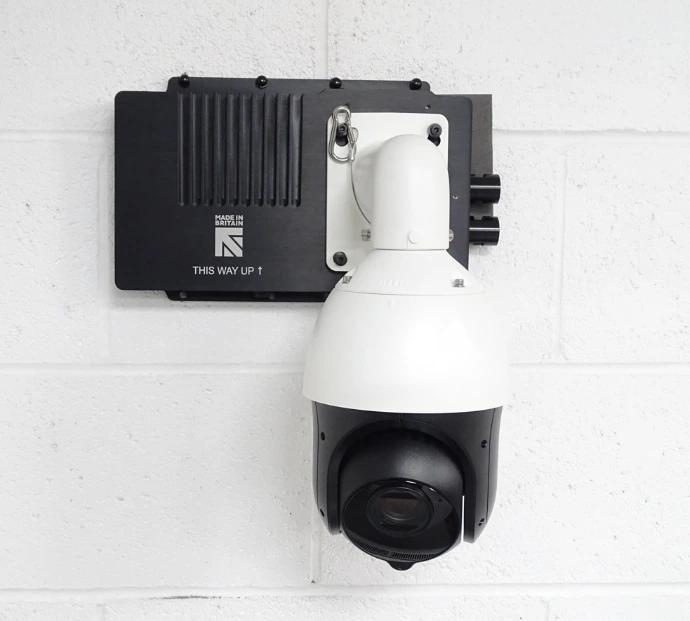
 sually, video surveillance systems are installed just so you can spend hours squinting at dark pixels on a screen, trying to figure out who made off with the garden hose. The latest market novelty tackles this task with a scale that will make any accountant twitch: the manufacturers decided to cram the guts of a full-fledged gaming-capable PC into an outdoor enclosure. The fresh VisionGuard VG-15M6 hardware complex combines a PTZ camera and a computing unit powered by a 14-core Intel Core Ultra 5 225H processor with Intel Arc graphics, as reported by specialists at FanlessTech, with details published by their colleagues at VideoCardz.
Let's translate that into plain English: instead of simply streaming video over wires to a remote server or the cloud, this nearly seven-kilogram beast chews through video feeds right on the wall of your warehouse or workshop. The idea is clear — to rid your infrastructure of monthly cloud subscriptions and communication lag, but you will pay for a desktop processor inside a security housing with very real money, which the manufacturer hasn't even named yet.
Computers in the rain with passive cooling
The mechanics are simple: all the computing power is gathered in a massive aluminum chassis with cooling fins, housing a 14-core Intel Core Ultra 5 225H processor with integrated Intel Arc 130T graphics. The system supports up to 96 gigabytes of DDR5-6400 RAM via two SO-DIMM slots, while two M.2 slots for PCIe 4.0 SSDs handle data storage. Cooling is entirely passive with no fans, so it operates without any mechanical noise.
The main feature of the VisionGuard VG-15M6 is its ability to process video feeds directly on the device, without constantly transmitting data to a remote server.
True, one of the M.2 slots can be used to install an additional Axelerate Matrix M.2 AI accelerator, pushing the stated AI computing performance up to 214 trillion operations per second. This kind of muscle is designed for local video analysis, object recognition, and motion tracking.
Where it plugs in and where the catch is
You can hook up to three cameras to this computing module via PoE interfaces, which supply both data and power over a single cable. Up to 90 watts are allocated to power the cameras, and an Ethernet port with speeds up to 2.5 gigabits per second handles communication with the outside world. The enclosure is built to withstand ambient temperatures up to 70 degrees Celsius, and the computer unit measures 355 by 358 by 214 millimeters with a weight of around 7 kilograms.
The development is primarily targeted at industrial video analytics, security systems, and other scenarios where real-time event recognition is required.
The counterargument here is obvious: if you just want to secure the perimeter of a country house, buying a seven-kilogram aluminum suitcase with desktop hardware is classic overkill. The device targets industrial video analytics, corporate security systems, and other scenarios where every millisecond counts, not the wallet of an everyday buyer who will be more than satisfied with a standard cloud camera.
You should pull your old cloud surveillance contracts and calculate how much server rental actually costs for your current video feeds before you start eyeing industrial local servers housed in ruggedized chassis.