
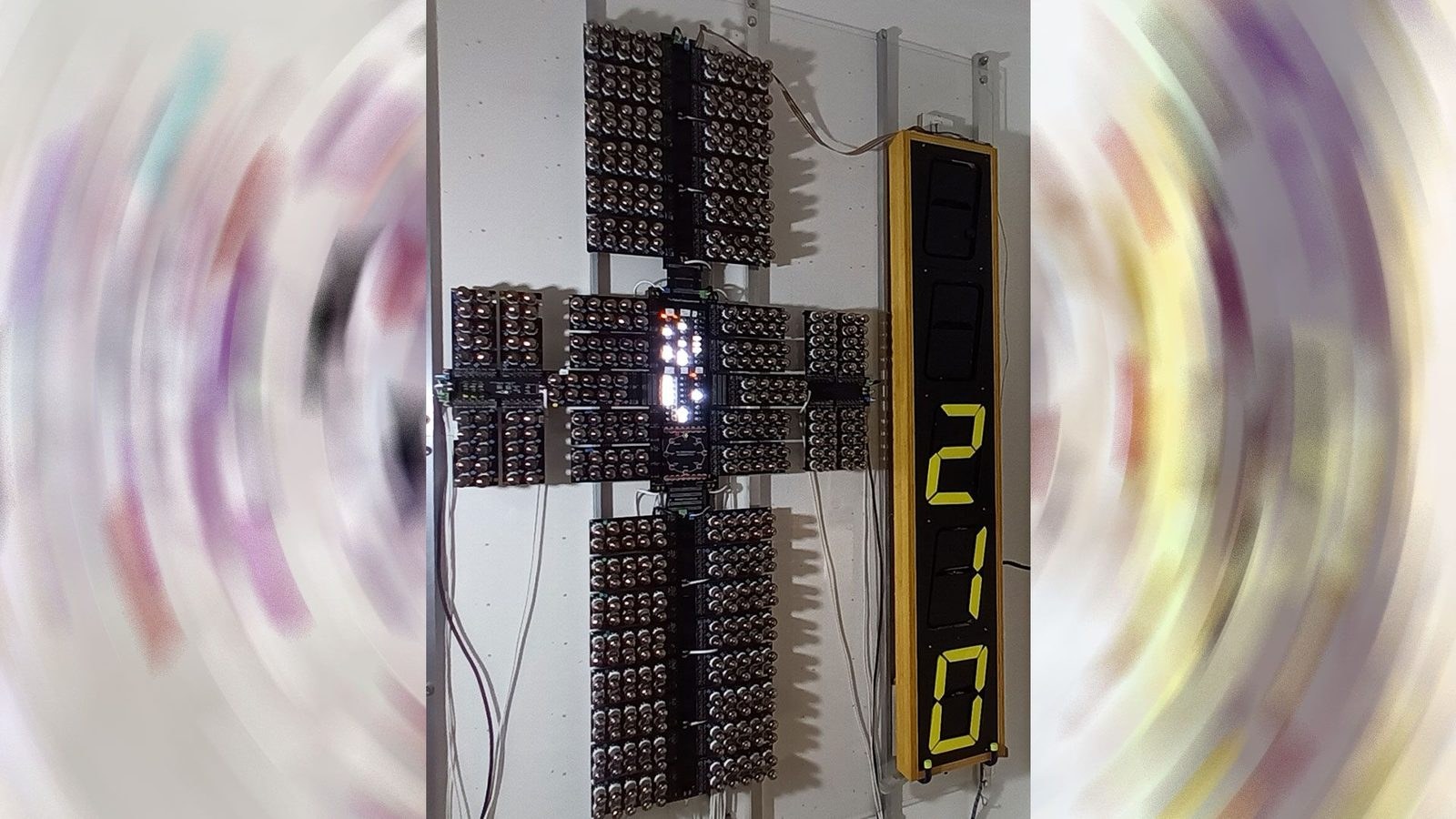
 f you find modern laptops frustrating when they take ten seconds to boot, consider the physical reality of computing before microchips took over. A self-taught hardware hacker named Mike documented his ambitious retro-computing build on Hackaday, showing off a massive, wall-mounted monstrosity that trades modern silicon for glowing glass.
His project, dubbed The Tube Computer (MK3), is a fully operational 8-bit machine built with 460 vintage Soviet-era 6N3P-EV double triode vacuum tubes paired with 1950s-style germanium diodes. Mike engineered the entire setup across three two-meter aluminum rails, five backplane boards, forty-six modular 10-tube PCBs, and a massive 190 cm by 130 cm sheet of acrylic—without using a single modern transistor or integrated circuit.
The Realities of Pre-Silicon Hardware
Living with a vacuum-tube computer feels less like running a PC and more like operating an electric furnace. Booting the MK3 demands a mandatory 15-minute warmup cycle just to bring the glass filaments up to operating temperature, followed by a manual system reset to stabilize the logic.
"these used/old stock 6N3P models only have about a 500-hour operational life"
The hardware radiates intense heat, fills the workspace with the distinct smell of baked dust, and keeps a fire extinguisher permanently stationed nearby. Maintenance is a relentless chore: these old-stock Soviet tubes carry an operational lifespan of roughly 500 hours, which means keeping a box of spares and a stepladder within arm's reach for the inevitable filament burnout.
Running an Airship on Five Basic Operations
Under the glass, the architecture strips processing down to raw logic primitives without modern microcode shortcuts. Mike designed the central arithmetic logic unit around just five basic operations: sum, carry, NOT, increment, and XNOR. The machine decodes instructions through an unpipelined, six-step fetch alongside a single execution cycle.
To prove the hardware works, Mike programmed an interactive Airship Simulator that models navigating a vintage British R80 airship from Brighton to Paris.
Extreme DIY projects like this illustrate the sheer physical bulk, energy cost, and maintenance overhead required to execute elementary software before microelectronics existed. Silicon chips turned room-scale mainframes into pocket-sized silicon decades ago, but watching hundreds of Soviet vacuum tubes slowly calculate a flight path puts the hidden luxury of modern hardware into sharp perspective.