
 idden spy cameras keep surfacing in power bricks, smoke alarms, clocks, and picture frames across hotel rooms and rental properties. Yet almost every consumer detector sold to anxious travelers fails at its basic job. Handheld flashers and red-lens optical filters ask you to squint into the dark, looking for a telltale optical glint—except polished plastic, mirror frames, and brass screws reflect light the exact same way. You end up interrogating light switches and wall outlets with zero certainty.
The Flaw in Current Scanners
A study from University College London demonstrated the futility of current gear: travelers using popular commercial detectors still missed 59% of hidden lenses during live trials. Traditional gadgets require you to coordinate your light source, phone camera, and viewing angle manually, introducing massive human error.
"Most handheld detectors rely on a pretty basic trick, shine light at something and look for a bright reflection bouncing back."
Because everyday reflective surfaces create constant false positives, standard inspection tools offer little more than security theater. Spending $50 to $200 on standalone radio frequency scanners or red optical peek-holes mostly buys peace of mind based on pure guesswork.
Light Sweeping Without the Guesswork
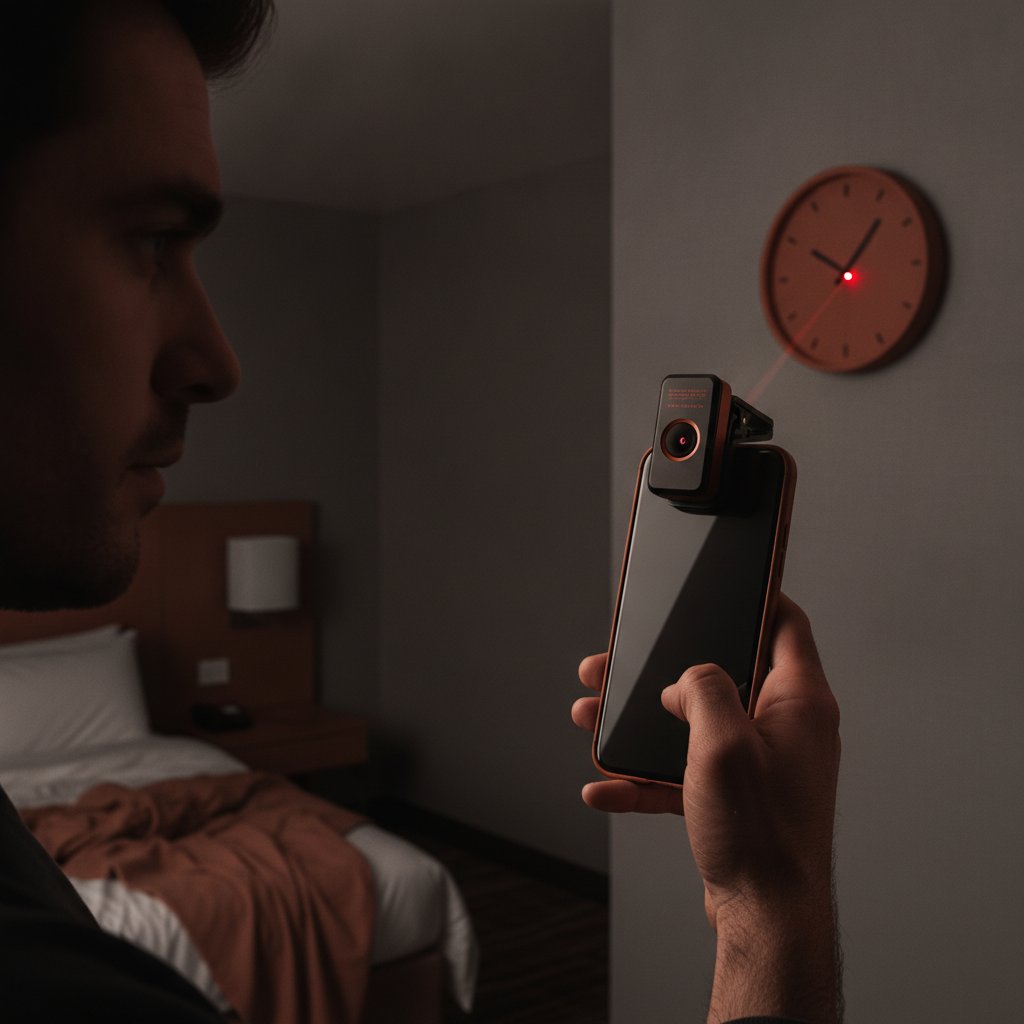
To end that guesswork, researchers from the Korea Advanced Institute of Science and Technology (KAIST) built SweepLED, an add-on case that turns an ordinary smartphone into an automated inspection rig for roughly $7 in off-the-shelf parts. Led by Professor Jun Han at KAIST’s School of Computing alongside researchers from the National University of Singapore and Singapore Management University, the team showcased the system at ACM MobiSys 2026. Instead of forcing you to orbit around an object, the attachment holds the smartphone steady and sweeps a sequence of multi-angle LED lights across the target.
A real camera lens consists of layered glass, an aperture, and an image sensor. That complex optical stack deforms reflected light in unique geometric patterns as the angle of illumination shifts. SweepLED captures a short video of this sweep, feeding the optical data into a lightweight on-device model trained to distinguish lens reflections from flat reflective plastic. In lab benchmarks across 30 common household items, the prototype detected hidden lenses with 94% accuracy in under five seconds per scan.
Buying dedicated inspection gadgets that fail six times out of ten is indefensible when a $7 lighting module and smart optical analysis yield a 94% hit rate. SweepLED remains a research prototype for now, but because it relies on dirt-cheap LEDs and basic microcontrollers, the barrier to commercialization is practically nonexistent. Once third-party accessory makers pick up the open design, travelers will finally get reliable privacy verification right inside their phone case without paying an extortionate markup.