
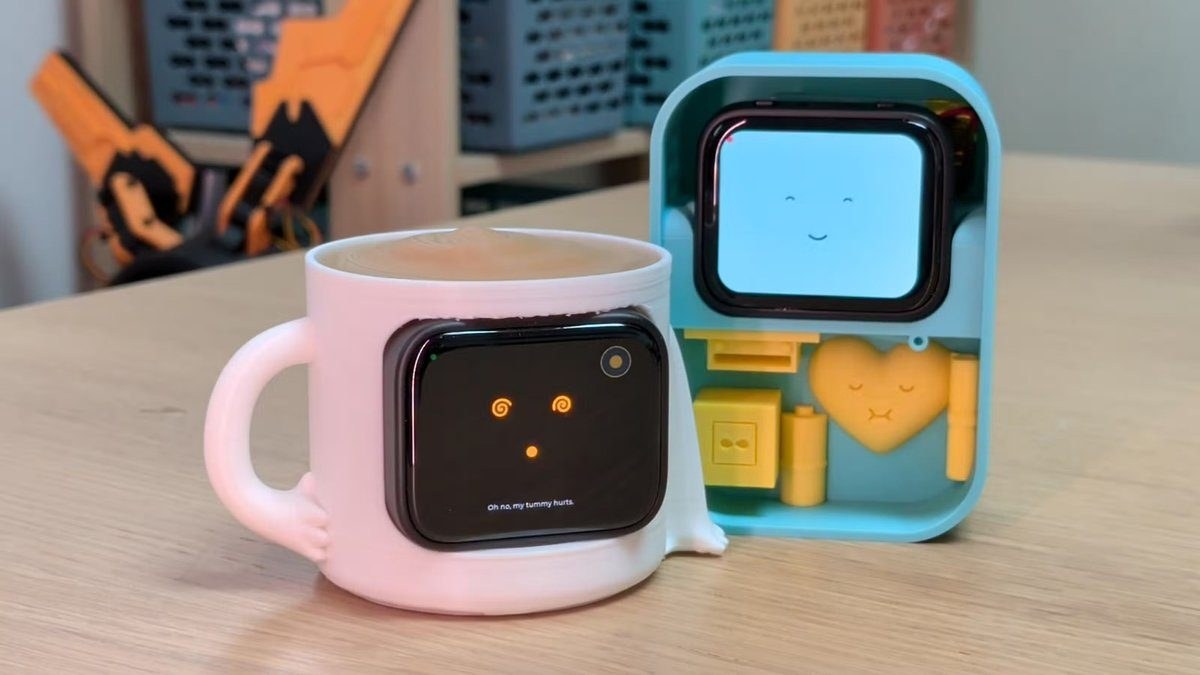
 ive minutes down an endless short-video rabbit hole, and your pocket pet is already slowly dying. Standard screen-time limiters on iOS and Android have long proven entirely useless: nearly everyone swipes away that bland grey system prompt in half a second on pure muscle memory. To drag users out of the infinite scroll, developer brenpoly decided to resurrect the time-tested emotional blackmail mechanics of the nineties, publishing the open-source detox gadget Polymo on GitHub.
Blackmail over software blockers
Software restrictions fail for a simple reason: they are far too easy to bypass with a single tap of "Ignore Limit." Polymo offloads this task to a dedicated physical keychain that literally gets sick and wastes away on your desk while you mindlessly burn hours on social media.
"Health only recovers after the problem app is closed"
How it works is straightforward. An Android companion app lets you set up blacklists and time limits. By default, the author configured the trigger to just five minutes of scrolling. Exceed that threshold, and the phone sends a Bluetooth Low Energy signal to the keychain. The creature on screen instantly gets depressed, loses health, and cries for attention. You can save it with exactly one action: lock your screen or close the app.
Hardware specs and DIY cost
The build is based on an affordable Waveshare ESP32-S3 board with a crisp 1.8-inch AMOLED display, making the pet's distress clearly visible even in bright sunlight. Beyond suffering for your screen addiction, the gadget features built-in speech synthesis to read incoming notifications aloud and voice-respond to simple prompts.
From a privacy standpoint, the implementation is remarkably clean: the device runs completely offline, transmits no telemetry to third-party servers, and delegates compute-heavy response generation to your smartphone. The maker released all schematics and code for free. By comparison, commercial blockers like ScreenZen's Halo cost around $49 while merely cutting off local signals without any emotional hook.
The DIY Polymo proves that an inexpensive physical object can curb digital addiction far better than built-in corporate software tools. Instead of annoying system banners, it relies on basic human empathy for a tiny pixelated creature. For anyone looking to cut down on mindless phone use, building this pocket warden offers a genuinely effective approach to digital hygiene without recurring subscription fees.