
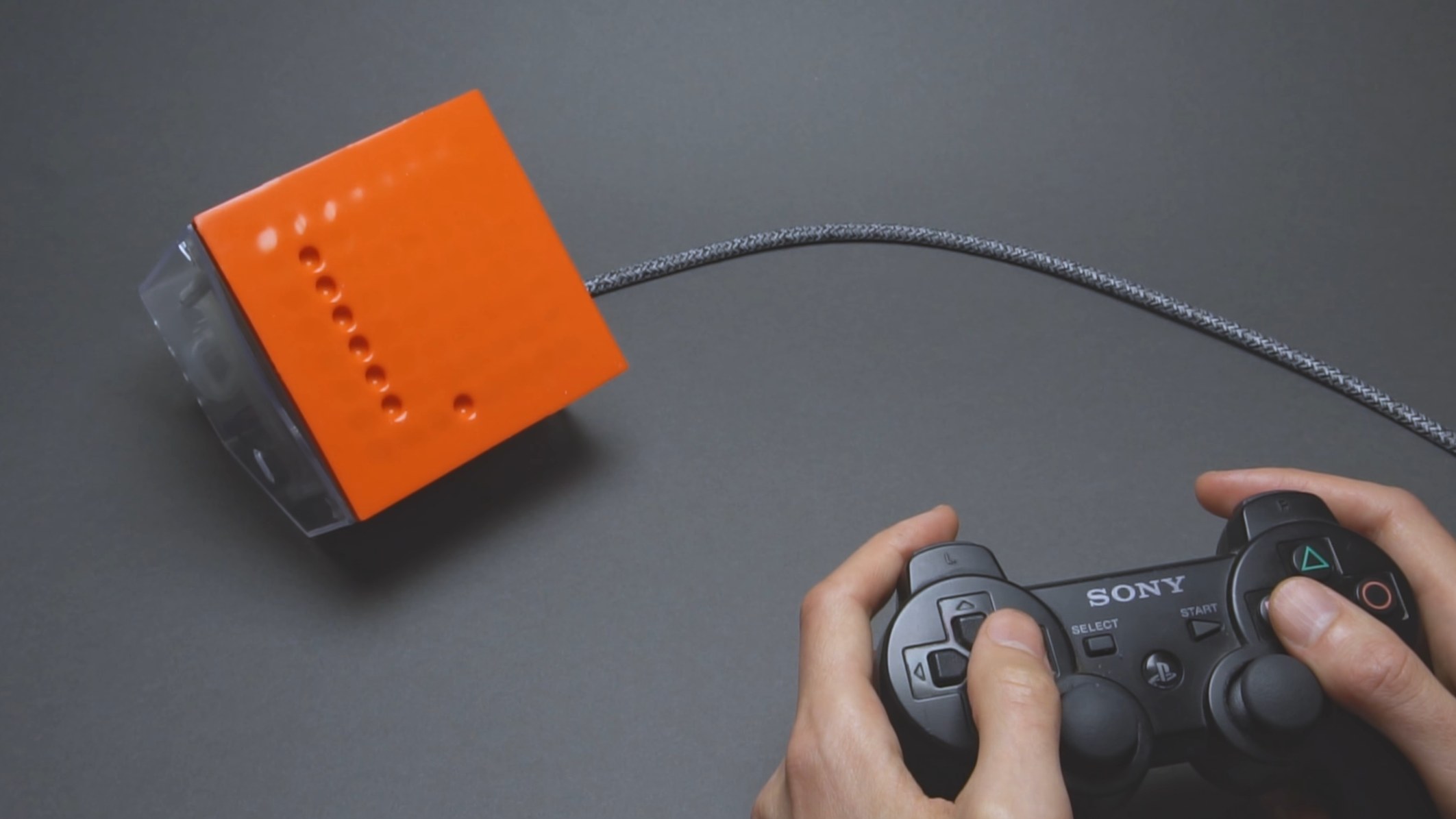
 ou do not need millions of glowing LEDs or microscopic silicon transistors to run a game of Snake. An engineer known as [soiboi soft] has built a functional dot-matrix screen made entirely of flexible silicone, microfluidic channels, and vacuum air pressure. Instead of emitting light like standard OLED or LCD panels, each pixel is a sealed physical cavity behind a flexible silicone membrane. When pneumatic circuits pull air out of a specific chamber, the silicone dimples inward, creating a distinct shadow that forms the visual image.
The logic driving this rubber surface relies on air pressure rather than conventional microchips. The architecture uses pneumatic "transistors"—miniature channels that open or close airflow depending on vacuum levels. In the initial 4x4, 16-pixel prototype, eight control channels routed vacuum across four rows and four columns to manipulate individual points without requiring complex electronic controllers.
The transistors act like one-way valves, so the pixels hold their state, even when pressed in by hand.
Because of that mechanical latching behavior, poking the display does not wipe the image. By pairing the silicone surface with basic contact sensors, the pneumatic matrix doubles as a tactile touchscreen that physically responds to human touch. Beyond novelty gaming, this opens up practical applications for soft robotics, adaptive tactile interfaces, and refreshable physical control surfaces for visually impaired users.
The Scaling Bottleneck
Moving beyond a rudimentary 16-pixel grid quickly exposed the brutal physics of DIY pneumatic fabrication. When scaling up to a 64-pixel display, 3D-printed molds began warping under tension, ruining the airtight seals required to keep individual pixels collapsed. To salvage the hardware, [soiboi soft] had to anneal the warped plastic against a flat glass build plate inside a vacuum bag at 60 degrees Celsius for several hours, reinforcing the perimeter with raised sealing rings. The setup ultimately requires rear-mounted solenoid valves, bulky pneumatic plumbing, and an external vacuum pump tethered via Luer lock adapters.
While [soiboi soft] successfully ran digits, basic animations, and playable builds of Pong and Snake, this will not challenge consumer mobile screens. Sluggish air displacement limits refresh rates, the pumps generate audible mechanical noise, and scaling microfluidic channels beyond low-resolution grids remains a manufacturing nightmare. It remains an ingenious demonstration of soft microfluidics—valuable for niche tactile feedback and deformable robotics, but hopelessly impractical for everyday consumer gadgets.