

 hy would anyone hide a wireless microchip inside a plain plastic toothbrush head right beneath an inconspicuous brown dot at the base? You expect toothbrush bristles to simply clean your teeth, but Philips has spent years embedding miniature near-field communication tags (NFC — a wireless data transfer technology working over a distance of a couple of centimeters) into its Sonicare attachments.
«A toothbrush feels like the absolute last household item that needs a microchip.»
Short answer: total control over consumption and protection of proprietary consumables against cheap knockoffs. YouTuber Circuit Helper hacked an NFC chip from a Philips Sonicare brush head, figured out how the system tracks wear down to the second, and ended up turning the extracted component into a physical key for unlocking a computer. A million-dollar question: how much working electronics do we throw in the trash every single time the bristles fray?
Reading the brush head like an open book
The hidden module sits under a tiny dot at the bottom of the attachment and communicates with the toothbrush handle via radio waves. There is no built-in battery: the chip is passive and gets its power out of thin air directly from the electromagnetic field generated by the handle.
To intercept the transmitted data, the enthusiast built a reader using an ESP32-S3 microcontroller board and a PN532 NFC module. The modules talk via a standard I2C bus (a simple wired protocol for connecting microchips), and the microcontroller connects via a regular USB cable to a computer running custom software. Bring the brush head close to the antenna, and the 13.56 MHz field powers up the passive chip and dumps its entire memory contents straight onto the screen.
What this chip is actually writing
By comparing memory dumps of a brand new and a heavily worn brush head, Circuit Helper discovered that the chip stores more than just a factory serial number. The hardware logs total brushing time down to the second, records power modes, and calculates wear. In one of the tests, an old attachment logged over five hours of cumulative operation.
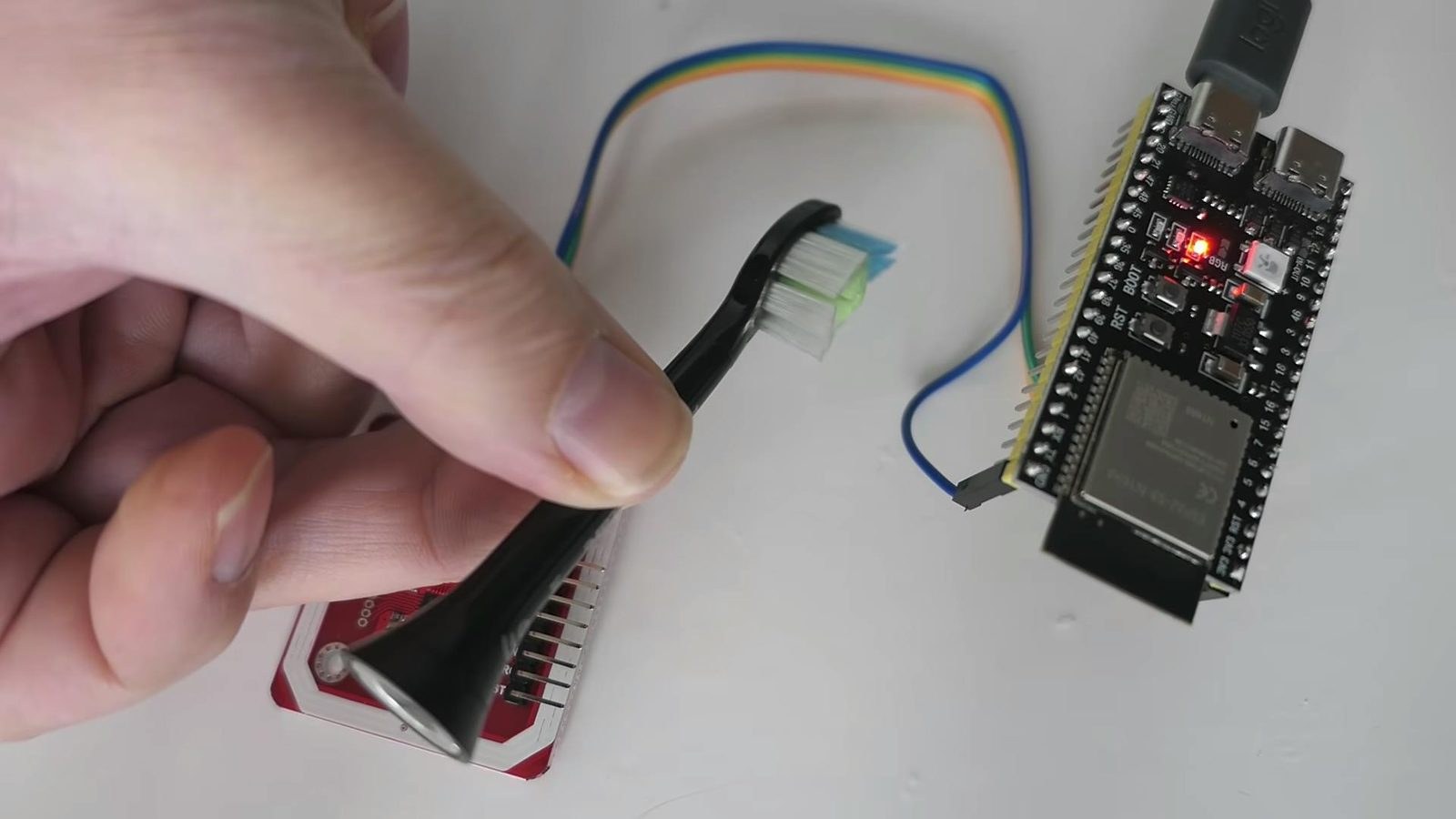
«Circuit Helper discovered that if you press too hard on your teeth, the wear counter spins faster.»
The pressure sensor in the handle directly interferes with the wear math. If you push on the brush with excessive force, the system artificially multiplies the accumulated time, making the counter reach the "time to buy a new one" mark much faster. The chip's memory is password-protected, but thanks to open-source reverse engineering tools, it was rewritten. Circuit Helper cracked the wear register of an expired brush head and, with a flick of the wrist, restored 50% of its lifespan.
Second life for silicon
If you saw through the old plastic casing, you are left with a tiny silicon chip die and a copper coil antenna inside. Circuit Helper extracted this module and reconfigured it as a contactless token for unlocking a PC. Instead of bowing to greedy manufacturers who artificially block the lifespan of consumables, the author proved: we throw away fully functioning authorization tags that belong in DIY projects.
What it means
Why put a fully programmable microchip with its own memory into a regular plastic brush head? The password-protected Sonicare component exists to tightly monitor replacement cycles and block third-party supplies. The hidden module tracks power modes and artificially speeds up the wear counter whenever the pressure sensor in the handle is triggered. Rewriting the wear register restored 50% of the used brush head's resource.