
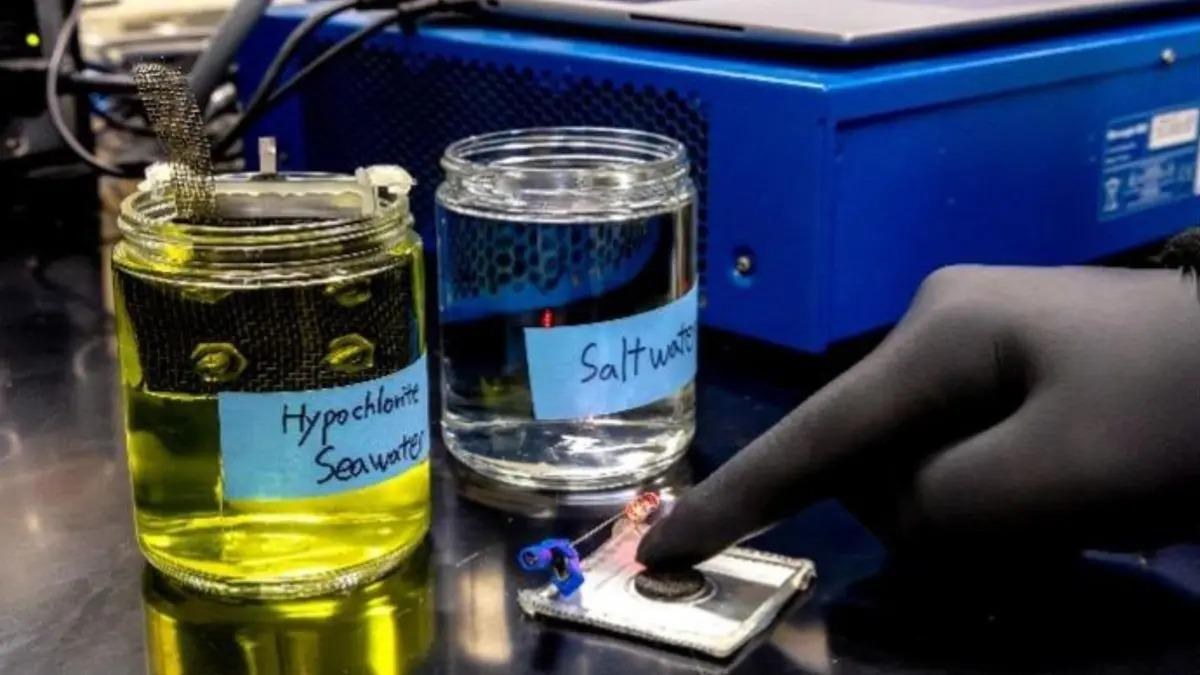
 dding just 5% common household bleach to a battery's electrolyte has unexpectedly doubled its peak power output. Researchers at the U.S. Department of Energy's Oak Ridge National Laboratory (ORNL) flipped conventional saltwater battery chemistry on its head, turning a pesky side reaction into the primary mechanism. Postdoctoral researcher Wooseok Go noticed that before the sluggish oxygen reaction occurs, sodium hypochlorite forms inside the cell, generating higher voltage. By spiking the electrolyte with 5% of this chemical, the team shifted the entire system to a hypochlorite/chloride liquid-phase redox couple. This move eliminated finicky liquid-to-gas phase transitions, ditching expensive catalysts, lowering internal resistance, and more than doubling peak power density to rival lithium-ion benchmarks.
Do not expect to carry this chemistry in your pocket anytime soon, however. Saltwater batteries remain far heavier and bulkier than lithium-ion cells, ruling them out for slim smartphone chassis or lightweight electric cars. Yet their aqueous electrolyte provides built-in cooling and completely eliminates thermal runaway risks. Startup Coulomb Technology has already licensed the breakthrough, targeting commercial deployments for data center backup power, grid storage hubs, and heavy cargo ships.
This technology offers a safe, fireproof alternative for stationary energy storage where weight is not an issue. While personal electronics will keep running on lithium, the heavy grid infrastructure powering them is poised to become vastly more reliable.