
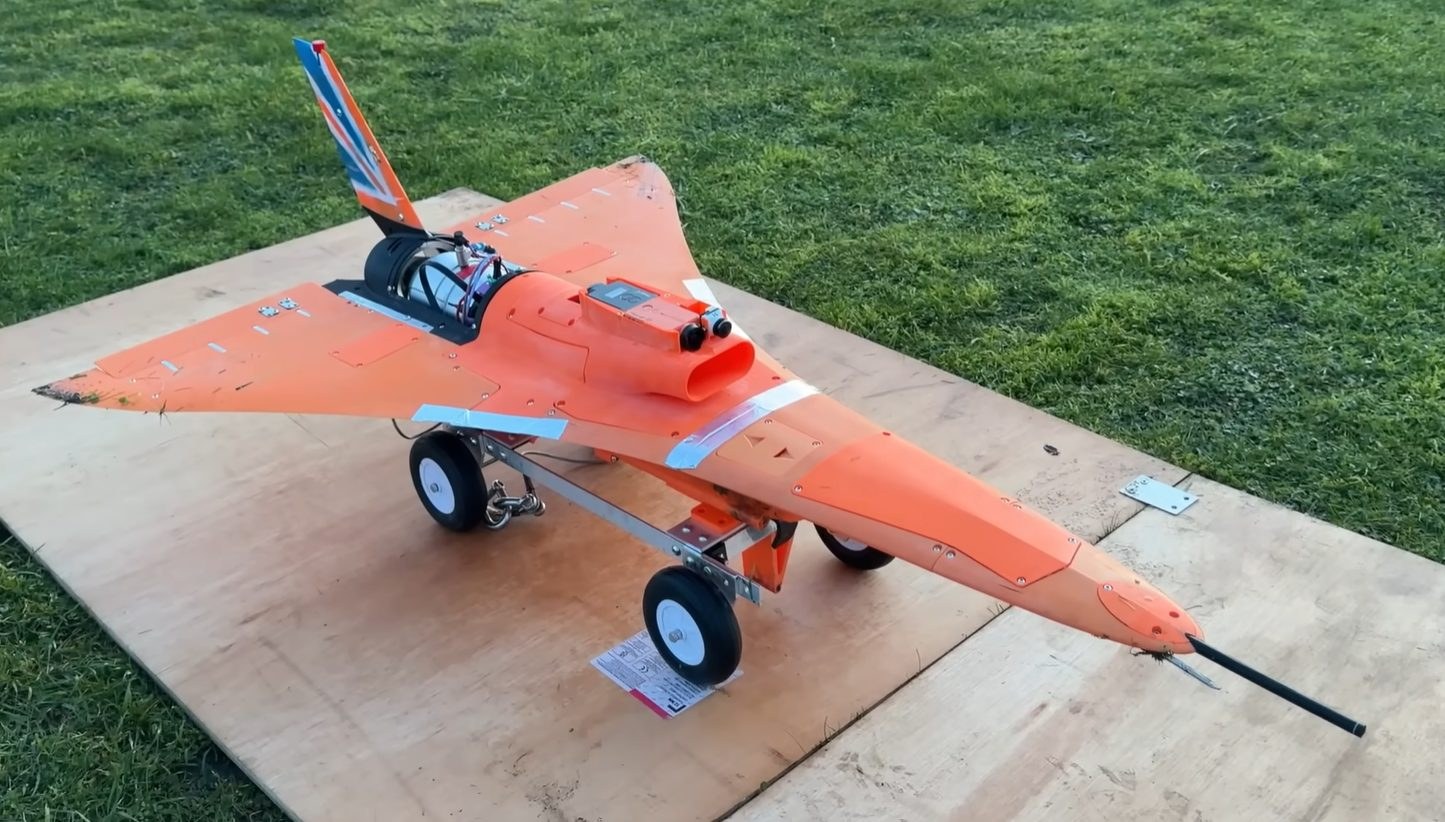
 team of university graduates aims to prove that everyday desktop plastic can handle high aerodynamic loads in high-speed flight. Their creation, the Kingchaser, is a 20 lb (9 kg) remote-controlled aircraft built to push toward Mach 0.8, as the Tom's Hardware report details. This project fundamentally shifts the economics of high-speed model aviation by swapping out exotic, high-dollar materials for standard desktop printing filaments.
The Kingchaser, a 3D-printed jet-powered remote-controlled aircraft made out of PETG, PPS-CF, carbon-fiber rods, and aluminum, aims to take the world speed record.
The Mach Initiative aims to break the current Guinness World Record held for nine years by German pilot Neils Herbrich. To get there, the engineers had to scale up and redesign their concepts iteratively. The team started with their first miniature prototype, the Kinglet, printed from PETG, PET-CF, and some PLA, using an electric ducted fan as a safe and low-cost way to test modular sections without risking a turbine.
Engineering for the Jet Age
Building a model that can survive extreme speeds requires rethinking structural integrity entirely. Once the Kinglet reached stable performance, the team moved on to the Kingfisher, measuring just under a meter and propelled by a Jetcat P60—a miniature jet turbine engine capable of 63 N · m of thrust that hits a top speed of 205 mph (330 km/h). The team of graduates from the University of Bath has posted their maiden flight of the Kingfisher to YouTube. While that engine was purely a milestone to achieve flight with a turbine, their ambitions quickly grew.
The engineers initially intended the Kingfisher MK2 to house a 150Nm jet engine to break the record by attempting to hit 614 mph (988 km/h). They ultimately decided to build a completely new aircraft that was 20% larger, christened the Kingchaser. The 20 lb (9 kg) Kingchaser still relies mostly on PETG for its external construction, but for the engine housing, the team switched from annealed PET-CF to PPS-CF because annealing the larger housing caused severe warping from uneven heating. They also armored the plastic frame using a carbon-fiber skin, aluminum, steel, titanium exhaust sheets, and aluminum tape to shield the print from the extreme thermal output of the turbine.
Avionics and the Road Ahead
The 20 lb (9 kg) Kingchaser still uses mostly PETG for its external construction.
Controlling a printed airframe at high speeds demands serious mechanical and electronic support. The aircraft relies on high-torque servos on the elevons to overcome crushing aerodynamic pressure. For navigation and data collection, the Kingchaser features an avionics system managed by a dedicated team member. There is currently no official announcement of when the record attempt will take place, but builders and enthusiasts can follow the logs on YouTube as the team prepares to challenge a nine-year-old world record using affordable materials and garage engineering.
Hobbyist aerospace is no longer gated by expensive custom molds and proprietary alloys. When a group of university graduates can print a near-supersonic jet airframe on standard desktop equipment, the barrier to entry for extreme speed projects drops through the floor.