
 very drone pilot knows the feeling: you head out to shoot winter mountains, and the battery percentage drops right before your eyes. Freezing temperatures and gusty winds force standard quadcopters to drain their entire charge in minutes just fighting to hover in place. Landing on a slope is rarely an option either—rubber landing pads slip on inclines as gentle as 9 degrees. On a sheer icy surface, physics works entirely against you: the steeper the angle, the less gravitational force holds the drone down.
Retractable claws replace endless hovering
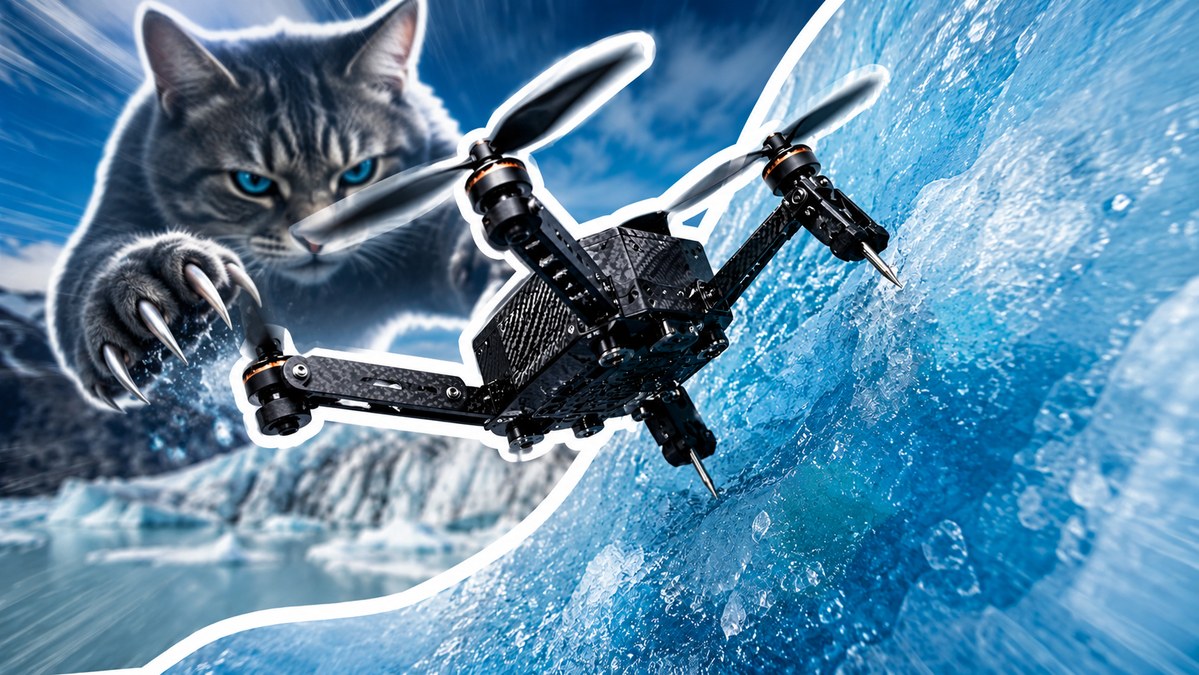
Engineers at the University of Sherbrooke in Quebec have devised a clever workaround: the Ice Dart drone, capable of perching on icy inclines up to 58 degrees. Published in IEEE Transactions on Field Robotics, the design takes inspiration from feline predators. Each of the drone's four carbon-fiber landing legs houses retractable spikes. Kept tucked away mid-flight, they deploy instantly upon impact, locking firmly into ice regardless of the approach angle.
The landing dynamics are finely tuned. Weighing 2.65 kg, the device handles touchdown speeds up to 3 m/s. To prevent the drone from bouncing off hard surfaces, the landing gear integrates 38 friction discs that absorb mechanical energy. Simultaneously, the motors deliver a quick burst of reverse thrust at the moment of impact, driving the spikes into the ice wall to compensate for the lack of gravity.
Tested on Icelandic glaciers
The team validated the prototype on Iceland's Fjallsjökull glacier. Operating in temperatures between 0°C and 10°C with wind gusts exceeding 30 km/h, researchers logged 24 landings on slopes up to 58 degrees—all executed successfully.
As Professor Alexis Lussier Desbiens explained, the primary benefit of this biomimetic approach is power efficiency.
"Once landed, the drone's power consumption drops drastically compared to hovering in the air."
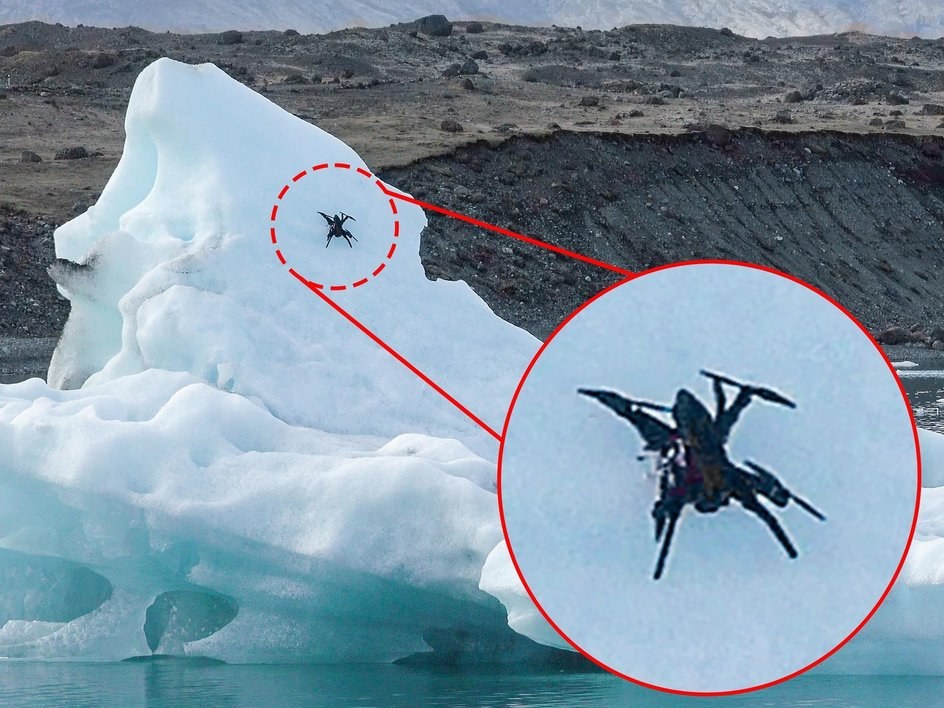
Instead of burning juice to stay aloft against high winds, the drone perches on an icy cliff face and operates for hours as a stationary observation post.
Commercial availability is still a ways off, as the Iceland trials relied on manual piloting. Developing fully autonomous perching algorithms remains the next hurdle. Once this bio-inspired mechanism reaches consumer and search-and-rescue drones, high-altitude winter flights will become far less risky and significantly more efficient.
Key takeaways
- Engineers designed the Ice Dart drone with feline-inspired retractable claws to land on icy slopes up to 58 degrees.
- A combination of 38 energy-absorbing friction discs and reverse thrust locks the 2.65 kg craft securely to sheer ice walls.
- Perching slashes power draw compared to hovering in high winds, turning the drone into a long-lasting stationary monitoring post.