
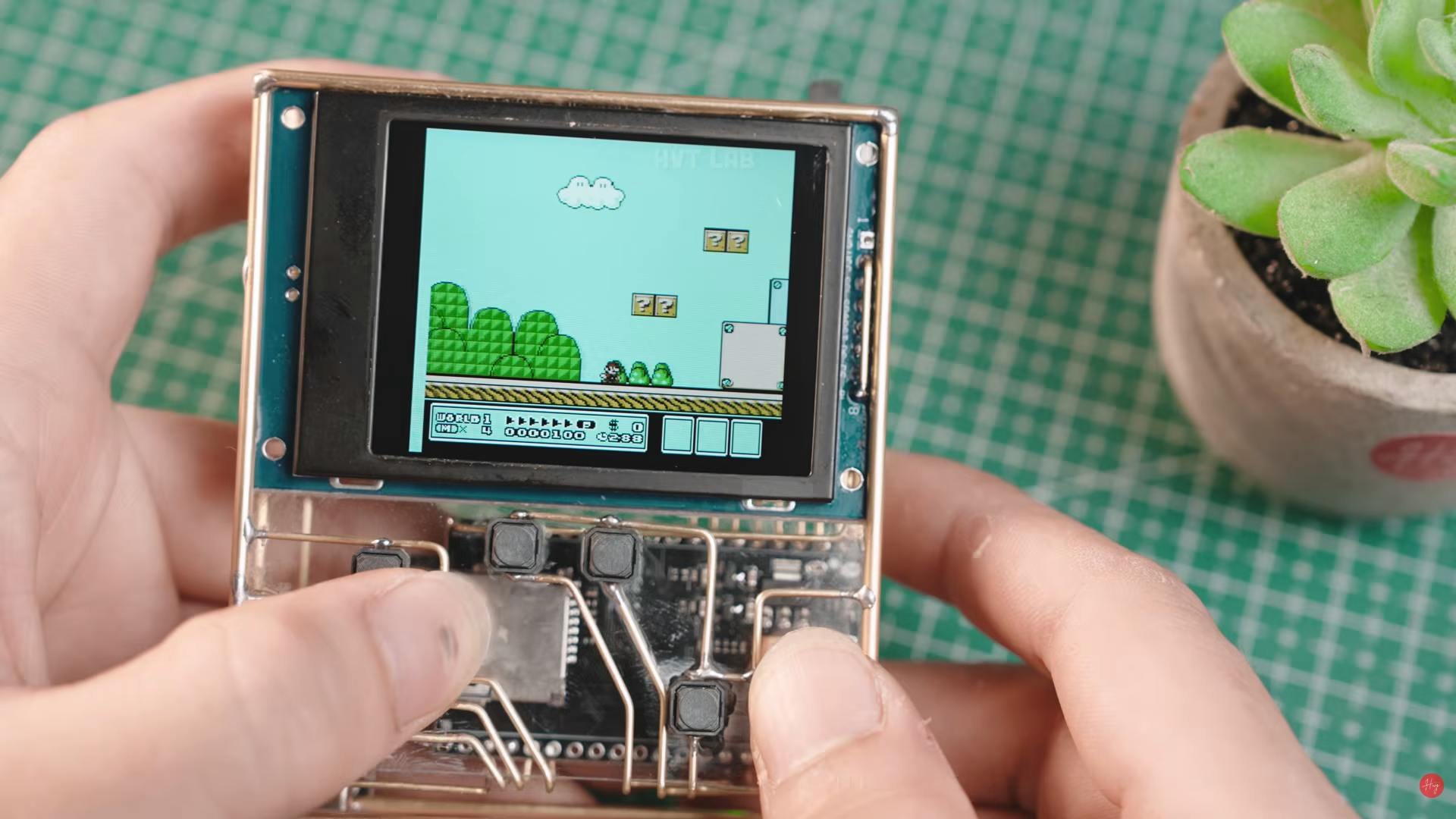
 f you have shopped for a budget retro gaming handheld lately, you know the fatigue: cheap, creaky plastic shells or rough 3D-printed boxes that all blur together. Vietnamese maker Huy Vector went in the exact opposite direction, ditching printed resin and custom printed circuit boards entirely. Instead, he built a retro handheld around a rigid skeleton crafted from 2 mm hollow brass tubing, leaving the raw electronics completely exposed to the open air.
After tracing a 2.4-inch IPS display on paper, Vector bent the metal tubing into rectangular front and back frames, joining them with four 8 cm brass corner pieces.
"The brass isn't just there to hold everything together. It also becomes part of the electrical system, providing a convenient common ground."
By turning the chassis into a functional common ground, the build cuts wiring clutter down to the bone while making the metal frame both a structural spine and an active electrical bus.
Anatomy of a Brass Build
Vector anchored the system around an ESP32-S3 microcontroller board. While its built-in camera sits idle, the integrated microSD card slot handles game ROM storage. He mounted the board directly inside the brass skeleton, routing connections to other hardware modules using stiff 1 mm brass wire rather than flimsy flexible cables.
Because off-the-shelf gamepad boards would ruin the open geometry, Vector cut a 2 mm acrylic faceplate and mounted eight 4 mm tactile switches for the directional pad, action buttons, Start, and Select. Power comes from three rechargeable 3.7 V AAA-sized cells placed right inside the open frame alongside a USB-C charging module, a slide power switch, and a small amplifier driving the built-in speaker.
What It Delivers in Your Hands
Flashed with custom firmware, the system handles NES, Game Boy, Game Boy Color, Sega Master System, and Game Gear emulation without breaking a sweat. Thanks to the ESP32-S3's Wi-Fi radio, you can even drop ROMs onto the storage card wirelessly without fiddling with card readers.
The firmware menu—summoned by hitting Start and Select simultaneously—lets you adjust volume, apply CRT-style visual filters, manage save states, and overclock the ESP32 chip. What you get in your hands is a dense, unapologetically tactile, and genuinely repairable handheld—an artisan counterweight to mass-market disposable plastic toys that head straight to landfills the moment a glued-in battery puffs up.