
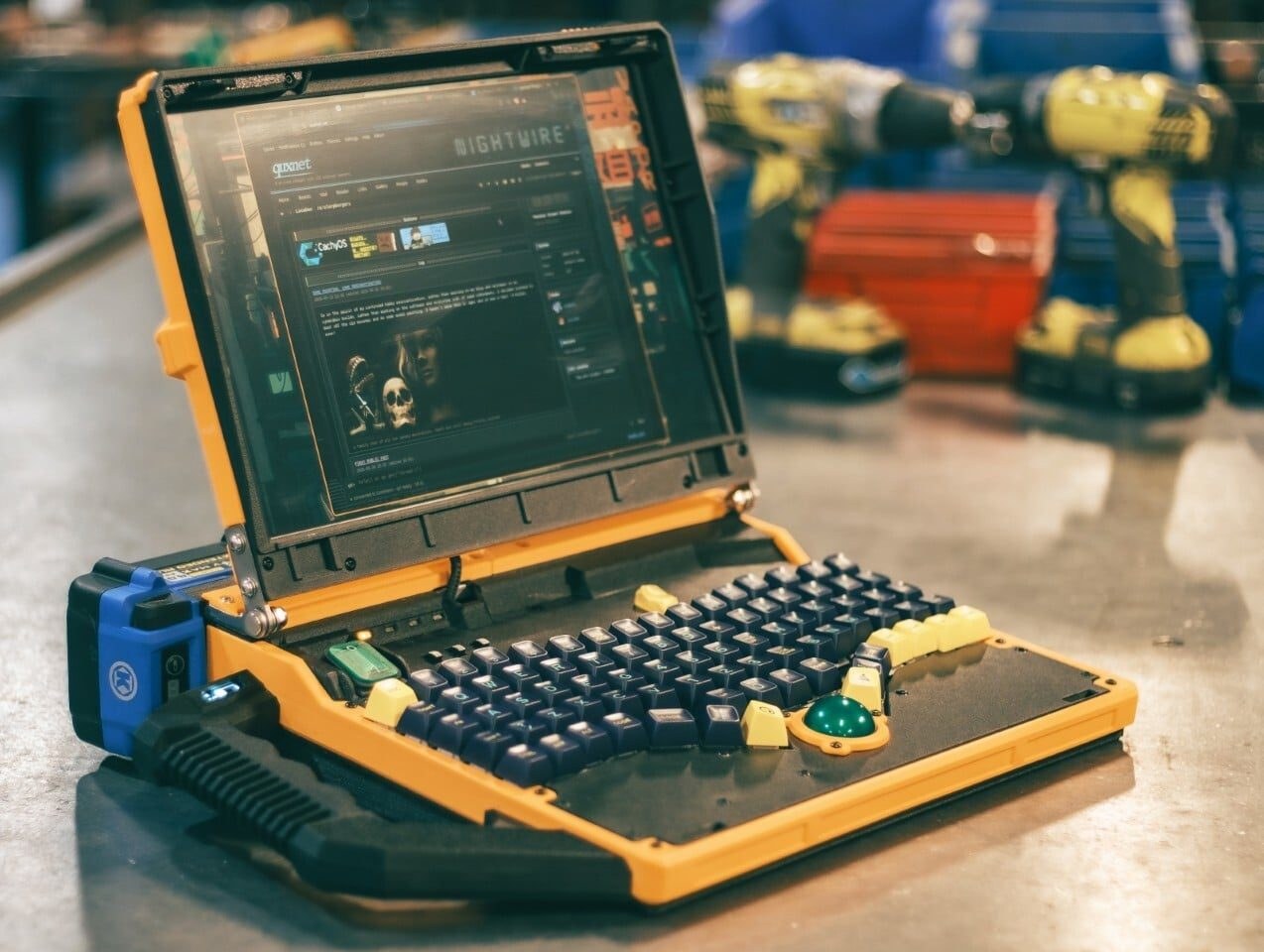
 hen your standard laptop battery dies at the worst possible moment and buying a replacement costs half the price of the entire computer, the idea of borrowing power from a heavy construction tool looks suspiciously attractive. Designer Slurpburgers has built a device called Slurptop out of spare parts, combining mini-PC components, a mechanical keyboard, and a cordless drill battery into a single unconventional chassis.
A short answer for those looking for practicality: this is an impressive piece of garage craftsmanship built as a personal project, not a mass-market product for retail stores. You won't find this in a shopping mall, and using it day-to-day requires truly angelic patience.
What this garage monster is made of
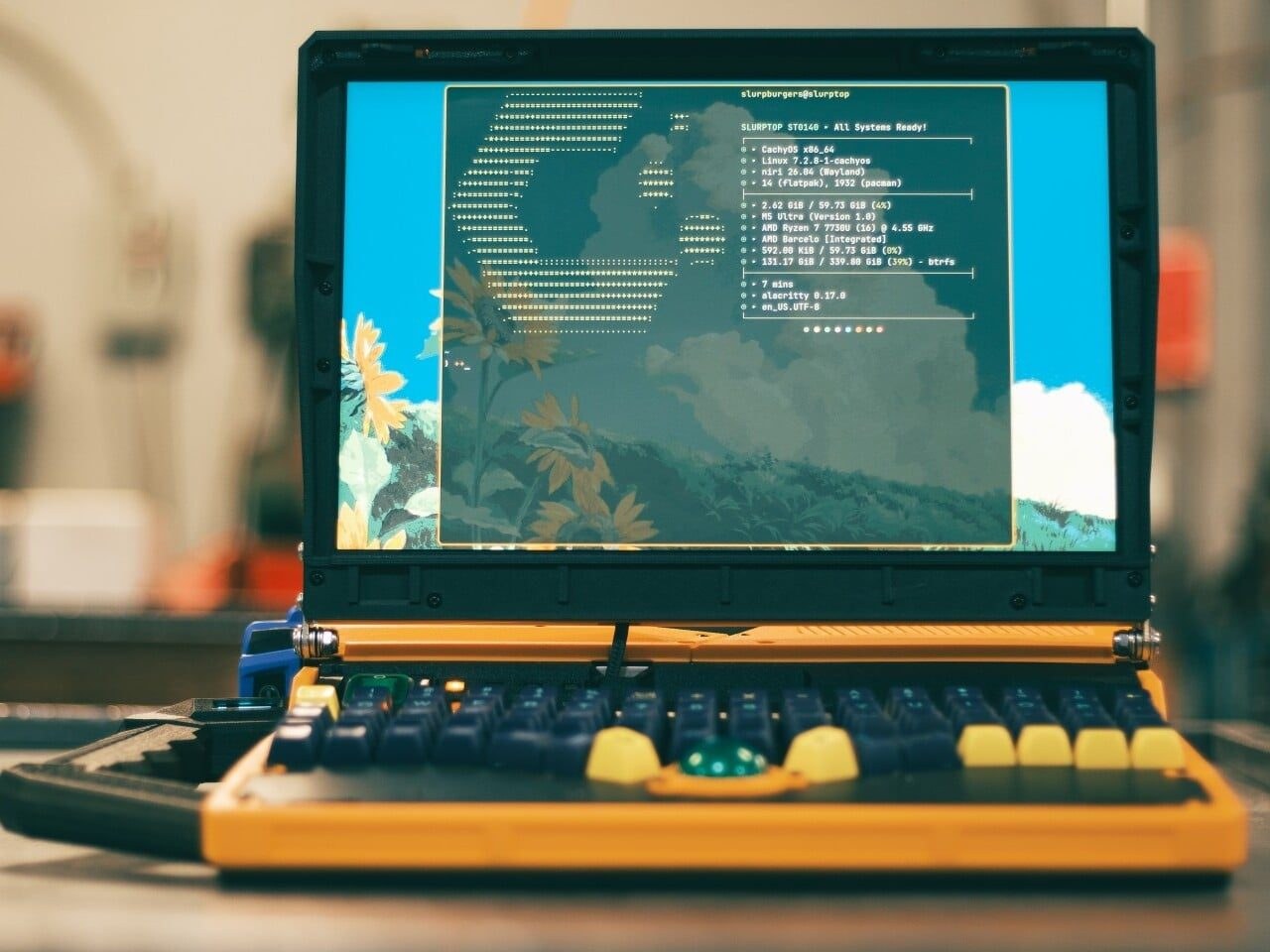
The operating system here is CachyOS, a Linux distribution that keeps a familiar desktop environment wrapped inside this aggressive exterior.
"This DIY cyberdeck packs mini-PC hardware into a massive yellow-and-black clamshell case with a built-in carrying handle and mechanical keys."
The chassis is 3D-printed in contrasting colors: the yellow parts use fiberglass-infused plastic, while the black elements are made from carbon fiber (a strong and lightweight material). An aluminum bracket holds the entire assembly together, reinforcing the hinge area alongside the main mounting bolts. The keyboard features 82 mechanical keys arranged in separate angular blocks instead of familiar straight rows. Next to it sits a green trackball (a ball for controlling the cursor with your finger), mounted on three ceramic bearings and powered by a standard gaming mouse sensor. Behind the screen is mounted an XP-Pen graphic tablet, adding pen-drawing capabilities without sacrificing the keyboard and trackball.
Power straight from the tool case
The most curious part of this build is the power source, borrowed straight from the hardware store.
However, this is where the catch lies for anyone looking for actual utility. The device doesn't know how to charge its own battery from a regular wall outlet, meaning you have to physically pull the battery out and stick it into a separate tool charger. According to the creator, the battery lasts for over four hours of typing and coding, with a little juice left to spare.
Should you try to build or buy something like this?
Can this monstrosity replace your working ultrabook (a thin and light laptop meant for travel)? Absolutely not, if you care about warranties, portability, and nearby repair shops. This contraption lacks any official drop or water resistance, so dragging it onto a construction site as a power tool substitute is a surefire way to murder the hardware in minutes.
This is a dead-end branch of portable computing for ordinary buyers, completely stripped of commercial support and repair shops. But it brilliantly demonstrates how far enthusiasts can go when they manage to build a rugged workstation out of mini-PC parts and a power tool battery.
Editorial analysis
Designer Slurpburgers built the Slurptop cyberdeck by combining mini-PC components, a mechanical keyboard, and a cordless drill battery inside a single custom shell. Independent builders continue to skip standard retail options: late last month we wrote about a $250 cyberdeck assembled from off-the-shelf parts instead of costly industrial hardware, and in late September we reported on a workstation built inside a wall frame by Matt from the five-million-subscriber DIY Perks channel. Slurptop follows the same garage ethos by routing power from everyday heavy tools into portable electronics. A custom rig powered by a power tool battery stays an uncertified one-off project rather than an off-the-shelf laptop replacement.
We covered this: August 26, September 30