
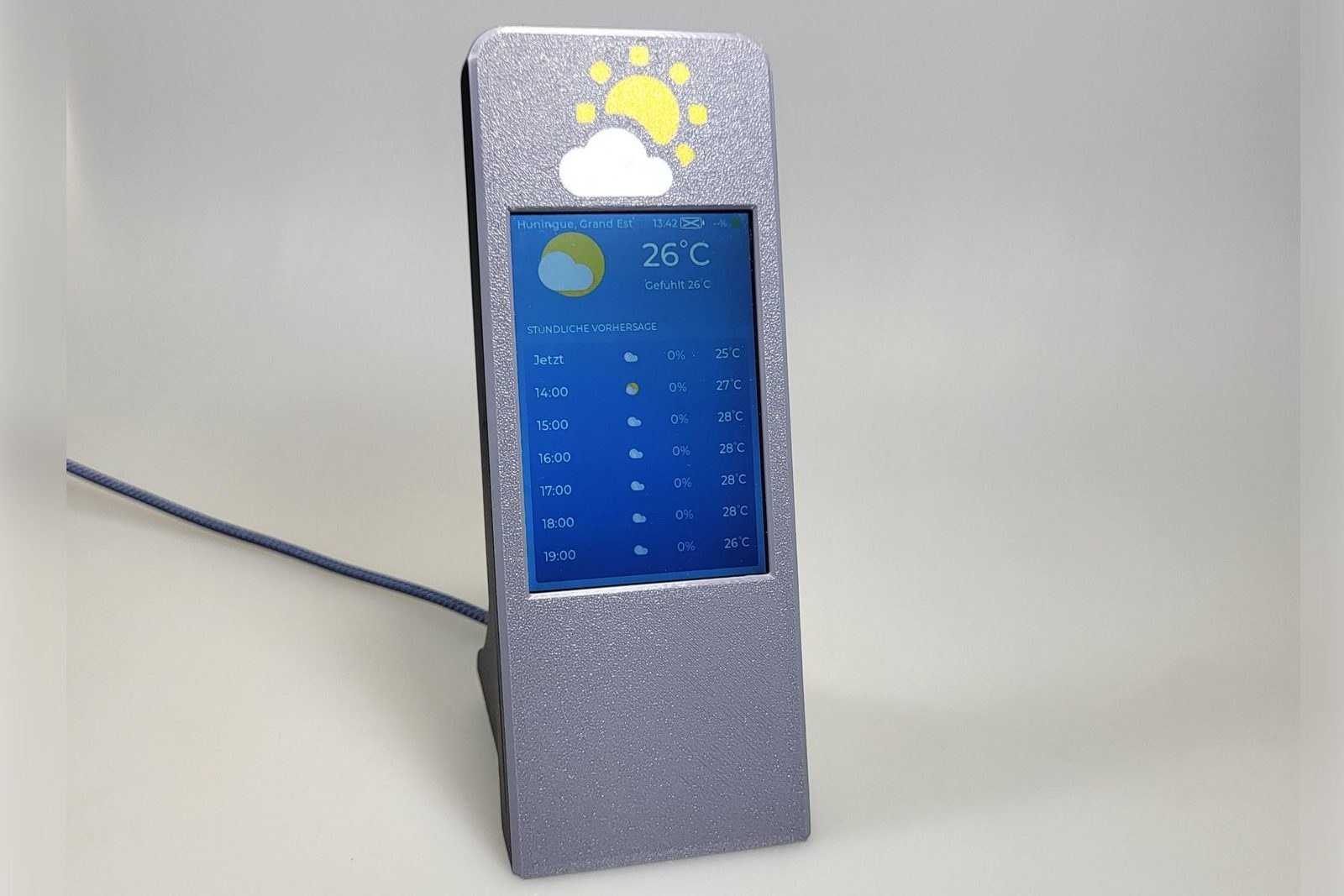
 ost DIY smart home displays share an infuriating flaw: they never shut up. If you build a desktop clock or a home weather station, the screen either drains your battery to zero or blasts your bedroom with a blinding glow at three in the morning. Traditional motion sensors are useless here because they trigger on literally any movement, from your cat stalking across the room to a stray breeze rattling the curtains.
As developer sudu1988 pointed out in an ESP32 Reddit post, you can solve this problem with a radar. Instead of wasting power running a display twenty-four hours a day, this project uses a sensor designed to detect actual human presence rather than generic motion. According to the project notes, the device pulls live weather updates from the Open-Meteo service and displays the time alongside a local forecast.
Millimeter-wave human presence radar wakes the screen only when someone is nearby to save power.
Yet the real achievement here isn't the weather widget; it's the sheer practicality of the power management. The build relies on a Freenove FNK0103S board powered by an ESP32-WROOM-32E chip. This single module packs in wireless connectivity, display control, and touch input, mercifully sparing you from a rat's nest of loose jumper wires.
How It Works Under the Hood
To keep the display from burning electricity over an empty room, the creator integrated a Hi-Link HLK-LD2410C millimeter-wave presence radar. This little component actually notices a stationary human who has walked up close enough to read the text on the screen. The display fires up only in that exact moment, while the system idles in deep conservation mode the rest of the time.
The hardware is a Freenove FNK0103S board with an ESP32-WROOM-32E, a 4-inch ST7796 display, and an XPT2046 resistive touchscreen.
Visuals are handled by a four-inch ST7796 screen paired with an XPT2046 resistive touch sensor. If you want to build one yourself, the author has shared the 3D-printing files for a custom enclosure and stand. The project also accounts for localized use by supporting time zones across the UK, Spain, Germany, France, Ukraine, Sweden, Italy, and Russia, complete with a toggle for temperature units.
This kind of build points directly to where compact home control panels should be heading. Instead of treating displays like dumb lightbulbs that punish your eyes in the dark, we get a smart peripheral that actually waits for you to show up instead of performing for an empty room.