
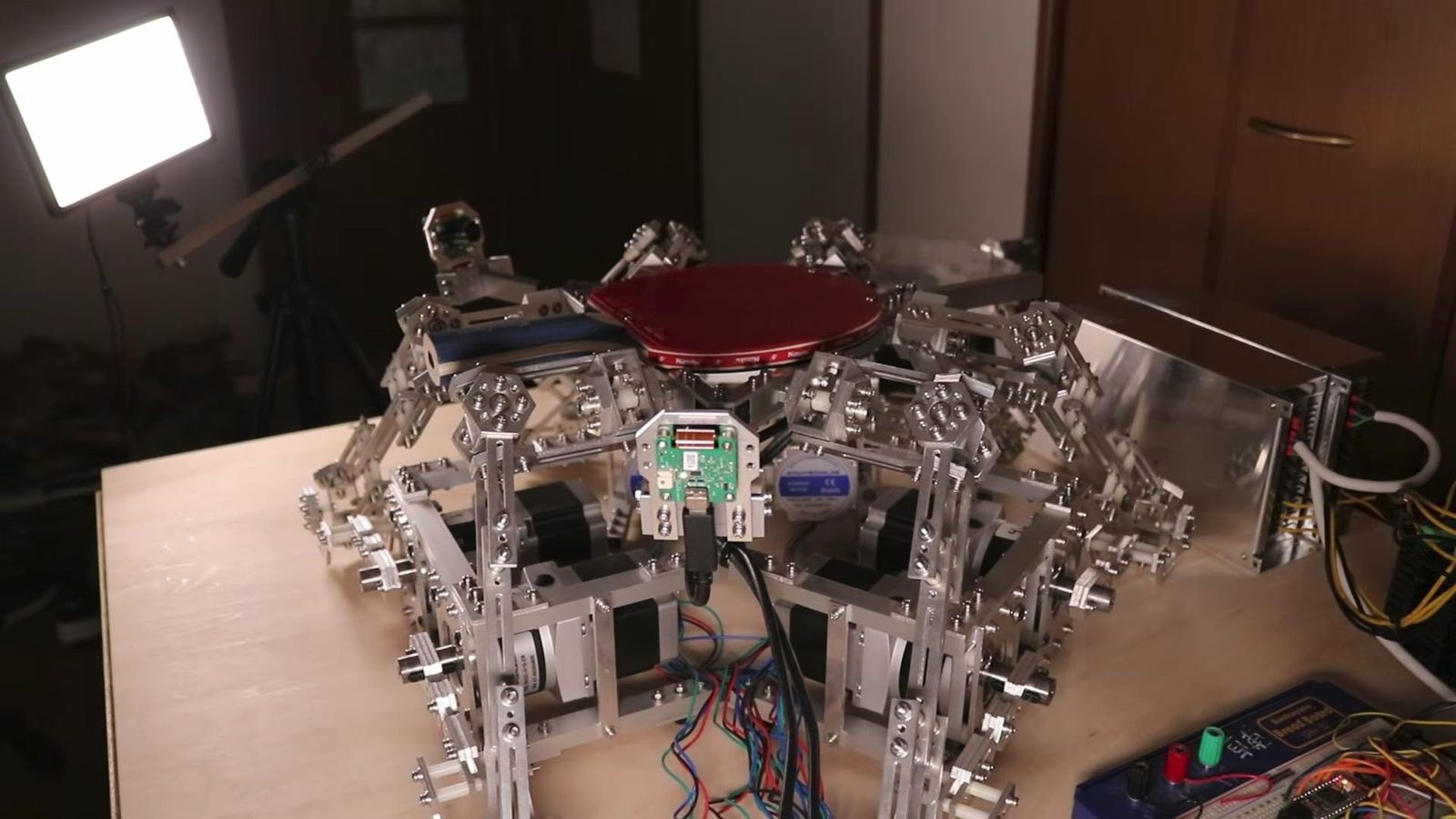
 lectron Dust built a machine called the Hexa-Bouncer that does one thing: it keeps a ping pong ball bouncing in the air using a six-axis moving platform. That is an absurd amount of mechanical complexity for a plastic sphere, but looking at it exposes the quiet stagnation of everything else we call smart hardware. While the tech industry spends billions teaching refrigerators to show weather widgets, garage workshops are casually reinventing industrial automation for a game of table tennis.
The mechanism behind the Hexa-Bouncer is a Stewart platform, which engineers also call a hexapod. Six independently controlled arms connect a fixed base to a triangular upper platform, giving it six degrees of freedom to move up, down, side to side, forward, backward, pitch, roll, and yaw. This lets the surface jump to meet the ball and tilt at the exact millisecond required to correct its trajectory.
Gears, Steppers, and High-Speed Vision
Making those moves happen fast enough to keep up with gravity requires serious hardware rather than a clever app. Electron Dust used six Nema 23 stepper motors, each hooked up to a 10:1 planetary gearbox to increase torque and tighten position control. Six StepperOnline CL57T drivers handle the motors, while a Teensy 4.0 acts as the low-level motion controller.
The Hexa-Bouncer is an absurd amount of hardware dedicated to bouncing a ping pong ball, but that is exactly what makes it so much fun.
Moving the platform is only half the battle because the machine also has to track the ball in real time. Two e-con Systems See3CAM_24CUG cameras watch the action from different angles at up to 120 frames per second, feeding video to a Windows personal computer running custom software built in Unity. The software isolates the white ball, calculates its three-dimensional coordinates, and predicts where it will intersect the platform before the next impact.
The Real Defect in Smart Home Automation
Every bounce is a high-speed race between cameras, software, and six powerful motors trying to predict the future. Miss by a fraction of a second and the game ends instantly. Compare this relentless physical feedback loop to a modern smart home, where your automated lights take three seconds to respond because a cloud server in another state is having a bad day.
Consumer technology has spent the last decade convincing us that smart means connected to a subscription service and controlled by a sleepy voice assistant. The Hexa-Bouncer proves that true engineering ambition looks nothing like a connected toaster. It relies on raw physics, closed-loop mechanical feedback, and hardware built to absorb kinetic reality rather than stream telemetry data.
Garage projects like the Hexa-Bouncer remind us how boring mainstream consumer hardware has become. Real automation is about millisecond physical reactions, not apps that turn your ceiling fan on from the couch.