
 hen you try to inspect the microscopic details of modern electronics through a standard microscope, you look straight down at the board—and that flat angle completely hides the actual condition of your solder joints. As maker Corebb pointed out, the classic top-down view is far too limited for proper chip inspection. Hunting for cracked solder or ungrounded pins turns into a guessing game, and the results usually only show up after a failed power-on test. The problem is that off-the-shelf optical equipment almost universally offers the exact same dead-end overhead light and vertical angle.
An Optical Kit Built from Spare Parts
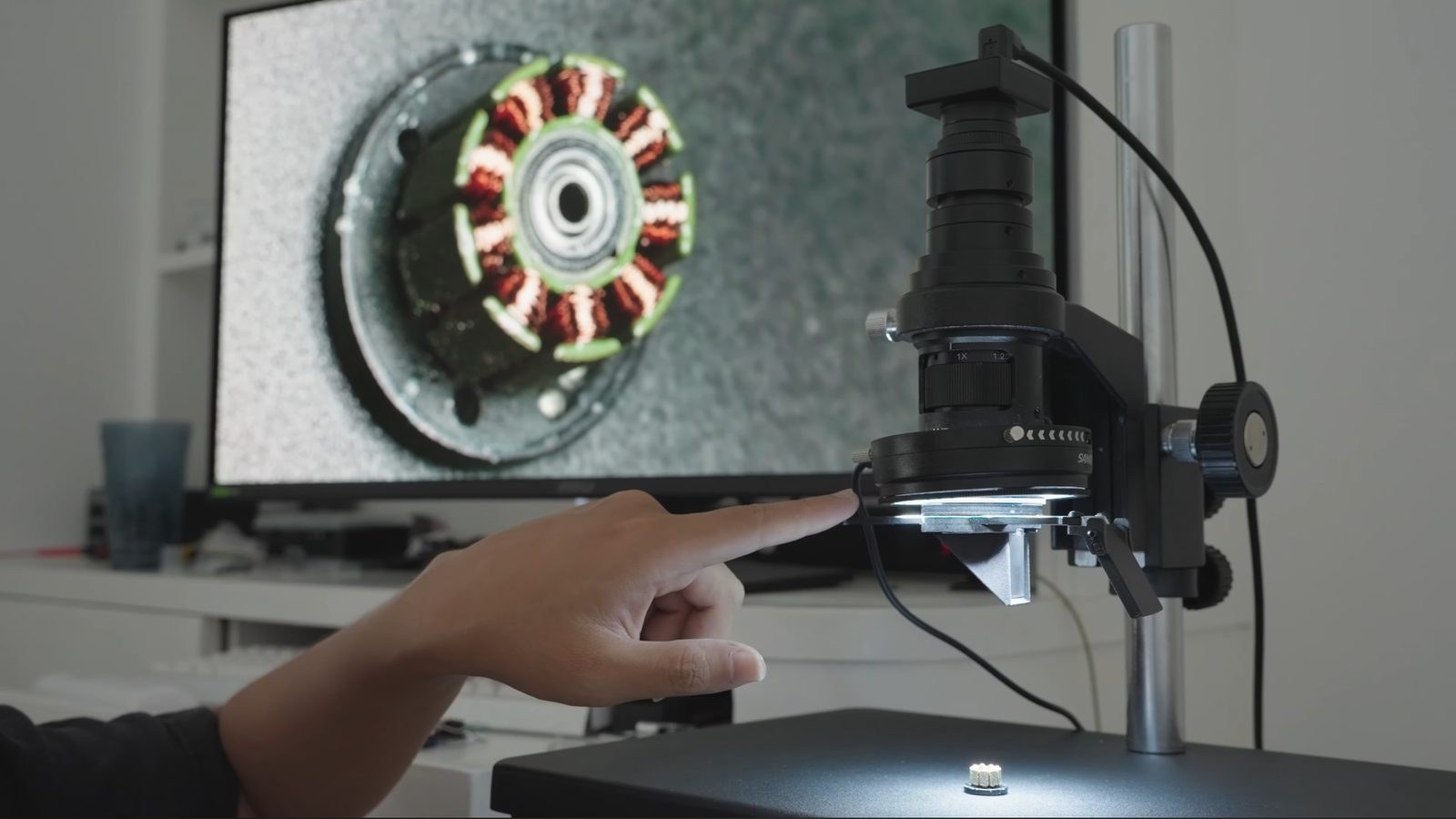
To beat this blind spot without spending a fortune, Corebb built a custom optical setup using a commercial C-mount lens with up to 200x zoom and a USB camera. The rig comes equipped with a ring light and two polarizing filters—one on the lens and another on the illumination ring. When these filters are adjusted 90 degrees apart from each other, they completely eliminate glare from shiny metallic surfaces.
when adjusted to 90 degrees from each other, these eliminate glare from reflective surfaces.
According to Corebb, the real trick lies in a custom side-view attachment that uses a pair of tiny mirrors to capture the image and redirect it into the main lens. An extra concave lens compensates for the extended optical path, while ball bearings let the entire assembly rotate around the object at any angle. An initial 3D-printed prototype failed miserably due to severe shaking and plastic flex. In the end, the part was machined from solid aluminum, providing the rigidity needed to make the supports thinner and rid the image of distracting shadows. The whole setup stays put via tiny magnets that lock the attachment in place while preserving exact optical alignment.
What This Means for Your Workbench
Building your own rig costs significantly less than factory side-view alternatives, but it demands machining skills, optical calibration, and an ironclad amount of patience during assembly. If you only solder electronics on rare weekends, you are better off sticking with a basic microscope and checking your connections with a multimeter. But if surface-mount repair is your daily headache, this maker-driven approach demonstrates a practical escape route out of standard optical limitations.