

 nstant cameras are clawing their way back into pockets because people are desperate to hold physical copies of their memories. Yet those same people immediately rediscover why we ditched film in the first place: every press of the shutter comes with a financial penalty attached to proprietary chemical cartridges. Maker Jim Bruges found a stubborn middle ground with a homemade instant camera called Rubber Duck-ify that spits photos out of a dirt-cheap thermal receipt printer instead of fancy instant film.
Bruges originally built a thermal printer instant camera more than a decade ago as a low-cost novelty for handing out physical snaps at parties. After getting his hands on the Arduino VENTUNO Q, he decided to revisit the concept to see what modern hardware could actually pull off. The new build combines a Logitech C270 USB webcam with a 58mm CSN-A2 thermal printer, Modulino Buttons, Modulino Pixels, and the VENTUNO Q brain. Everything lives inside a custom three-part 3D-printed enclosure, with the optical gear up front and the computing muscle tucked in the rear.
Local Brains Beat Corporate Cloud Subscriptions
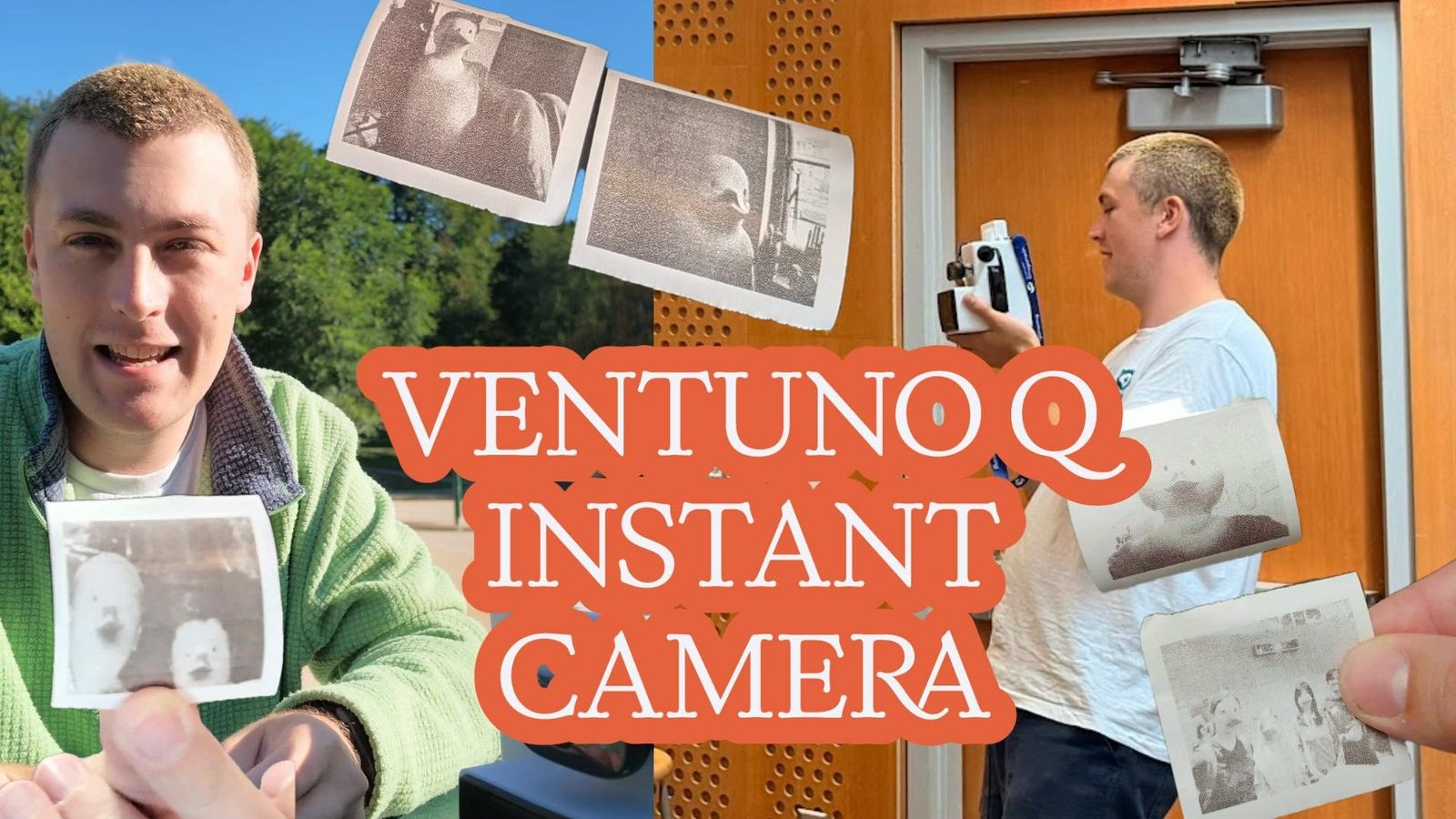
In standard mode, pressing the shutter grabs an image from the webcam, converts it into a gritty monochrome dithered bitmap, and dumps it straight to the thermal printer. The output is never going to rival traditional instant film chemistry, but rolls of receipt paper cost pennies, meaning you can fire away without calculating the cost of every mistake. Flip it to Local mode, and things get genuinely interesting. The captured image runs through an image editing model living entirely on the VENTUNO Q's onboard NPU, completely untethered from external servers or monthly subscriptions.
Bruges configured the default prompt to replace people's heads with rubber ducks while attempting to preserve the rest of the scene.
If rubber ducks aren't your aesthetic, the prompt is fully configurable, letting the exact same physical hardware handle completely different visual transformations without a single modification to the body. A separate Describe mode deploys a local vision-language model instead of an image editor, scanning the room and printing out a dry textual description of the chaos unfolding in front of the lens rather than a picture. There is a Cloud mode tucked away for remote experiments, but the whole point of using the VENTUNO Q is that you don't actually need it.
Controls Without the Screen Overhead
Three physical buttons handle six distinct actions through short and long presses, while the Modulino Pixels pull double duty as a flash and a status light. The VENTUNO Q's built-in LED matrix provides extra feedback, which means the device completely skips the useless luxury of an external display. Configuration, previews, diagnostics, and recent print history are handled through a simple browser-based interface, but once you dial it in, the camera operates entirely from its tactile physical controls.
There is a browser-based interface for configuration, previews, diagnostics, recent print history, and test prints.
Projects like Rubber Duck-ify prove that modern hobbyist silicon has evolved far past basic automation and can now run actual machine learning right on the board without leasing server time from a tech giant. As long as you are willing to trade glossy photo cards for receipt paper, local hardware hands you complete ownership over every pixel and prompt without any ongoing subscription tax.
This project strips the romance away from corporate photo monopolies by jamming local intelligence and penny-per-meter paper into a single 3D-printed box. When independent workshops outpace major consumer brands in sheer utility, buying into closed ecosystems starts to look less like a convenience and more like an expensive tax on nostalgia.