
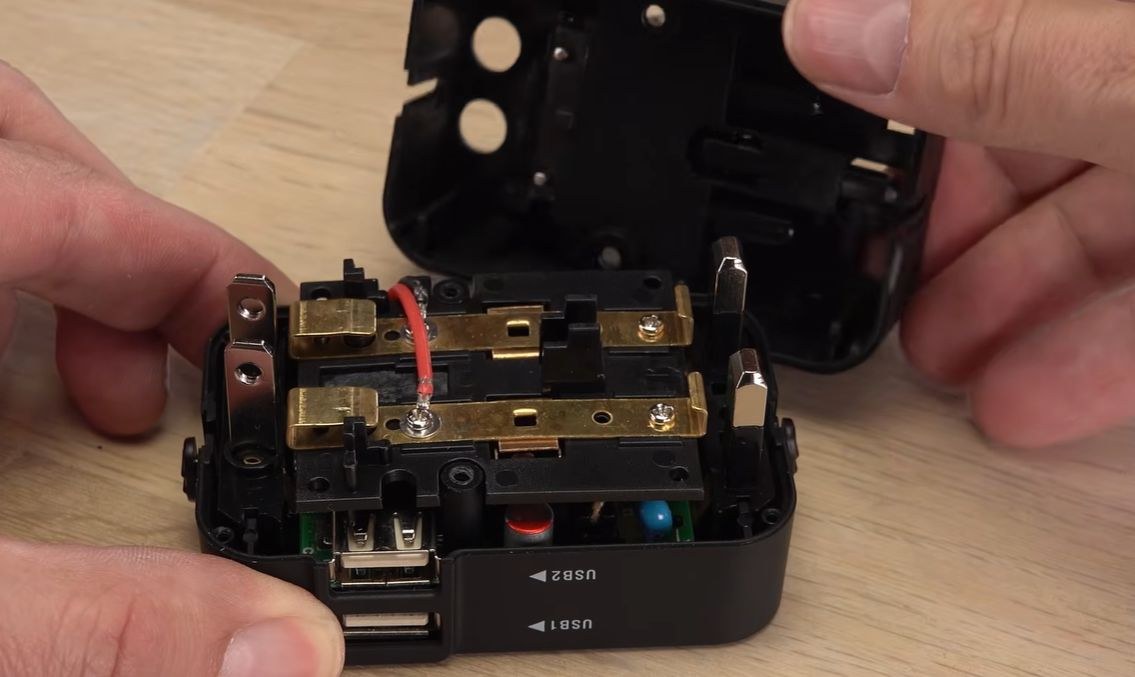
 f you bought a generic all-in-one travel plug online for under ten bucks, throw it away before it shocks you. Tech teardown specialist Brainiac 75 recently dissected an unbranded $9.26 universal travel adapter and exposed a lethal engineering shortcut: every retractable prong is wired directly in parallel to a central internal bus bar. When you slide out one set of plugs and plug it into a 220V wall socket, every other exposed metal pin instantly carries that full mains voltage.
As the teardown revealed, resistance testing confirmed that the sliding connectors share a direct line with zero mechanical or relay isolation. The pins only disconnect when pushed entirely flush into the plastic housing, but the cheap mechanism never forces unused prongs to retract automatically. If you leave a secondary US or UK plug sticking out while charging your phone in an EU wall socket, those bare prongs sit live at 220V, ready to deliver a severe shock to anyone who grazes them or short out against nearby metal. The unit also squeezes in two basic 5V/2.1A USB ports, but they offer no relief from the fundamentally flawed primary circuitry.
To make the fire hazard halfway usable, Brainiac 75 literally ripped out the US and UK prongs and taped over the empty gaps, reducing the device to a single dedicated EU charger. Saving a few dollars on uncertified travel gadgets isn't thrift—it is an open invitation to electrocution and fried hardware. Skip the bargain-bin universal combo bricks and stick to dedicated, certified plug adapters with proper mechanical interlocks.