
 uying a massive, humming tower for under your desk just to open spreadsheets and stream movies is roughly the equivalent of driving a tractor to the corner store. Marketing keeps convincing us we need nuclear-reactor power for office tasks and home chores, or everything will crawl to a sluggish halt.
Chinese manufacturer Beelink has expanded its ZeroTech EQR5 mini PC lineup with a version featuring the AMD Ryzen 5 5500U processor, and this machine completely flips the script for anyone tired of paying extra for dead weight. Our analysis shows that for a modest sum, you get a proper workhorse capable of handling ninety percent of your daily tasks without the noise or cable spaghetti.
What is actually inside and how much does it cost
Strip away the marketing fluff, and you are left with a compact plastic brick that easily hides behind a monitor or slips into any bag. As data shows, the barebones configuration without RAM and storage costs 1,379 yuan, while the version with 16GB of DDR4 RAM and a 500GB solid-state drive runs 3,029 yuan, translating to just over two hundred dollars for a ready-to-go setup.
The barebones configuration without RAM and storage costs 1,379 yuan, while the version with 16GB of DDR4 and a 500GB SSD costs 3,029 yuan.
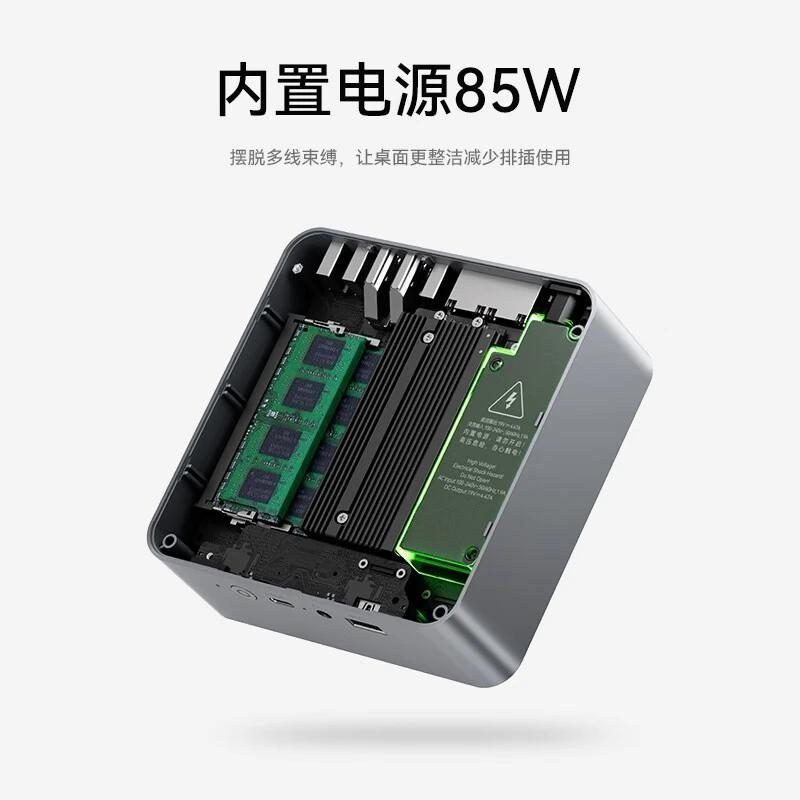
For the average buyer, this means one thing: you are not paying extra for someone else's 4K gaming fantasies when all you need is a browser with thirty open tabs and a work messenger. The mechanics are simple: the AMD Ryzen 5 5500U processor chews through routine tasks faster than five-year-old office desktops, and the built-in power supply spares you from hiding a massive charging brick under your desk.
Desk silence and the quiet terror of upgrading
Jumbo desktop towers share a nasty habit of vacuuming up dust and roaring like jet engines under any serious load. According to Beelink's engineers, even under maximum stress, noise levels never cross 32 dB. In real life, that means the machine will not ruin your evening movie or your quiet focus with a persistent drone.
Cooling is handled by the MSC2.0 system with bottom air intake, heat pipes, radiators, and a low-noise fan, plus a dedicated heatsink for the solid-state drive. But here lies a trap for hardware tinkerers: the compact chassis imposes strict limits on repairs and component swaps, though the manufacturer left decent headroom for the future. Expansion options include two SO-DIMM DDR4 slots supporting up to 64GB of RAM and two M.2 2280 PCIe 3.0 x4 slots allowing up to 8TB of total storage.
Budget home server or hobbyist trap
Beyond basic office duties, this little box unexpectedly appeals to home network tinkerers. Connectivity features include an Intel AX200 adapter with Wi-Fi 6 and Bluetooth 5.2, alongside two Gigabit Ethernet ports, turning a standard mini PC into a ready-to-go home server or secure router without building clunky custom rigs out of old motherboards.
Still, the average buyer who has zero interest in setting up a home cloud will likely find the second Ethernet port entirely useless, leaving it as a nice but pointless bonus. The front panel packs USB-A and USB-C ports rated at up to 10 Gbps plus a 3.5mm audio jack, while the back hosts two USB-A 10 Gbps ports, a USB 2.0 port, two HDMI ports supporting 4K at 60 Hz, dual Ethernet, and the power input.
Before you buy, take a sober look at your actual needs and decide whether you want a pre-built kit with memory included or if you would rather grab the barebones version and source the components yourself.