
 he Honor Robot motorized camera has shown its weak spots in a fresh durability test. Famous tech creator JerryRigEverything put Honor Robot through the grinder and tore it down to see if its moving parts are actually reliable.
Sand vs. the motor
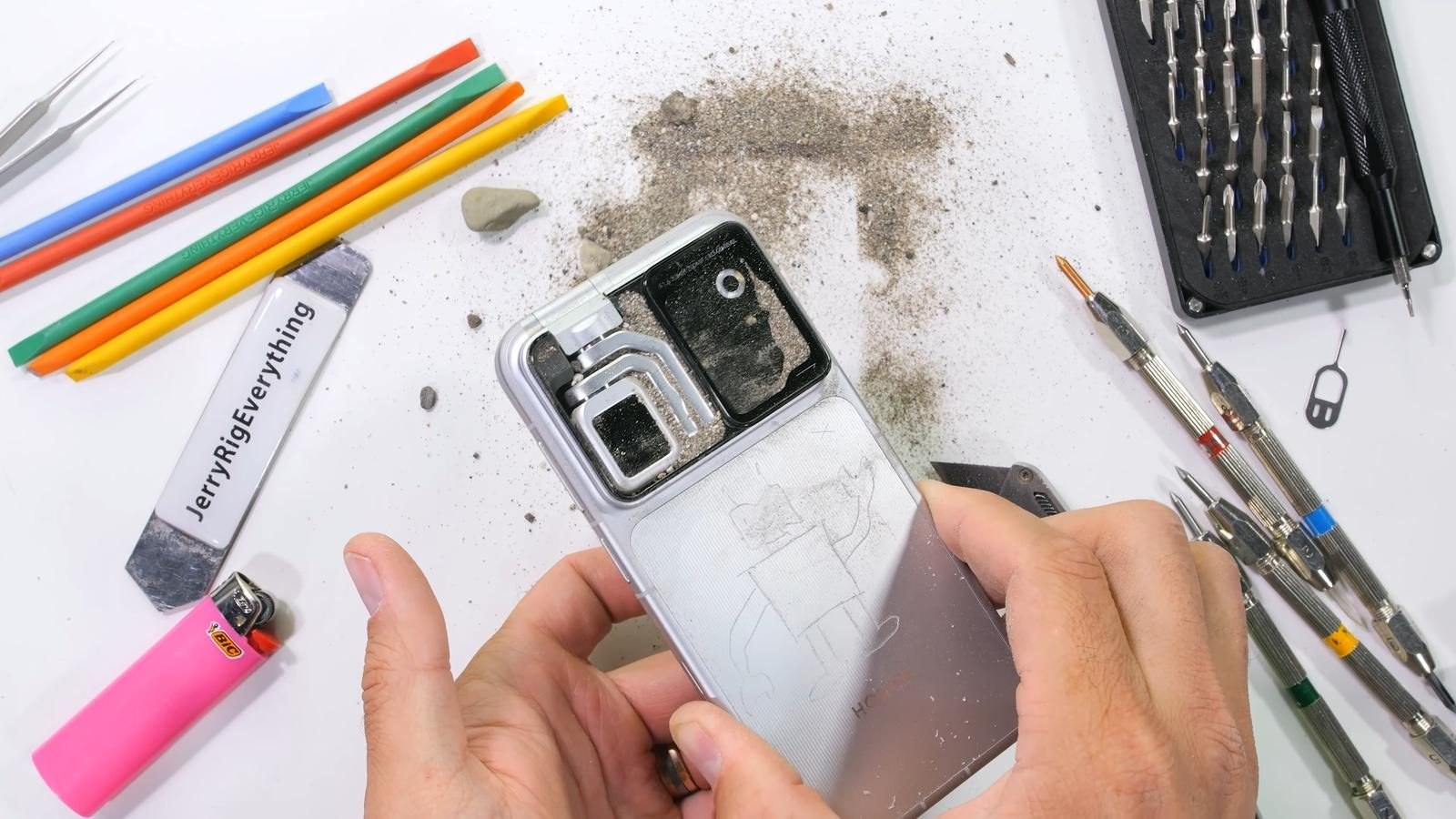
In daily use, the body holds up fine: the screen protection is standard, and the glass over the robotic camera module refuses to scratch even with a knife. The phone also survives bend tests easily simply because it is quite thick. Problems start the moment physics meets exposed gaps. The electronics stubbornly try to close the module even if something gets in the way — like a finger during a safety test. But the mechanism failed the sand test completely: once a few grains get inside, the camera simply stops working.
«Blowing out the module made the camera pop out of its recess, but it refused to go back in.»
After trying to clear the bay with a blast of compressed air, the lens popped out, but could not retract. Taking a phone like this to the beach means rolling the dice on whether your optics will survive the day.
What the teardown reveals
The internal layout brings another surprise: a thermal conductive pad is glued directly to the back of the screen, turning the display into part of the cooling system. The tiny robotic actuator connects to the mainboard using unusually thick cables.
At the same time, you cannot easily repair or service a jammed mechanism on the cheap. Tearing down the robotic camera module itself destroys it because the fastening screws are hidden under a plastic cover. Any grain of sand inside means you are looking at a full replacement of an expensive mechanical assembly, not just a quick clean.
Moving optics in smartphones look cool, but they remain an extremely fragile point of failure. If the phone takes a dive into dirt or sand, fixing that complex motorized drive will cost a fortune due to the single-use design of the mechanism. Buying engineering experiments like this only makes sense if you are a tech geek with cash to burn, not for anyone who values practical everyday reliability.