

 an a handful of cheap parts and an online artificial intelligence model crack the mechanical deadbolt protecting your home?
Dr. Kun Dániel proved it is possible by creating a DIY lockpicking robot that uses an ESP32, 3D-printed parts, and Claude to autonomously open pin tumbler locks. Instead of needing years of locksmith training, the machine connects cheap hardware to cloud intelligence to feel its way through a physical cylinder.
How AI Replaces Human Touch
Traditional lockpicking is a skill that traditionally requires a steady hand, a good sense of touch, and plenty of patience. Dr. Kun Dániel replaced that physical intuition with sensors and software by designing a custom rig that mounts directly onto a door's lock cylinder.
"The system uses force feedback to determine how the pins are responding and adjusts its approach accordingly."
At the core of the machine is an ESP32-C3 Mini development board (a tiny, low-power microcontroller chip with built-in Wi-Fi), which handles the local control logic and communicates with Anthropic's Claude over the network. The mechanical assembly consists of just one stepper motor, two servo motors, and two load cells (sensors that measure physical force and pressure) to gauge resistance. Nearly everything else is 3D printed, including the chassis, mounting hardware, and rack-and-pinion mechanism that translates rotational motion into the linear movement needed to probe the pins. A rechargeable lithium-ion battery powers the electronics, while a small OLED display provides real-time feedback about the picking process.
Real-Time Feedback Over Brute Force
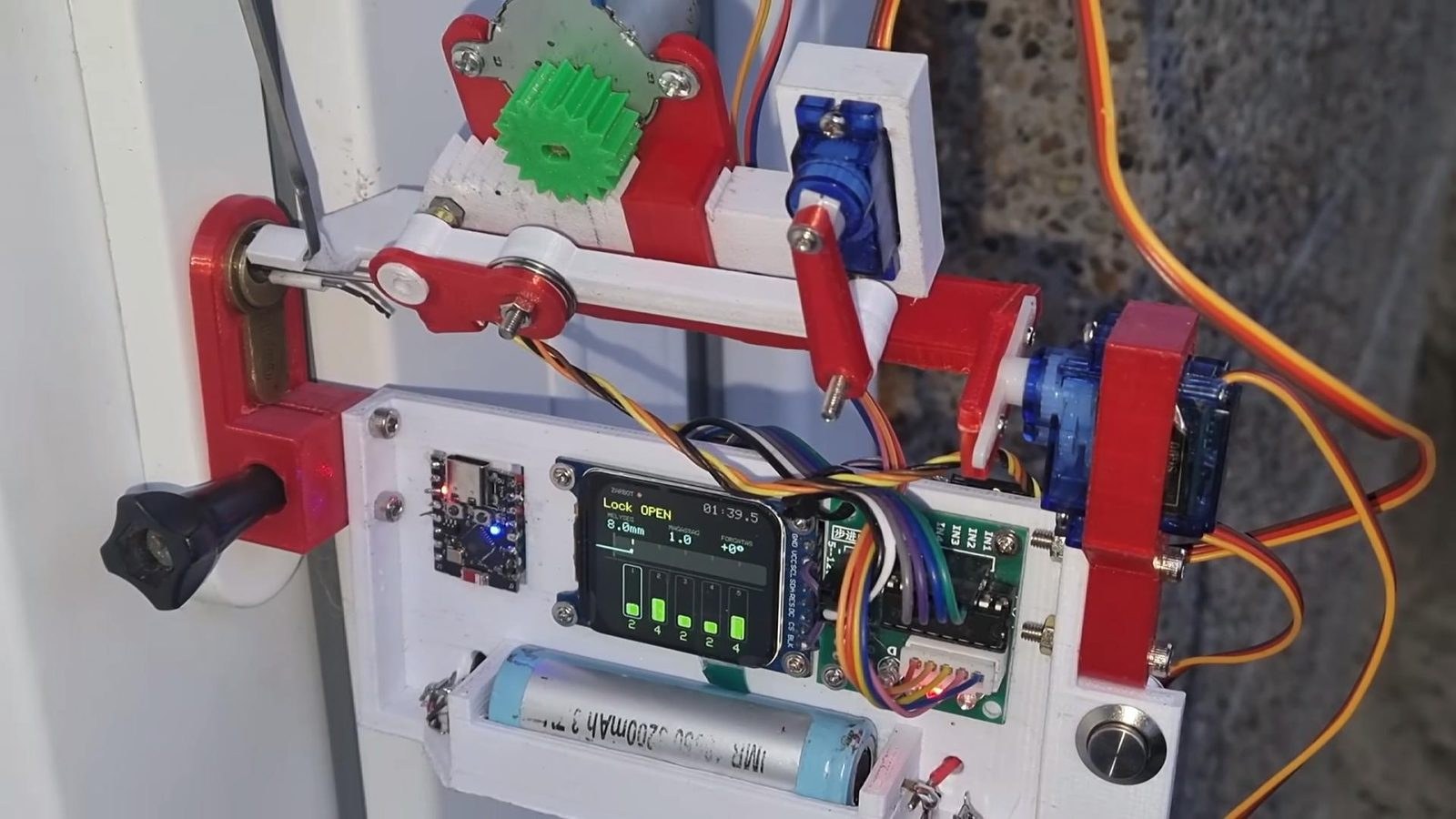
Many assume automated lockpickers rely on hardcoded movement sequences or brute force. In fact, this robot works like an automated locksmith: the ESP32 gathers real-time force measurements from the load cells and sends information to Claude, which analyzes the feedback and helps determine what the robot should do next. The neural model evaluates the physical resistance and tells the robot how to adjust its pick on the fly. The machine probes each pin individually until the cylinder finally rotates to open the door.
Whether this setup can become an immediate threat to home security remains the real question. Dániel has already invested more than 200 hours into its development, and his video demonstration shows the device successfully opening a lock. However, the creator notes that the project isn't quite finished, as he is continuing to fine-tune the hardware and software to improve reliability.
Once Dániel polishes the project's reliability, he plans to release the source code, STL files (standard 3D printing file formats), and complete documentation for other makers to build. Standard pin tumbler mechanisms are rapidly losing their status as reliable barriers against automated tools, forcing physical security to evolve beyond basic mechanical keys.
The catch
A cheap ESP32-C3 Mini board with basic servos effortlessly replaces years of lockpicking experience, yet making this DIY setup work with Claude took over 200 hours of engineering. Releasing the open-source code and design files turns an elite physical skill into an accessible automation script for hobbyist boards.