
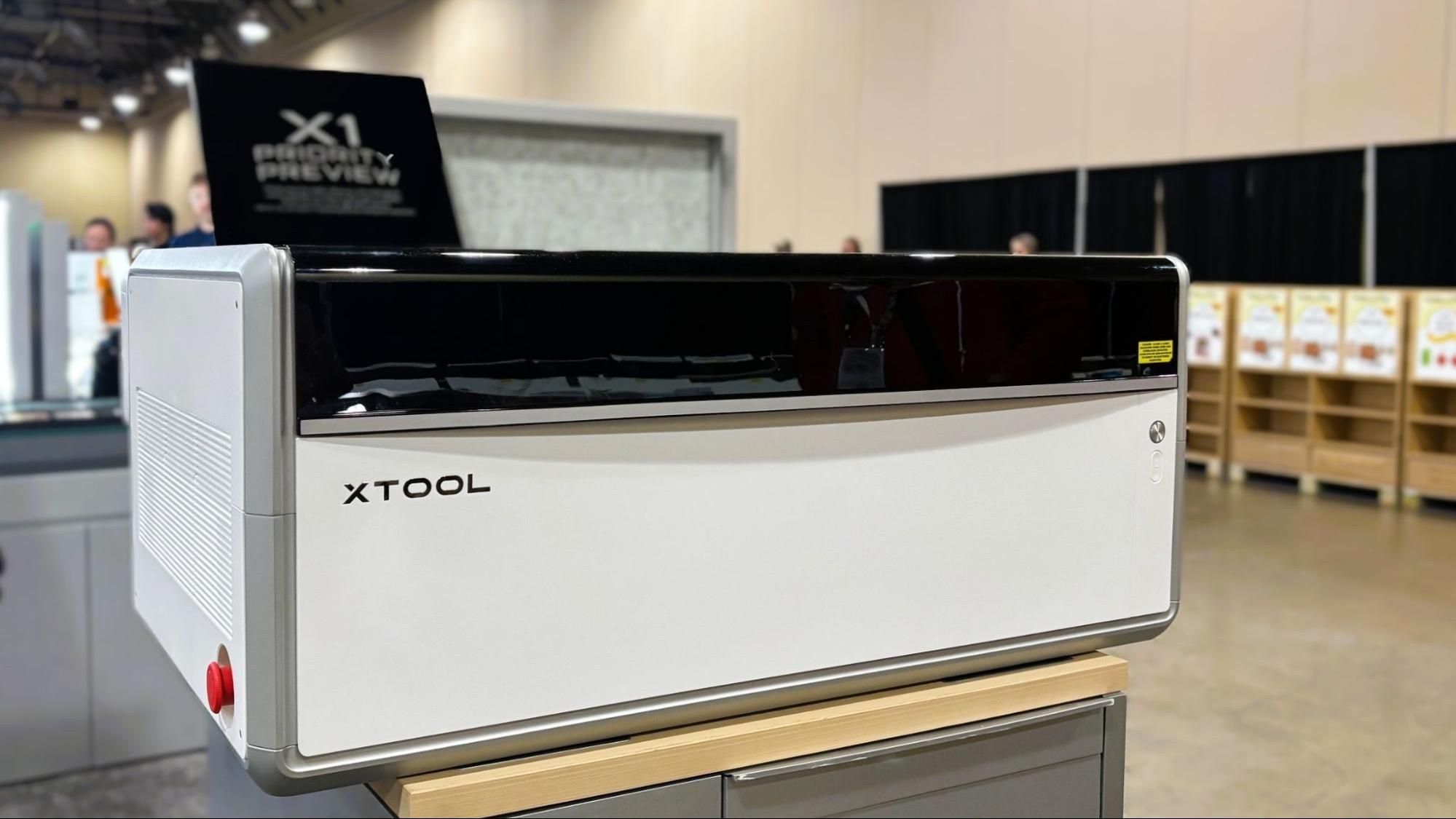
 Tool wants small workshop owners to believe their days of juggling separate, space-hogging machines are over. Unveiled at The Next Level Maker Conference in Grapevine, Texas, the modular xTool X1 attempts to eliminate a classic production headache: choosing between a sluggish, large-bed gantry for cutting plywood and a blisteringly fast galvo engraver trapped inside a postage-stamp work area. Instead of forcing that trade-off, xTool engineered a flying-galvo hybrid that rides the wide gantry frame while carrying both mechanisms simultaneously.
The hardware uses a dual-head layout where a rapid galvo mirror assembly sits directly beside a traditional CO2 cutting laser. Rather than forcing you to tear down your rig whenever an order shifts from slicing thick acrylic to batch-marking serial numbers on anodized pens, the X1 automatically engages whichever emitter the job requires—or fires both in tandem across mixed-media runs.
Swappable Backpacks and Missing Numbers
Versatility on this scale lives or dies on optical modularity. Older hybrid setups barely offered more than modest diode swaps, but the X1 relies on a swappable backpack architecture that feeds distinct laser sources straight into the galvo optical path. In practical terms, this setup accommodates five distinct emitter types: CO2, Diode, UV, Fiber, and MOPA. That spread turns a single machine from an organic-slicing workhorse into a crystal-etching UV engraver or a multi-color metal-marking MOPA rig.
"The machine’s default build will be a powerful 55w CO2 laser paired with a 20w diode for the galvo head."
That stock combination delivers genuine cutting muscle alongside rapid surface engraving straight out of the crate, but xTool conveniently omitted the single detail that matters most to a working business: the final price tag. Alongside the X1, the brand also previewed an embroidery machine and thread-coating hardware, but the core laser rig remains the real test of whether small workshops can actually consolidate their benches.
Cramming five laser technologies onto a flying carriage solves real floor-space bottlenecks, yet high-speed moving optics always introduce vibration, mirror misalignment, and mechanical failure risks that can grind a production deadline to a halt. The X1 ships this October, and its true viability will depend entirely on whether that unannounced sticker price actually beats the cost and reliability of maintaining dedicated standalone units.