
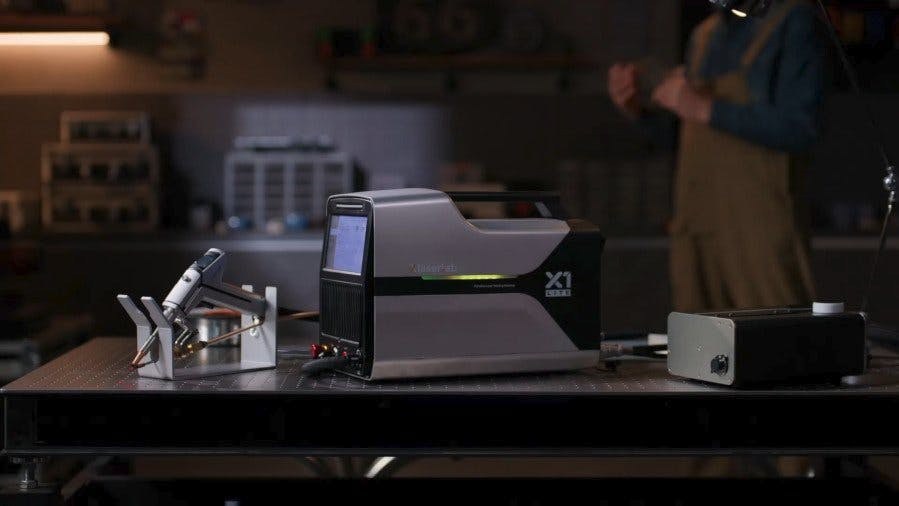
 Photonics sub-brand XLaserlab has turned to Kickstarter to pitch the X1 LITE, a desktop metal fabricator that compresses cutting, rust removal, and welding into a single tabletop box. Heavy fiber laser rigs have historically been the exclusive domain of commercial sheet-metal shops—weighing hundreds of pounds and costing five-figure sums. Compressing that tech into a maker-friendly package sounds appealing, but practical utility depends entirely on how well it balances raw output against domestic safety.
The hardware runs on a 1,080nm fiber laser delivering a 700W peak and 500W continuous output rating, powered by an internal 55W laser diode. In the workshop, that translates to slicing through mild steel up to 2.5mm thick (roughly 0.1 inches). The machine switches between pulse, continuous, and spot welding routines alongside dedicated cleaning and cutting profiles.
Interchangeable Heads and Automation Ambitions
The central selling point is a modular dual-head setup splitting duties between a wide torch and a precision pen. The torch sweeps across 150mm swathes for quick rust stripping and seam welds, incorporating an integrated display for power, frequency, and pulse width tweaks directly on the grip.
For tight joints and delicate jewelry work, the lightweight pen takes over without requiring dedicated shop infrastructure.
"Pen mode eliminates bulky shielding gases. Just plug in and weld with greater freedom in garages, studios, and compact workspaces."
As XLaserlab representative Lina Wang points out, operating the pen like a manual stylus lets makers weld thin sheet metal without tethering the unit to external gas canisters. For those looking beyond manual passes, XLaserlab claims both the X1 Pro and X1 LITE can integrate with proprietary CNC stages and small robotic arms for automated runs.
The Price of Downsizing
Kickstarter pricing starts at $1,799 for the bare-bones Precision Kit, while the Complete Kit—packing the pen, the wide-area torch, and a motorized mini wire feeder—runs $2,699. XLaserlab targets deliveries by the end of the year.
A sub-$3,000 desktop fiber unit will not displace industrial TIG rigs or dedicated plasma cutters for structural steel, but it shifts the economics for small repair benches and prototype studios currently outsourcing light metal jobs. Operating an open-beam 1,080nm laser in a residential garage demands serious eye protection and disciplined ventilation, but if the retail hardware safely cuts 2.5mm plate without gas tanks, desktop fabrication takes a genuine step forward.