
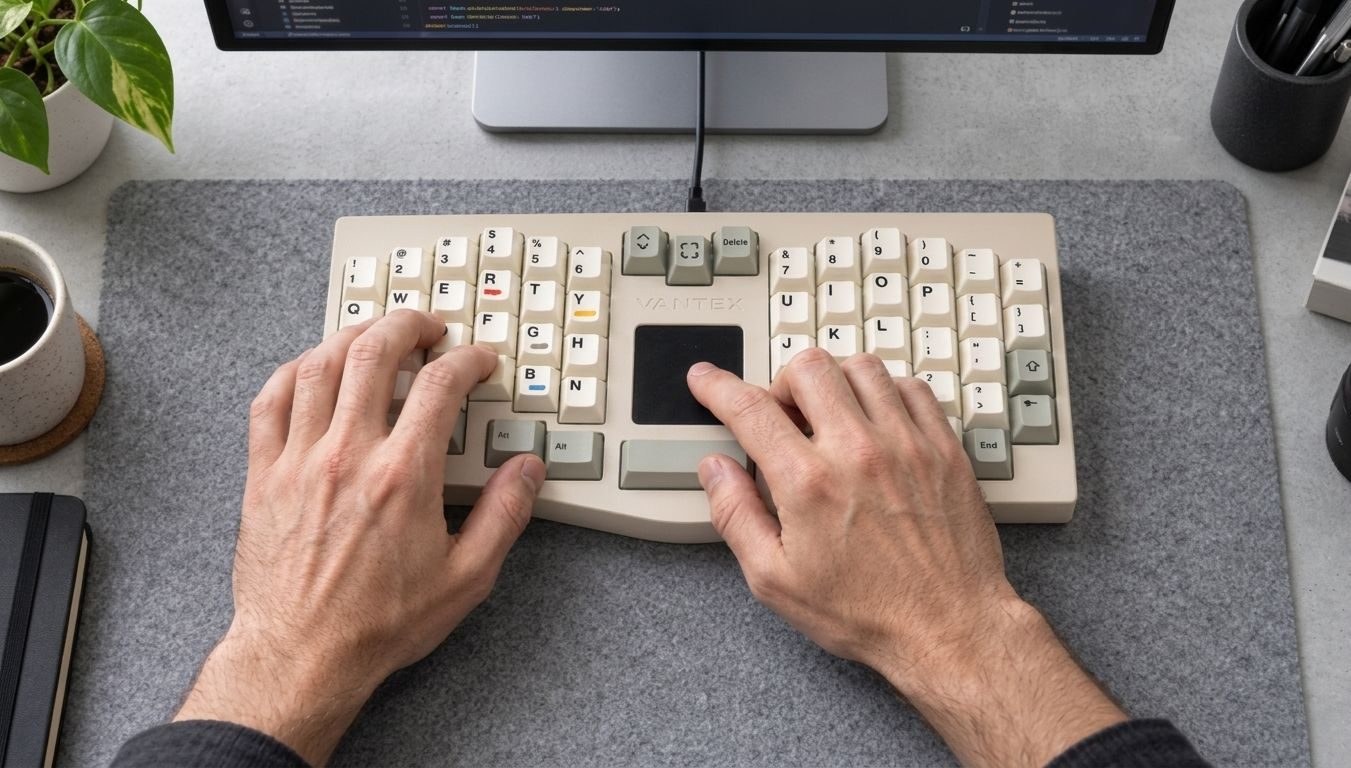
 f you are tired of reaching across your desk for a separate mouse every time you want to move a cursor, a new peripheral promises to keep your hands in one place. The Vantex V1 mechanical keyboard goes on preorder for $160, offering a built-in touchpad right in the middle of a split layout. As TechRadar reports, the CNC aluminum mechanical keyboard uses a split layout that leaves space between both sections for a 45 × 45 mm touch-sensitive surface for cursor movement. You can switch between typing and pointing without moving your hands far from the keyboard, which sounds efficient on paper until you look at the physical reality of the device.
The keyboard measures 30.74 × 13.74 × 3.48 cm and weighs approximately 1.57 kg, according to TechRadar. This is a massive, heavy slab of metal designed to stay bolted to your desk rather than travel in a backpack. The V1 has 60 keys, four programmable layers, and an aluminum body with a rearward incline of 7°. For typing, it features white linear switches that have an actuation force of 42 ± 3 gf, a bottom-out force of 47 ± 5 gf, and a stated lifespan of 50 million keystrokes. Those mechanical switches support replacement without soldering, and a gasket-mounted construction cushions keystrokes. The PBT keycaps use dye sublimation printing, and their layouts can be customized using an included interchangeable keycap collection.
Pricing and crowdfunding risks
When it comes to paying for the device, you have multiple purchasing tiers and packages to evaluate. The Kickstarter campaign lists an introductory price of $129 for the wired package, while the wireless package for the Vantex V1 starts at $159. If you want to stock two desks, a two-keyboard wired bundle costs $239 against a listed retail price of $518, while a two-keyboard wireless bundle is priced at $299 against an advertised standard price of $598. The wired package includes the keyboard without fitted keycaps, 148 keycaps and a data cable, meaning you have to install your preferred arrangement yourself.
Buying into this hardware requires accepting substantial early-stage risks. TechRadar notes that the wireless version of the V1 is equipped with a 4,000 mAh battery, but its operating duration and connection performance remain under evaluation. As Vantex explained, the company is still evaluating battery capacity, runtime, and connectivity for wireless operation, and it has identified component availability, assembly consistency, final testing, packaging and international shipping as potential sources of production delays. Furthermore, Vantex discloses using AI-assisted tools for promotional writing, visual design and image enhancement, suggesting that campaign materials may not represent the actual product.
What this changes for your desk
For anyone looking to ditch a traditional mouse and reclaim desk space, the Vantex V1 offers an intriguing combination of split ergonomics and central cursor control. At the same time, the device does not include Microsoft's dedicated Copilot key, an omission that may appeal to users who prefer conventional keyboard controls without a button for launching Microsoft's AI assistant. Connectivity options include USB-C, Bluetooth and 2.4 GHz wireless, and Vantex stated that its wired prototype has undergone testing with Windows, macOS and Linux.
At the time of writing, the Vantex V1 Kickstarter campaign has raised $2,556 from 19 backers, exceeding its $637 funding goal with 27 days remaining before it closes. The creators promised an innovative split mechanical keyboard with a built-in touchpad and no forced AI buttons starting at $159 for the wireless package. What they actually delivered for now is an unproven crowdfunding prototype weighing nearly 1.57 kg that comes with unverified battery life, unfinished wireless performance evaluations, and a frank admission that promotional materials were generated with AI tools.