
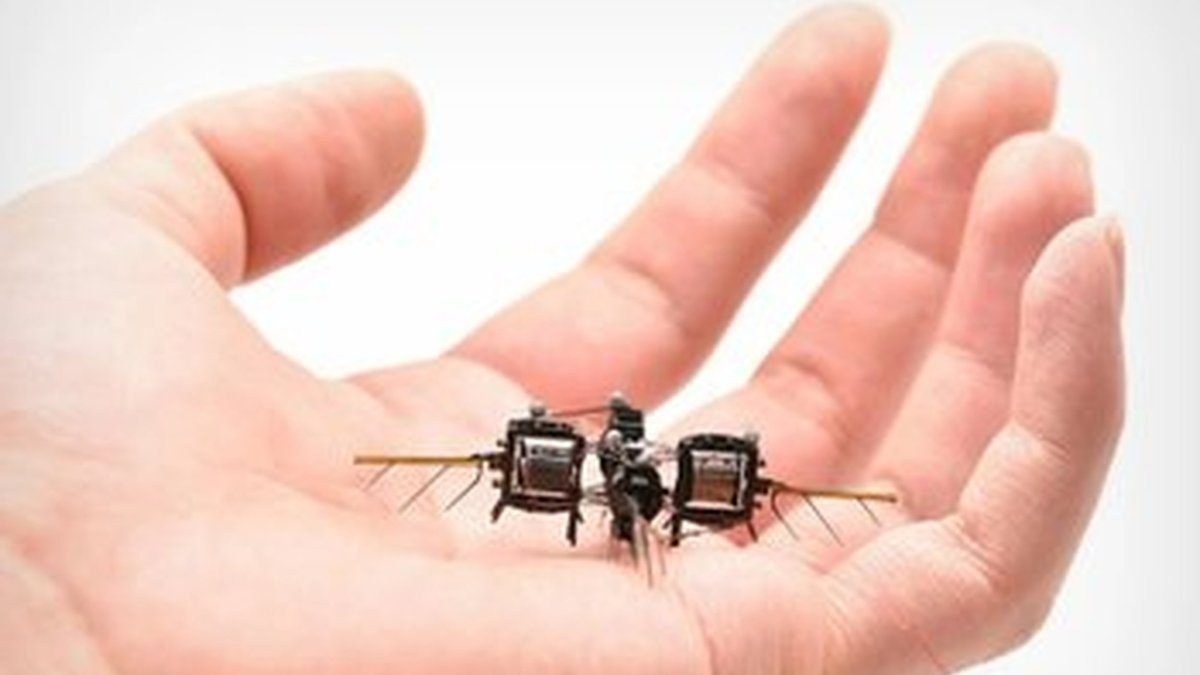
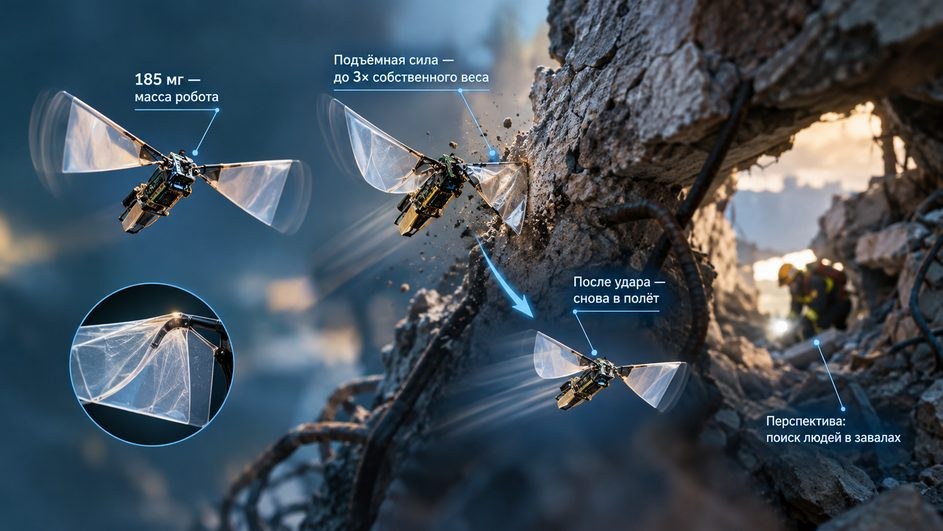
 standard flyswatter can send almost any insect straight to the afterlife, but against a new flying robot, that trick might fail. Researchers from UCLA and UC Davis have unveiled a micro-drone that survived a swatter strike, endured being crushed under a load roughly 11,000 times its own weight, and kept on flying. The results of this work were published in Science Robotics.
When it comes to miniature drones, we're used to expecting fragile gears and tiny motors that shatter upon the slightest wall collision. Ditching rigid gears and motors, they swapped in an artificial muscle—the actuator is a thin film made of relaxor ferroelectric polymer, a material that changes shape when exposed to electricity. Under an electric field, the material reversibly expands. This property, known as electrostriction, lets the film bend rapidly and move the wings without complex mechanics.
A crucial design feature is that there is completely no separate mechanical transmission mechanism between the actuator and the wings.
Fruit flies, bees, dragonflies, and mosquitoes served as the inspiration for the engineers. The cone-shaped wings and the entire apparatus are made of polymers. They deform upon contact with obstacles, and the materials used are resistant to creasing. Thanks to this, collisions with obstacles don't turn into fatal crashes.
In real-world operating conditions, miniature flying machines have to deal not only with wind but also with unexpected mechanical impacts—from falling branches and hit objects to accidental wall bumps in tight spaces. Traditional mechanics with micromotors and gearboxes break instantly in such scenarios, rendering the device inoperable after the very first incident. The polymer design solves this problem by distributing the impact energy across the entire flexible body, allowing it to keep working where classical robots turn into a pile of scrap.
However, serious engineering barriers still separate the laboratory sample from practical application. At this stage, the project is in early physical testing, proving the viability of motorless flapping flight itself. Lab tests show high material durability, but in practice, the device's maneuverability remains severely limited. Engineers haven't yet taught the micro-drone how to execute confident controlled turns, perform a proper landing, or carry a payload.
The main technological obstacle remains autonomy. Right now, the microscopic device is physically incapable of carrying a battery of sufficient capacity onboard, forcing it to run on external power cords. This severely restricts its travel radius and makes real field use in hard-to-reach places impossible. In the future, such devices could inspect hazardous zones, search for people under rubble, monitor environmental conditions, and even pollinate agricultural crops. But before commercial versions for these tasks arrive, engineers must solve numerous problems with miniaturizing power sources and onboard navigation systems. The researchers haven't named exact market release dates.
Key takeaways
- An 185-milligram micro-drone proves that polymer wings without rigid mechanical transmissions can survive flyswatter strikes and colossal compression.
- The design uses an artificial muscle made of electrostrictive polymer instead of fragile micro-motors and gears.
- Power autonomy is still missing: the robot currently crawls on external wires, meaning real-world use is a long way off.
Strategic context
- Researchers are pushing swarm robotics and micro-air vehicles toward extreme physical durability by mimicking insects.
- The elimination of complex micro-mechanics points to a future where micro-robots shrug off impacts instead of shattering.
Key takeaways
- Don't expect to buy one to swat your actual flies anytime soon; this is strictly a lab proof-of-concept with no release date or price.
- For now, it's an impressive physics demo that can't fly untethered, so your current quadcopter is safe from replacement.
Future outlook
- Scientists intend to improve control, including teaching the robot to turn and land, as well as increasing payload capacity.
- In the future, such devices could inspect hazardous zones, search for people under rubble, monitor environmental conditions, and even pollinate agricultural crops.
- However, as long as the apparatus runs on external wires and lacks onboard power, actual sales and field flights remain a distant dream—the researchers give no exact release dates.
What came before
Earlier miniature flying devices shattered from the slightest impact against a wall, but now a polymer robotic fly withstands a load 11,000 times its own weight and flies after a flyswatter strike. The creators replaced brittle gears with a flexible film that bends under current and flaps wings without a single motor. Yet this remarkable durability remains confined to the lab by a tether: the tiny frame cannot carry an onboard battery. A crash-proof flier that survives a direct swat remains tied to an outlet by an electric cord.