
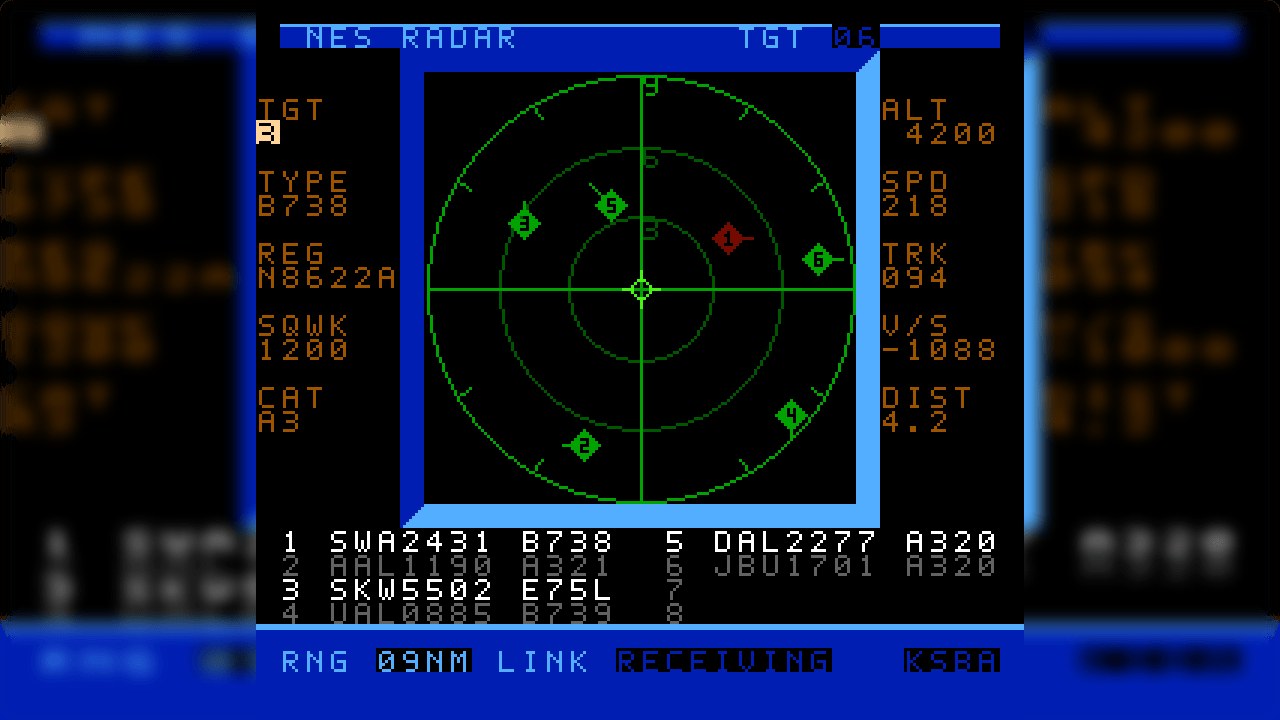
 f you want to track overhead flights, opening a browser tab or checking Flightradar24 is easy—and completely boring. Maker Levi Maaia chose a much more inventive path with NES Radar, an open-source project that converts an entirely unmodified 1985 Nintendo Entertainment System into a live desktop airspace monitor. Instead of cluttered digital maps, you get a clean, retro 8-bit radar sweep visualizing actual aircraft in real time on hardware built four decades ago.
Operating the system is refreshingly tactile: plug an original controller into port one, type in a standard four-letter ICAO airport code, and press Start. The NES generates a radar scope displaying live flights within a nine-nautical-mile radius of the selected airfield. The display handles up to eight aircraft simultaneously, making it ideal for regional airports, even if massive international hubs will rapidly crowd the screen.
The Hardware Bridge Behind the Cartridge
A 40-year-old console obviously has no native concept of modern Wi-Fi or web APIs. Rather than butchering the console's motherboard, Maaia runs a companion script on a host computer to pull live ADS-B transponder data from adsb.fi. That stream is parsed, formatted into coordinates, and piped directly into the NES through an ingenious physical workaround.
"To transfer that data, Maaia uses the second controller port as a 9,600-baud bidirectional serial interface."
This creates a functional two-way bridge: the NES transmits your chosen airport code out through port two, and the host machine feeds back real-time flight vectors. Building the custom tether requires just a 5V FTDI USB-to-TTL adapter, an expendable controller cable, and a pair of 1 kΩ current-limiting resistors to keep the antique silicon safe from voltage spikes. Maaia specifically stresses using a genuine 5V FT232R-compatible adapter over 3.3V alternatives to ensure the console registers clean logic levels without dropped packets.
Working Around Vintage Hardware Limits
Plotting live flight paths highlights the brutal constraints of 1980s gaming hardware. The NES Picture Processing Unit can only draw eight hardware sprites per horizontal scanline; excess planes sharing an altitude band would simply vanish. Maaia solved this classic bottleneck with sprite-priority cycling, rapidly alternating sprite draw calls between frames so every aircraft stays visible as a flickering retro blip. For retro enthusiasts tired of generic browser tabs, NES Radar proves that clever interface engineering can turn forgotten living room hardware into dedicated, functional desk art.