
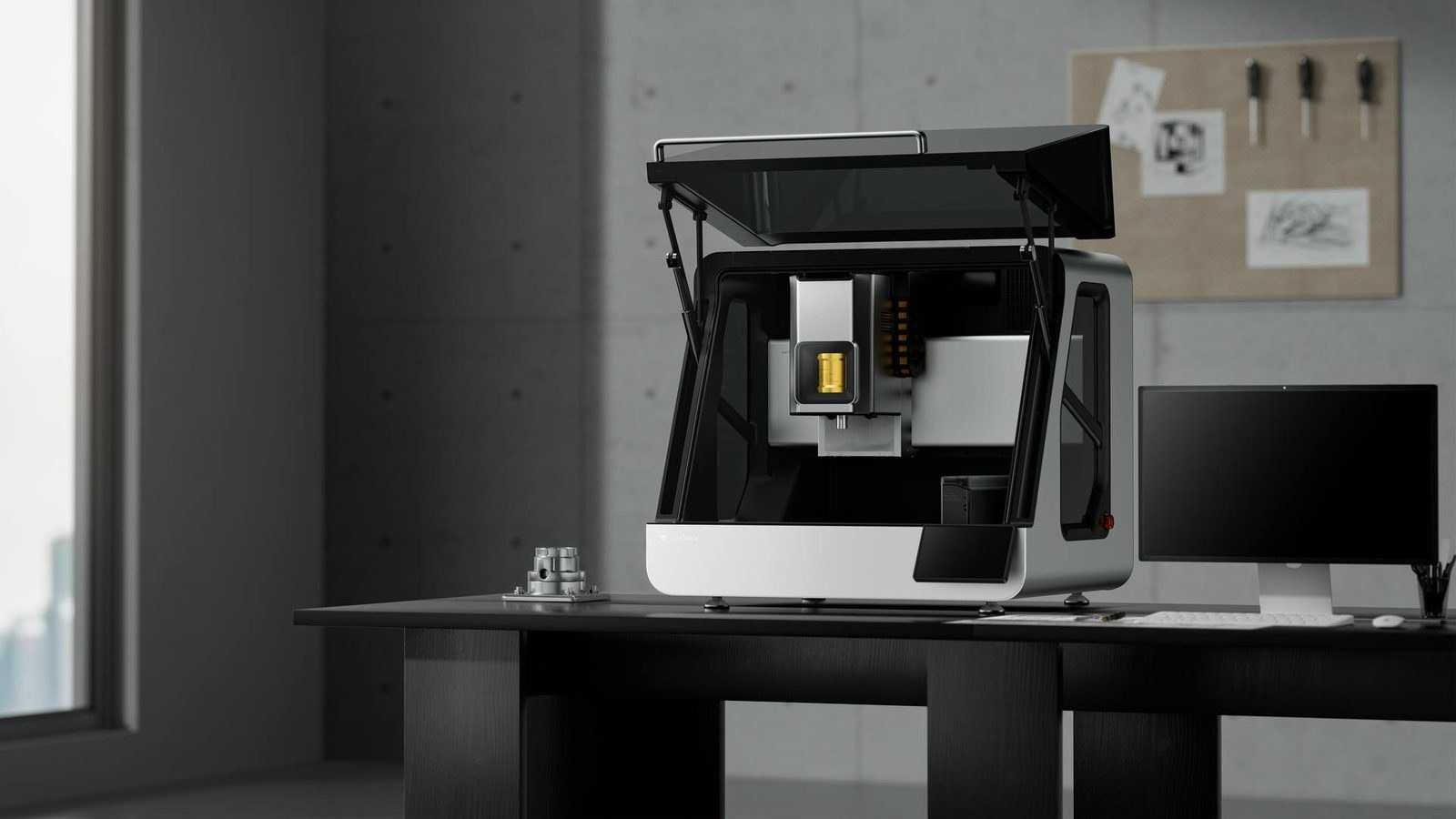
 f you spend any time scrolling through maker forums, you have likely endured months of targeted ads teasing a desktop machine that promises to bring industrial-grade metal cutting right to your workbench. That machine is now a reality, as the ToolDance X1 campaign just launched on Kickstarter. For anyone trying to decide whether to drop serious cash on a workshop upgrade, this release forces a very real question about whether desktop machining has finally grown up or if it remains an expensive toy.
The thesis here is simple: you are looking at a heavy cast aluminum alloy frame designed to punch well above its weight, but bringing a 110kg milling machine home comes with spatial and financial compromises that social media ads rarely mention. According to the report, the machine weighs 110kg and provides a working area of 400 × 265 × 180 mm without the automatic tool changer. That working space shrinks slightly once you install the tool changer, which can swap between nine different tools during a job as noted in the report. If your garage or spare room already doubles as a storage unit, finding floor space for a hundred-plus-kilogram block of metal is going to test your domestic diplomacy.
Power and Precision Under the Hood
Let us look at what you actually get for your money when it comes to raw performance specs. The spindle motor is rated for 1.5 kW and the max spindle speed is 24,000 RPM per the report. To put that in perspective, the report points out that a traditional 1,600kg industrial CNC mill in a garage can have a 1.5 kW spindle motor while topping out at only about 5,600 RPM. Getting that kind of high-speed rotation into a desktop form factor is genuinely impressive engineering.
The machine weighs 110kg
Motion control relies on preloaded ball screws on all axes paired with hefty NEMA 23 stepper motors, featuring closed-loop FOC with feedback from 14-bit absolute encoders according to the report. The RTOS-based motion controller runs at a deterministic 2kHz interpolation rate with a look-ahead capacity of at least 200 blocks in the g-code per the report. You also get features like automatic probing, a safety door lock, flood coolant, dust collection and air filtration, a built-in HD camera to monitor jobs, a touchscreen interface, and an MPG hand wheel for jogging as detailed in the report.
The Multi-Axis Pitch and the Catch
- The real selling point of the hardware is its modularity, letting you scale from 3 axes up to full simultaneous 5-axis capability.
- In the default configuration, it is a 3-axis machine, but you can add the 4-Axis Expansion Module for 4-axis and 3+1-axis indexed jobs, or the 5-Axis Expansion Module for simultaneous 5-axis and 3+2 jobs according to the report.
- Software support includes ToolDance Studio to import and verify standard G-code from third-party CAM, alongside direct plugins for Fusion 360, Siemens NX, and Mastercam per the report.
Yet the financial reality requires looking closely at the checkout page. In our view, paying five-figure sums for a crowdfunding campaign where the core utility depends entirely on whether you have a reinforced workbench and three phase power reveals a massive disconnect between marketing renders and real-world shop constraints. If you are running serious short-run production parts, you are still competing with established machine shops that amortize their tooling costs over decades. Skip the early bird hype unless your livelihood depends on milling aluminum parts in your spare bedroom.