
 very smart home owner knows the quiet dread of a battery dying in a door sensor at three in the morning. Chemical coin cells rule our automated lives, forcing us to stockpile spares just to keep track of who opened the back door. As noted by industry observers, this reliance on external power sources remains a fundamental vulnerability in home security. If a battery drops dead overnight, your carefully curated setup misses the intruder entirely.
Most home security sensors require a chemical battery or external power source to operate, which can be a point of weakness.
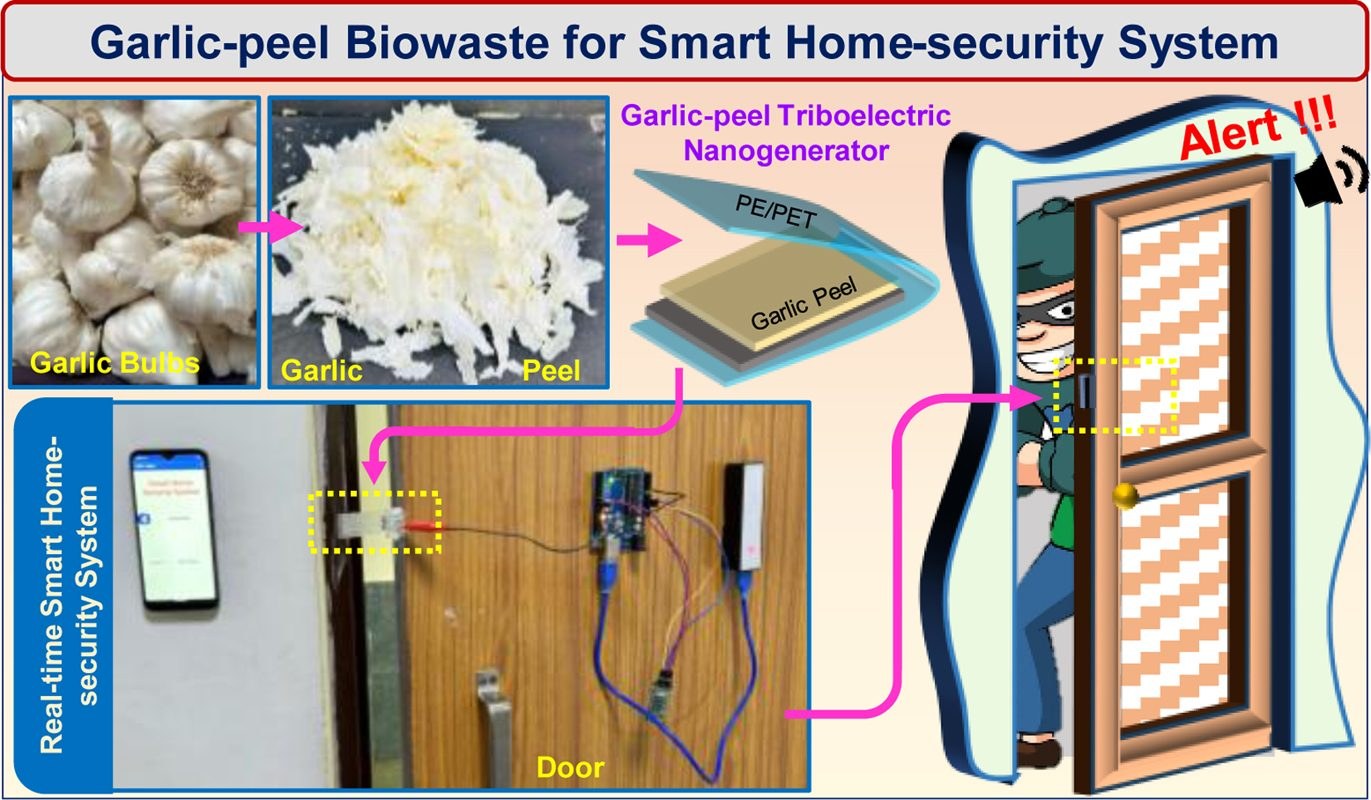
Here comes garage alchemy at its finest. Researchers Manas Tiwari and Deepak Bharti decided to bypass traditional chemistry altogether by building a self-powered door and window sensor driven entirely by the triboelectric effect—an electrostatic phenomenon you usually experience when rubbing a balloon against your sweater. As reports covering the findings detail, the sensor uses ground-up garlic peel for the positive side of this triboelectric nanogenerator, paired with a sheet of polyethylene forming the negative side to generate energy at every single opening.
Kitchen Scrap Power Generation
When installed on a door frame, the physical act of opening the door generates about 210 VAC with a 45 µA short circuit current, per the data detailed in the source. If you upgrade to a dual-side layer of garlic peel, that output bumps up to 400 VAC and 65 µA. It turns out your leftover kitchen scraps pack a surprising electrical punch when violently rubbed together by a swinging hinge.
The sensor uses ground up garlic peel for the positive side of this triboelectric nanogenerator, with a sheet of polyethylene forming the negative side.
There is a catch, of course, because garage prototypes rarely survive contact with reality intact. As installed by the researchers, the generated current actually fed into a separate microcontroller unit running off an auxiliary power bank, which completely defeats the purpose of cutting the cord on power sources. Still, the underlying physics show promise. The researchers reported that the sensor survived 200 stress cycles during testing and stayed fully functional after sitting in storage for half a year.
Do not expect to see garlic-powered security gear on store shelves anytime soon, as this technology remains firmly in the realm of academic experimentation and is far from the commercial market. For the everyday buyer, chemical coin cells are staying put for the foreseeable future. Yet this project points to a genuinely weird future where your smart home runs on vegetable waste rather than lithium imports, proving that alternative organic materials can generate real electricity from everyday friction.