
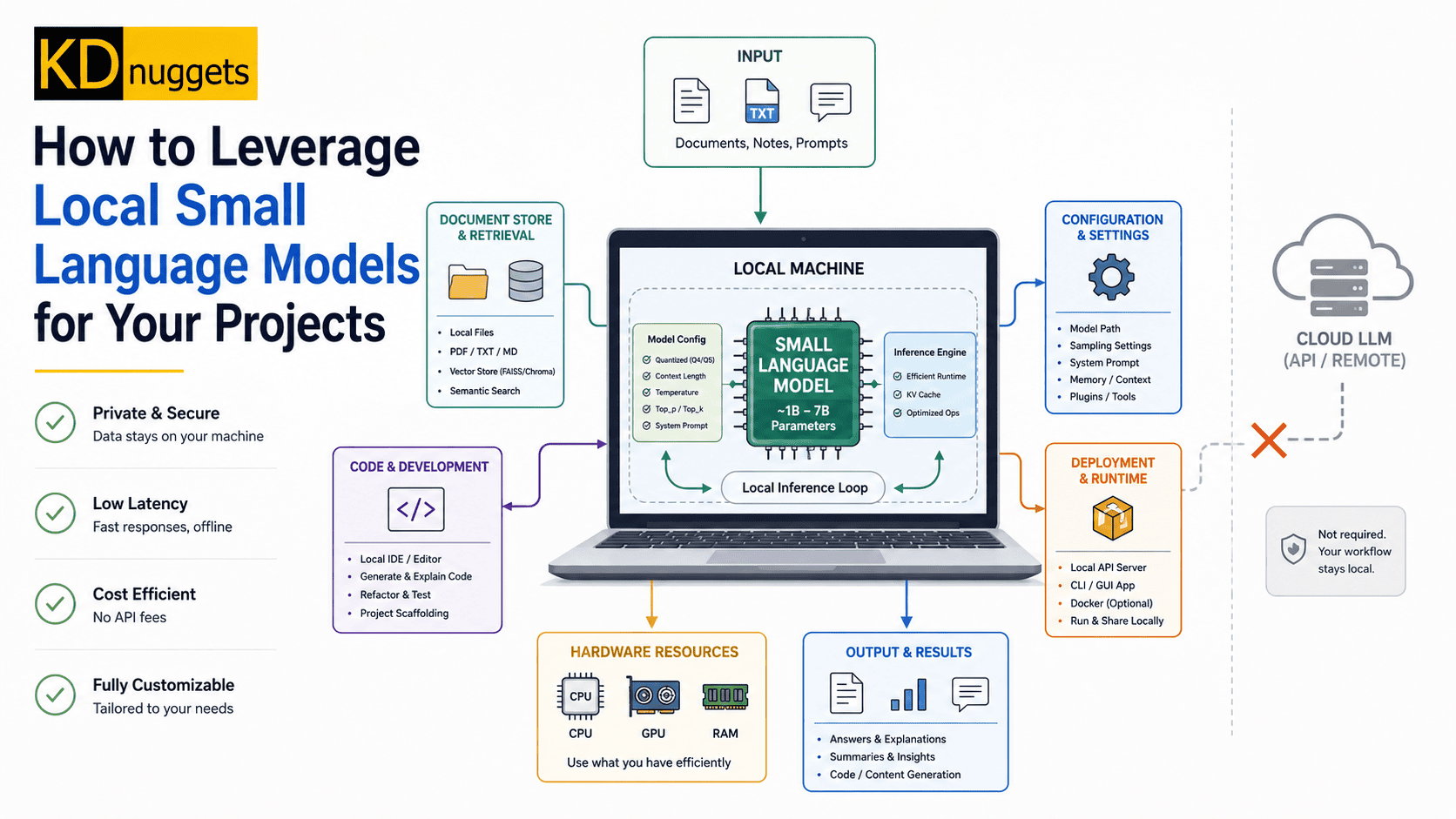
 or years, enterprise IT operated under the lazy assumption that bigger parameter counts automatically yielded better business outcomes. Teams routinely routed basic workflows through third-party cloud APIs, swallowing unpredictable latency, recurring per-token fees, and external data exposure as unavoidable overhead. That dogma is dead. Modern small language models (SLMs) ranging from 1B to 13B parameters have matured to deliver fast, highly specialized inference directly on consumer silicon without leaking proprietary corporate data.
Cutting Out Token Bills and Data Leaks
The financial upside of running SLMs locally comes down to cost predictability and perimeter security. Cloud API pricing scales relentlessly with throughput, turning routine internal tools into variable operational liabilities. Deploying local weights replaces recurring meter counters with sunk hardware costs, allowing internal teams to run continuous document extraction, search, and QA pipelines without financial friction.
When you run a model on your own machine, your prompts and outputs never leave your environment.
Self-hosted local inference eliminates third-party data transit entirely—a non-negotiable requirement for regulated industries handling proprietary source code, patient records, or financial data. Stripping out the network round-trip also slashes latency, delivering interactive responses and autocomplete streams that feel instant compared to queued remote endpoints.
Matching Parameter Count to Real Hardware
Ditching cloud subscriptions demands practical memory arithmetic rather than theoretical enthusiasm. Memory capacity—specifically Unified RAM on Apple Silicon or dedicated VRAM on discrete Nvidia GPUs—sets the operational boundary. A 7-billion-parameter model represents the practical sweet spot for consumer workstations, requiring roughly 8 GB of VRAM or system memory when running under 4-bit quantization (GGUF/AWQ). Scaling up to 13B models necessitates at least 16 GB of dedicated memory to sustain fluid token generation without memory paging.
Quantifying the Operational Trade-Offs
Local deployments do not render cloud frontier models obsolete. Compact on-device SLMs carry constrained context windows and struggle when handed open-ended, multi-step logical synthesis. If your workflow demands advanced mathematical reasoning across massive context, centralized hosted APIs remain necessary. But for high-volume text classification, routine code assistance, and localized knowledge base search, compact models operating on local memory beat hosted endpoints on cost, speed, and privacy every single time.