
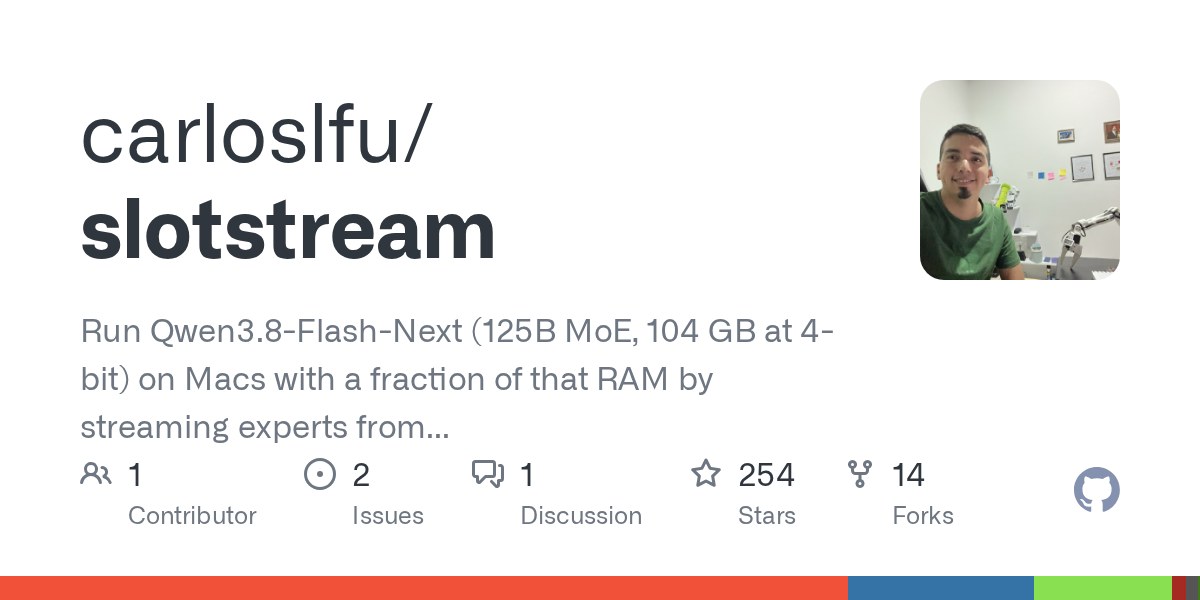
 unning massive artificial intelligence models on a consumer laptop has always hit Apple's notorious hardware paywall: unified memory limits. If an open-weights model weighed over 100 gigabytes, you had to own a workstation with at least 128 GB of RAM—which meant handing Apple thousands of dollars in absurd memory upgrade premiums. An open-source project called slotstream by developer carloslfu effectively flips that calculus on its head by streaming the heavyweight Qwen3.8-Flash-Next model directly off a fast internal solid-state drive.
How disk streaming beats memory bloat
The Qwen3.8-Flash-Next model is a 125B-parameter mixture-of-experts (MoE) network that commands roughly 104 GB of storage at 4-bit quantization. Normally, attempting to fire up a neural network of this footprint on a mid-range machine triggers immediate memory exhaustion, but slotstream alters the execution mechanics entirely.
The engine is MLX and Metal, and the memory design assumes unified memory: experts are read from SSD straight into memory the GPU already addresses.
Instead of parking the entire 104 GB parameter matrix inside unified memory, the utility keeps only a lean 3.8 GB core trunk permanently loaded. As text generation progresses, it dynamically streams individual MoE expert layers from the solid-state drive into a fixed pool of memory slots on demand. Because Apple Silicon leverages unified memory architecture, data shuttles straight from fast NVMe storage directly into GPU-addressable space without duplicated bus overhead.
Real measurements on consumer hardware
Real-world performance figures puncture the persistent myth that running hundred-gigabyte models requires enterprise-grade clusters. On a mid-tier MacBook Pro equipped with 48 GB of memory, developer benchmarks show engine initialization taking roughly 2 seconds, peak RAM consumption capping at just 32 GB, and sustained warm decode speeds hitting an entirely usable 12 tokens per second.
Local execution without enterprise clusters
Naturally, there are baseline hardware boundaries. You need an Apple Silicon Mac running macOS 14 or later and roughly 110 GB of unallocated disk space, setting a 512 GB drive as the practical floor. Crucially, the system ships as a self-contained Swift binary built directly on Apple MLX—zero Python dependency bloat—and natively exposes standard Ollama and OpenAI-compatible chat endpoints so drop-in tooling works out of the box.
Smart architectural engineering makes raw hardware overprovisioning obsolete for local mixture-of-experts workloads. You no longer need to burn enterprise budgets on top-tier 128GB+ Mac configurations or pipe sensitive proprietary data into third-party cloud infrastructure just to run capable hundred-gigabyte models at home. Disk-streamed execution turns massive local AI into everyday consumer reality.