
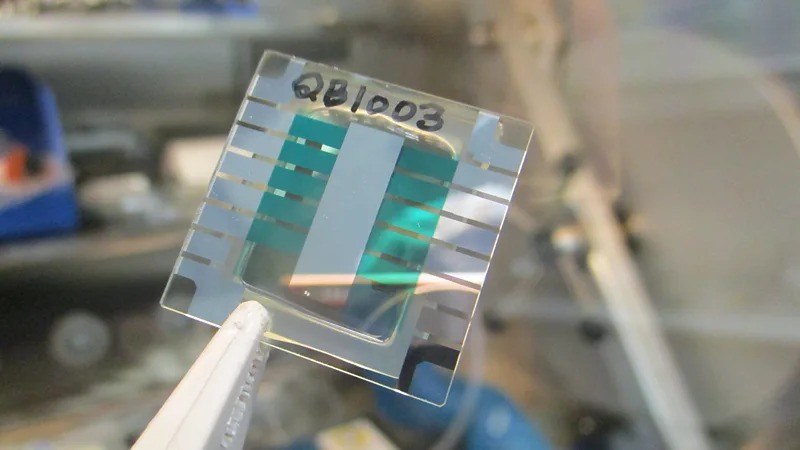
 he biggest headache in any pocket today is the standard lithium-ion battery. It takes frustratingly long to recharge, overheats under heavy loads, and inevitably degrades after just a couple of years of daily use. Physicists have now built the first working prototype of a so-called quantum battery that upends the fundamental logic of conventional electrical engineering. While a larger traditional battery takes longer to fill, the quantum realm works in reverse: the more storage cells linked together, the faster they absorb power.
Physics turned inside out
The laboratory prototype relies on superradiance—a quantum phenomenon that forces particles inside the storage cell to act in perfect synchrony as a single unit. A standard battery pack requires extra time and higher current to charge multiple cells simultaneously. In a quantum setup, collective particle coupling allows the system to absorb energy from a laser pulse in fractions of a second.
Adding more cells to the system does not slow down charging; it actually cuts the total recharge time.
In theory, this promises the exact breakthrough mobile users have been waiting for. Instead of half-hour charging sessions at the wall outlet, devices could achieve near-instant top-ups without messy chemical side effects. With no classic chemical reactions occurring inside, both excess heat and electrode degradation vanish. Such a power cell could easily outlive the smartphone itself.
The laboratory roadblock
Do not expect to buy a quantum power bank anytime soon. The working prototype is not a slim pouch cell fitted behind a screen, but a sprawling optical rig mounted on a specialized lab table. Maintaining particles in an entangled state demands precision laser arrays, ultra-high vacuum, and complete shielding from environmental interference, which instantly shatters fragile quantum coherence.
The real engineering roadblock is energy retention. Physicists managed to pump power in instantly, but safely storing that energy and releasing it steadily over several hours to a mobile chipset remains impossible. The technology is strictly confined to university labs, and commercial silicon implementations are still years of fundamental research away.
The experiment proves quantum supercharging works on real hardware rather than just on paper. However, the commercial reality remains unchanged: traditional lithium-ion packs and portable chargers will stay in our pockets for the foreseeable future.