
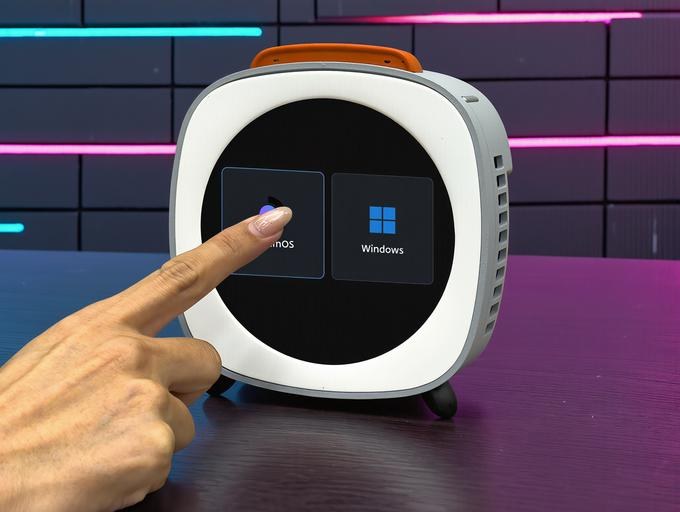
 unding is already heading into the hundreds of thousands of dollars for a case that looks like a cross between a vintage CRT television and a retro alarm clock. The Piston V mini-PC launched on Kickstarter and hit its funding goal almost instantly. Buyers are clearly tired of anonymous black boxes hidden behind monitors. The creators of the Piston V went the opposite route, designing a distinctly chunky desktop statement piece measuring 149 by 130 millimeters, complete with a front-facing four-inch touchscreen.
Why a PC Needs Its Own Screen
Practical utility drives this miniature display: it eliminates the guesswork at startup. Built for dual-boot setups running both standard Windows and SteamOS, it lets you switch environments effortlessly. Instead of blindly mashing keyboard shortcuts before the primary display wakes up, you simply tap the desired icon directly on the chassis.
Promotional material boldly compares the newcomer to Valve's iconic Steam Machine, claiming superior overall execution. Looking closely at the specs, the system packs a modern Ryzen AI 9 365 chip with integrated Radeon 880M graphics, 16 GB of RAM, and a modest 500 GB drive. While it offers more modern CPU cores, the dedicated graphical prowess of Valve's purpose-built hardware still holds an edge. However, the designers included a clear path for upgrades.
The Piston V features an OCuLink port, allowing users to hook up an external GPU and convert the unit into a full-scale gaming rig.
Technically minded users can pull off a similar trick with other hardware, but the Piston V comes fully loaded out of the box with Wi-Fi 7, Bluetooth 5.3, dual 2.5 Gbps Ethernet ports, a USB4 connector, and an external power brick. The result is a densely packed machine that avoids looking like generic office equipment.
Retro Aesthetics and Backer Risks
Early backers secured the base configuration for $590, while standard campaign pricing sits at $680. Retail prices will climb further, though final figures remain unannounced. The promise of December shipments sounds ambitious, and hardware crowdfunding always carries delivery schedule risks.
Buying the Piston V purely for benchmark records makes little sense, as traditional desktop builds offer significantly more performance per dollar. The appeal lies instead in unique aesthetics, a stable chassis that will not get dragged off the desk by heavy cables, and a functional front screen. For those seeking distinctive desk hardware, the design premium is easy to justify.
The campaign demonstrates strong demand for unconventional form factors and deliberate desktop ergonomics. Because quirky hardware typically arrives in retail channels with a steep markup, the $680 preorder makes sense for aesthetic-focused buyers. Everyone else should wait for December deliveries and initial user reviews.