
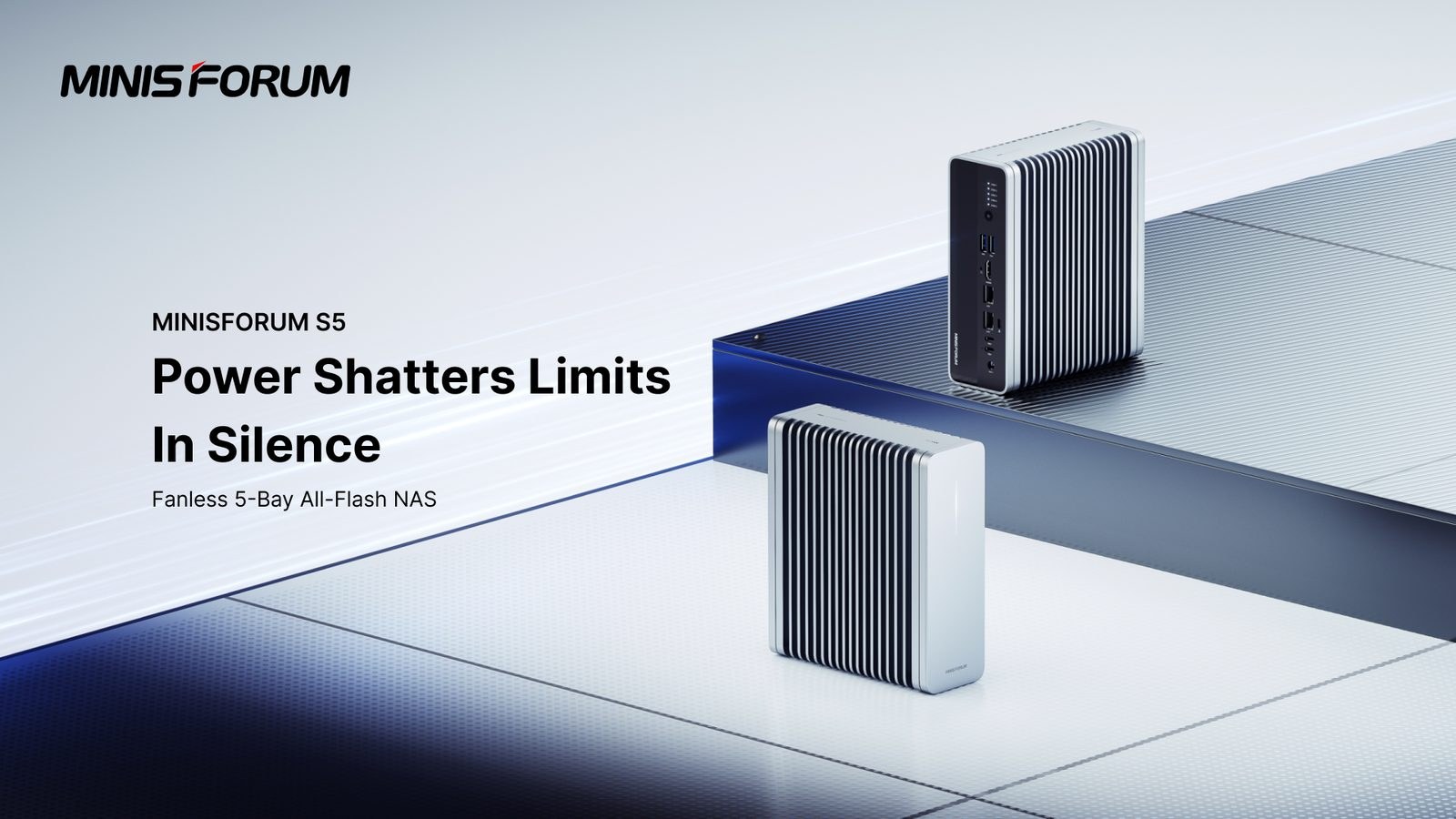
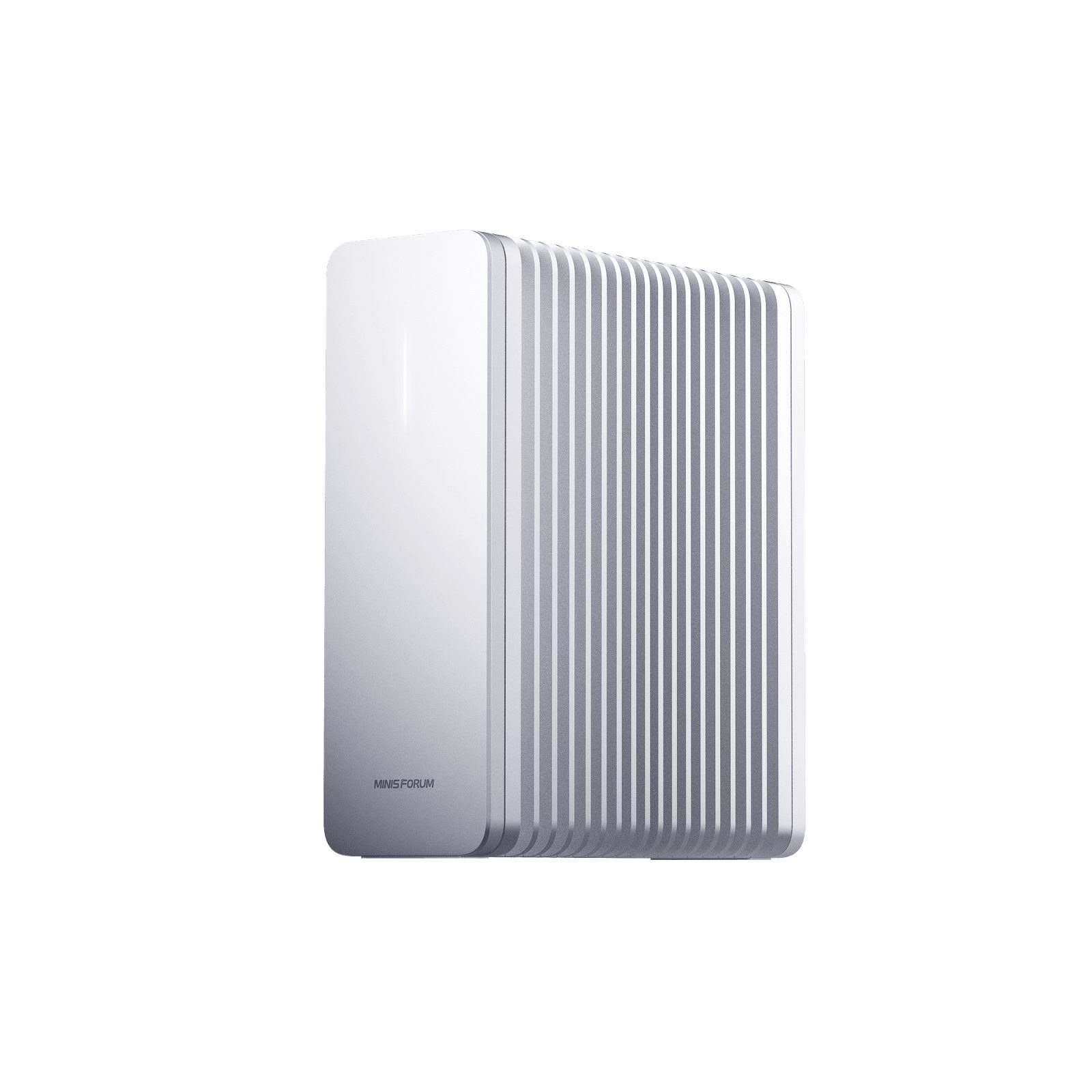
 raditional network-attached storage units sound like miniature jet engines taking off in your hallway. Minisforum's S5 offers an alternative for anyone who wants fast shared storage without the persistent clicking and whirring of mechanical hard drives. Instead of noisy fans, the system relies on internal heat pipes and cooling fins to dissipate thermal load passively.
Minisforum lists the bare-bones S5 at $599, discounted from its regular $749 price tag, which includes 12GB of LPDDR5x memory and 128GB of UFS storage. Its five M.2 NVMe slots support up to 40TB of solid-state storage, allowing owners to choose capacities that match their actual requirements rather than paying for a pre-bundled drive tier they might not want.
Under the hood, the S5 runs on Intel’s Core 3 304 processor with five cores and boost speeds reaching up to 4.3 GHz. According to Minisforum’s internal benchmarks, sequential read speeds can hit six times those of traditional hard disk drives, while random reads reach up to 100 times faster. Connectivity options include one 10GbE port, one 2.5GbE port, built-in Wi-Fi, and two USB4 interfaces supporting transfer speeds up to 40 Gbps. These ports let the S5 serve multiple users across a home network while connecting external storage devices and compatible peripherals simultaneously. In Minisforum's testing at a 25°C ambient temperature, the system's CPU drew about 15W of power under combined stress testing, though that measurement excludes total system electricity consumption.
Crunching the Numbers on Drive Selection
Online retail pricing provides a practical way to assess whether buying the barebone version beats the preconfigured 20TB model, which lists for $3,759 after a discount from $4,699. According to online retail listings, buying five budget-friendly 4TB SSDs like the Silicon Power UD90 costs $2,549.85, bringing the complete system total to $3,148.85. That combination saves $610.15 against Minisforum’s preconfigured 20TB option before accounting for local taxes, shipping fees, or additional hardware accessories. Stepping up to five WD Black SN850X drives raises the component cost to $3,022.45, producing a combined system price of $3,621.45 and a modest saving of $137.55 over the prebuilt equivalent.
However, choosing premium components changes the math entirely. Five Crucial T500 drives cost $3,995, pushing the complete system price to $4,594. That setup exceeds the preconfigured model by $835, though it still sits below the manufacturer's original undiscounted retail price. Buyers can mitigate these hardware costs by tracking retailer promotions, seasonal sales, and bundle offers before purchasing their storage media. Checking reputable sellers for refurbished or open-box drives can also trim expenses, provided the warranty coverage remains acceptable. Pairing discounted drives with the $599 barebone chassis widens those upfront savings without forcing compromises on total storage capacity.
The S5 also features an onboard NPU rated at 15 TOPS for INT8 operations, intended to handle local AI workloads alongside conventional file storage. Real-world applications for this hardware include running continuous background utility agents, maintaining shared creative project files, and streaming household entertainment libraries. Ultimately, the actual day-to-day performance of this device will depend heavily on the specific SSDs installed, the characteristics of your workloads, and how you configure the storage pool. For anyone ready to trade mechanical drive noise for silent flash storage, building out the barebone version requires careful component selection to ensure the final price tag undercuts prebuilt alternatives.