
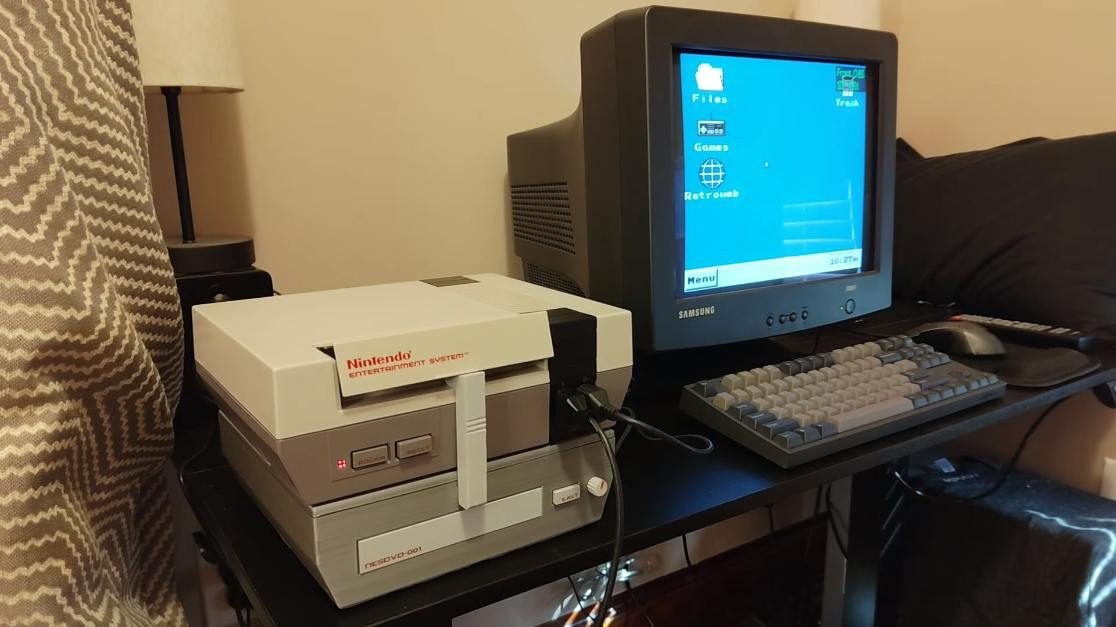
 an you actually turn a decades-old Nintendo console into a daily-driver desktop personal computer for web surfing?
According to the hacker project by Throaty Mumbo, you can pack a working desktop computer with browser access right inside the plastic shell of an original Nintendo Entertainment System (NES). If you are looking at dusty retro hardware in your closet and wondering if it can double as a modern workstation, the short answer is that it is a brilliant engineering stunt rather than a practical desktop replacement.
Under the Hood of a Modded Nintendo
Giving a console a second life usually means gutting it for parts, but this build keeps the original architecture alive in a surprising way. Throaty Mumbo previously gave the original Nintendo Entertainment System the CD drive it never had and never needed. That project proved that unlike optical discs used in systems like the PlayStation, where a disc is just passive storage loaded entirely into system memory, NES game cartridges work differently. A cartridge in an NES becomes an active part of the system hardware, and the central processing unit interacts with it directly to run games straight from the chip without pre-loading them into memory.
To trick the console into acting like a desktop computer, Throaty Mumbo turned once again to the Everdrive N8 Pro. That component uses a field-programmable gate array to reproduce the full hardware of a cartridge, passing display output through the cartridge connector to the NES central processing unit and receiving controller inputs back. Running a desktop operating system on retro hardware sounds impossible until you look at how the processing load is handled. The operating system is a custom Linux distro running on an x86 processor built to run on the Everdrive N8 Pro’s field-programmable gate array, replacing the traditional game cartridge entirely. That setup provides enough processing power to run a usable operating system, while the original NES hardware handles basic input and output.
The operating system is a custom Linux distro running on an x86 processor built to run on the Everdrive N8 Pro’s field-programmable gate array, in place of a game.
Connecting modern peripherals required some clever hardware gymnastics. Throaty Mumbo went through a complicated process of connecting a USB keyboard and mouse through a special adapter with a Nintendo Entertainment System cable on the other end. While the console natively expects a single byte representing standard controller button states, the adapter feeds characters and mouse movements over the same physical connection. The custom operating system on the field-programmable gate array reads the incoming data cleanly, bypassing the console's native limitations. With the addition of a Wi-Fi adapter, Throaty Mumbo built a complete usable personal computer inside a vintage shell, directly answering whether old hardware can run a daily browser session.
What This Means for Your Desk
Before you throw away your modern laptop, remember that console hardware comes with severe modern compromises. It is still limited by the Nintendo Entertainment System graphics capabilities, resulting in low resolution and color depth, which leaves web surfing looking like a harsh 8-bit experiment.
This project is an astonishing feat of hardware modification that bridges four decades of computing in a single plastic box, proving that if you have staring at your old dusty retro hardware and wondering if it can double as a workstation, the answer remains a hard engineering curiosity rather than a desk upgrade.
Editorial analysis
We have written about this before: September 6 — instead of cluttered digital maps, you get a clean, retro 8-bit radar sweep visualizing actual aircraft in real time on hardware built four…; October 13 — a Panasonic VCR connected to a microcontroller capture card delivered a mere 3 frames per second and rendered colors incorrectly. Throaty Mumbo's build follows the same logic of garage experiments by fitting a functional Linux desktop inside the iconic grey chassis. Four decades after its debut, the grey Nintendo box has shifted from a home console into a playground for hardware stunts rather than a sensible workspace.
We covered this: September 6, October 13