
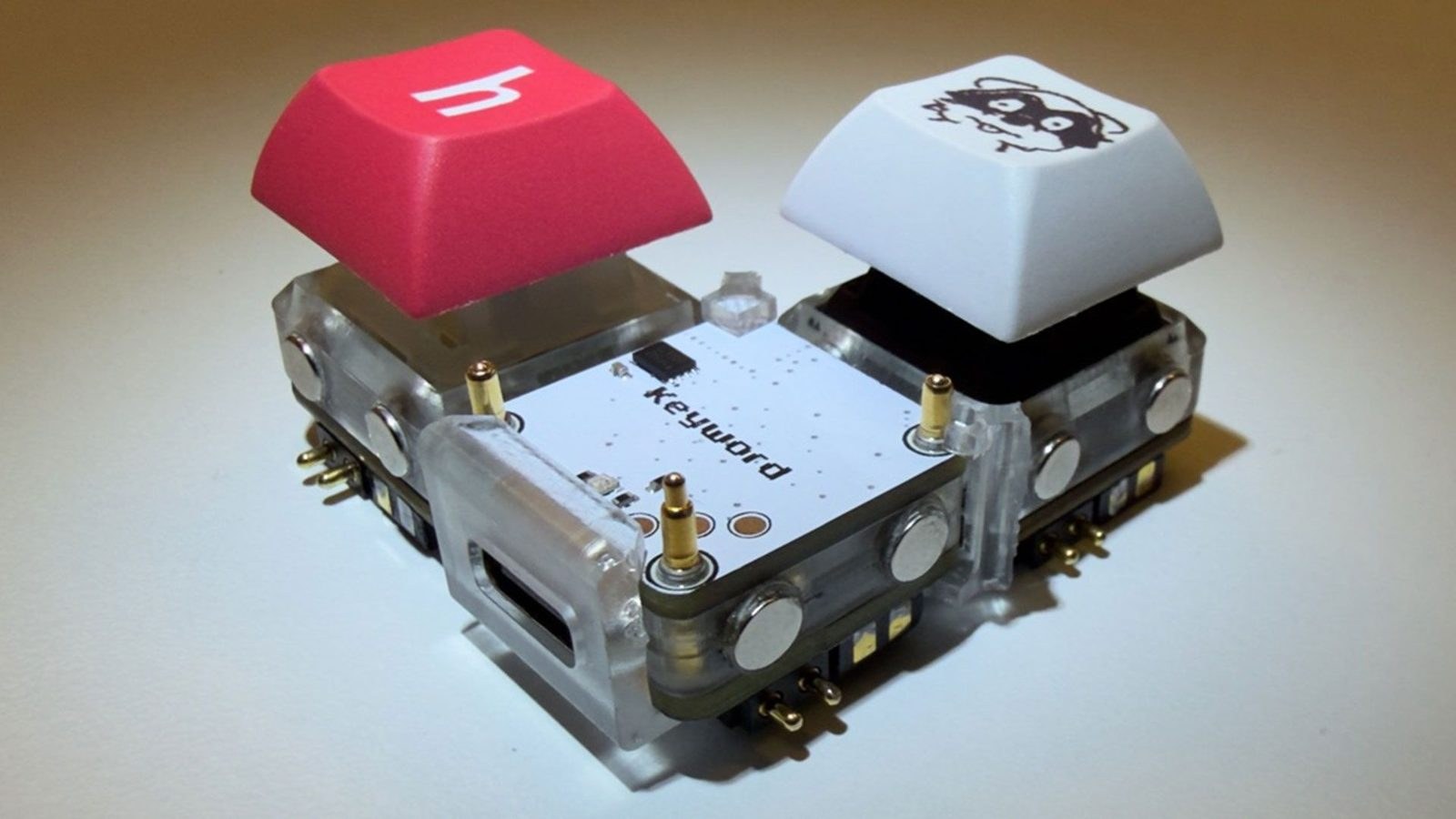
 hen you want to build the keyboard of your dreams, you usually pick out custom cases and switches from China. An architecture with a separate microcontroller (the tiny chip that controls the device's logic) in every single button turns keyboard customization into a hundreds-of-dollar engineering project, where the freedom to build any shape bumps into a skyrocketing price tag for the finished device because of redundant microelectronics in every key. The Keybytes project proposes building peripherals out of individual magnetic keys called Keybit, each equipped with its own RISC-V microcontroller (an open-architecture chip design), as developer notaroomba, also known as Nathan Alspaugh, explains.
A central hub called Keyword connects to these keys through pins and magnets, allowing for arbitrary configurations that look like Lego blocks, as developer notaroomba, also known as Nathan Alspaugh, notes. The central component holds a pair of circuit boards (the fiberglass plates with copper traces that connect electronic components), where the top board carries an Arm Cortex M4 microcontroller, a Bluetooth antenna, and flash memory, and the bottom board handles the USB-C port, charging, and power conversion, according to the project's technical description.
Alspaugh actually mentions that he priced out a "full-sized keyboard (2 keyboard modules and about 110 key elements), and in assembled form it will cost about 900 dollars."
Each individual Keybit key contains a CH32V003 RISC-V microcontroller and spring-loaded pins on all four sides to transfer power and I2C bus signals (a standard protocol for communication between chips), as stated in the project documentation published on GitHub. The modules have a standard 1U size of 19.05 by 19.05 millimeters and magnets on the sides to snap together, while Cherry MX mechanical switches are installed on top, according to the project materials.
Should you bother with the modular constructor
The project has existed since March of this year, and the author has already posted all the necessary files and blueprints as open source on GitHub under a permissive MIT license, as Nathan Alspaugh, who is an MIT student, recounts. However, you will have to pay for this freedom of shape not just with money, but with a massive amount of manual labor ordering circuit boards, soldering components, and 3D-printing cases for each individual element.
On top of the nine-hundred-dollar price tag for a full version with one hundred ten keys and two Keyword hubs, an interesting detail emerges regarding backlighting: while the central hub is equipped with a status LED, the Keybit keys themselves lack any backlighting at all, as the developer points out in his dev log. Those who want the illumination typical of gaming keyboards or extra controls like scroll wheels and fingerprint scanners will have to wait for a hypothetical second version of the device.
A full-sized build of one hundred ten buttons costs about nine hundred US dollars, making this invention a niche toy for enthusiasts with a soldering iron rather than a replacement for standard mass-market peripherals for the average buyer. The project was released to the public in March of this year.