
Premium Tech for Pocket Money
 f you want an advanced bipedal robot today, your choices usually boil down to two terrible options: spend thousands of dollars on industrial testing rigs or stare at Disney's Star Wars BDX Droid wandering around theme parks with zero chance of ever taking one home. Pollen Robotics, operating under AI heavyweight Hugging Face, just tore down that artificial paywall. The team opened pre-orders on August 27 for Microduck, a 25-centimeter-tall, roughly 1.7-pound bipedal robot duck priced at an introductory $399, with retail deliveries promised by Christmas.
That price tag is genuinely aggressive considering the hardware packed inside the plastic shell. Instead of the hollow motorized novelties clogging retail shelves, Microduck arrives fully pre-built with 15 degrees of freedom—meaning 15 separate motorized joints governing how it bends, turns, and steps, completely eliminating the need for soldering or DIY assembly.
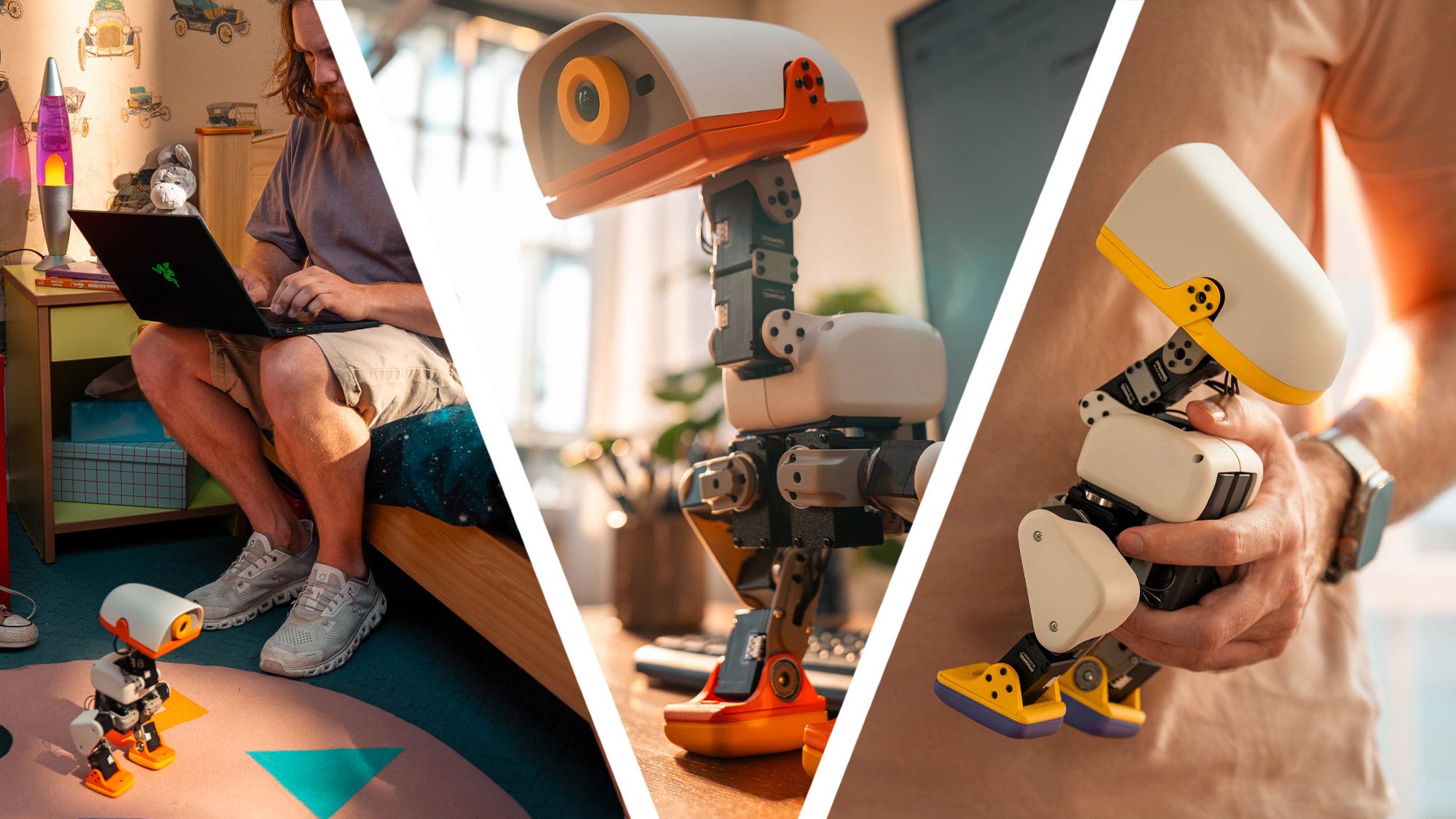
Microduck is an educational robot that arrives with surprising mobility, balance, and personality.
It features a motorized beak that doubles as a mechanical gripper, integrated microphones, speakers tuned for quacks, and a single-eye camera paired with a legitimate Lidar sensor for room mapping. Dual inertial measurement units and roller-assisted foot mounts keep the machine balanced on two legs, allowing it to walk, waddle, nod, and recover after taking a tumble.
The Open-Source Trade-Offs
To hit that $399 price point, Pollen Robotics made pragmatic compromises under the hood. The unit runs on an entry-level Rockchip RK3566 ARM processor paired with 1GB of RAM and 32GB of internal storage. Connectivity covers standard Wi-Fi, Bluetooth, and NFC, while a modest 2,600mAh battery delivers roughly one hour of active runtime before needing a recharge. That silicon setup resembles a budget tablet from years ago, but it packs enough compute to manage local navigation and pre-trained behaviors without driving production costs into four digits.
Crucially, this is not a locked corporate sandbox. Pollen Robotics provides an open-source software stack complete with virtual simulation environments, ready-to-run training scripts, and an established sim-to-real workflow.
Microduck delivers a needed reality check to an educational robotics market overrun by overpriced evaluation boards and proprietary plastic toys. It cuts past tech demo hype and hands buyers a fully functional, programmable bipedal machine with real Lidar navigation straight out of the box for four hundred bucks.