
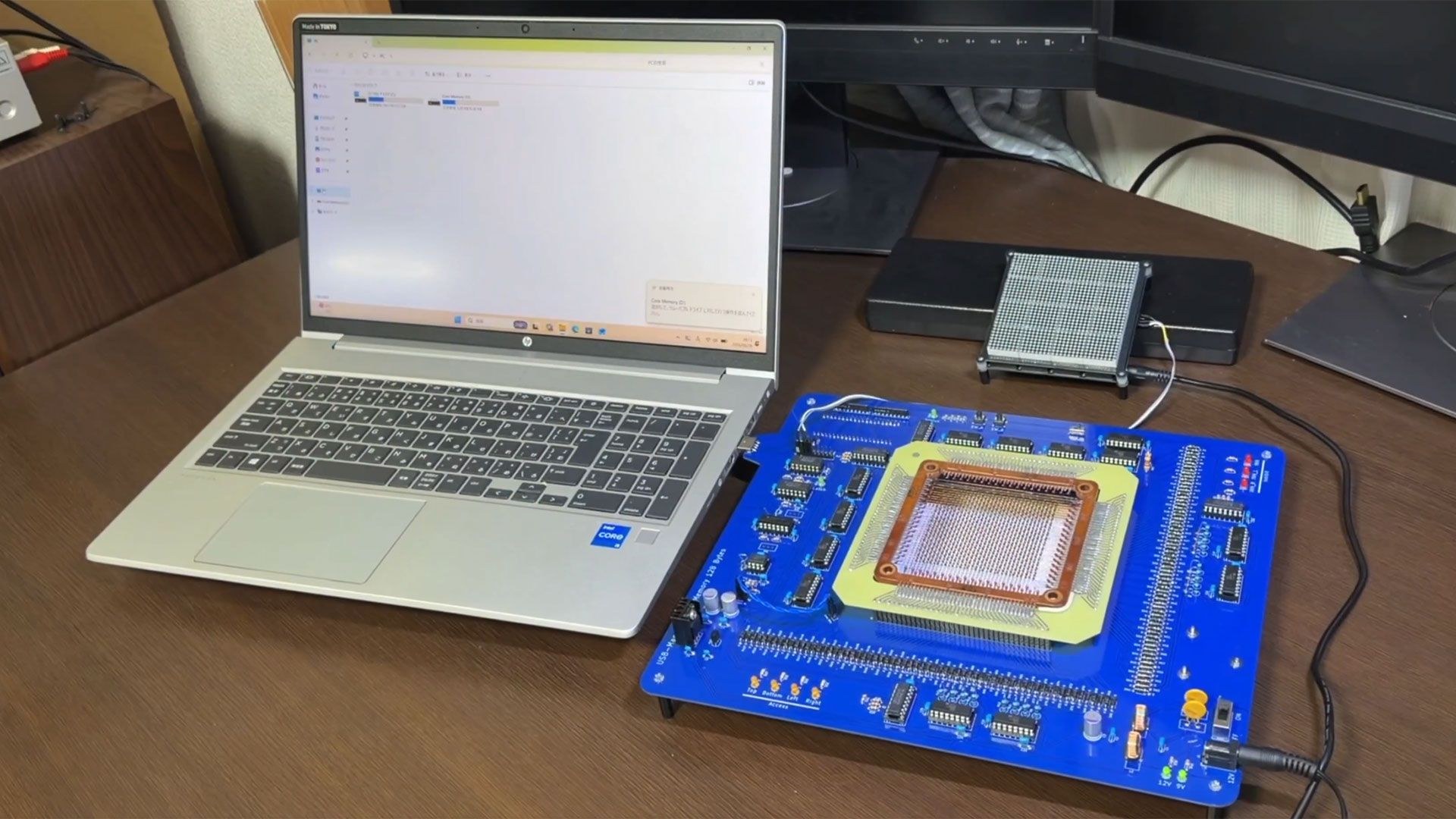
 f you think your keychain flash drive is too easy to lose at the bottom of a bag, Japanese space science researcher @dydt_Nao has engineered the ultimate antidote: a 30-centimeter square circuit board that holds barely enough data for a couple of sentences. As documented by Tom's Hardware, this homebrew contraption revives archaic magnetic core memory—the foundational tech behind early mainframes and Apollo-era computing—to physically shuffle files between PCs over standard USB Type-A.
To move a file, you plug the dinner-plate-sized board into a computer, write the data, physically haul the hardware across the room, and plug it into another machine. While modern solid-state drives pack terabytes into microscopic silicon dies, this DIY project tops out at a microscopic 128 bytes. That is not gigabytes, megabytes, or even kilobytes—just 128 raw bytes of storage.
Glowing Cores and Disposable Reads
The underlying physics trace directly back to MIT engineer Jay Forrester, whose work established magnetic core memory as the dominant random-access storage standard for two decades. The recreation by @dydt_Nao bridges vintage physics with modern monitoring by adding a 32 x 32 LED matrix that pulses bright red in real time as data shifts across individual magnetic rings.
"Every LED corresponds to an individual magnetic core."
Watching raw bits flip visually demystifies data storage, but it also underscores why computing abandoned the format. Beyond the massive 30-centimeter footprint, magnetic core memory relies on destructive reads: reading the state of a bit flips it, immediately wiping the stored data unless it is instantly rewritten. An onboard Raspberry Pi Pico microcontroller manages the communication and USB protocol translation, which explains why Windows misinterprets the hardware as a 6.5KB storage device.
Pushing 128 Bytes to the Absolute Limit
Despite the extreme hardware constraints, @dydt_Nao pushed the setup beyond raw text snippets in Notepad. In a follow-up demonstration, the researcher transferred a monochrome BMP image measuring 32 x 28 pixels across the USB link, squeezing the payload into the remaining storage after the mandatory bitmap header claimed the first few bytes.
Nobody is going to ditch modern flash drives for a fragile, foot-wide board that self-erases during every read cycle. But in an era where modern storage is locked inside opaque, black-box silicon chips, projects like this offer something no multi-terabyte SSD can: a tangible, glowing demonstration of computer memory in action.