
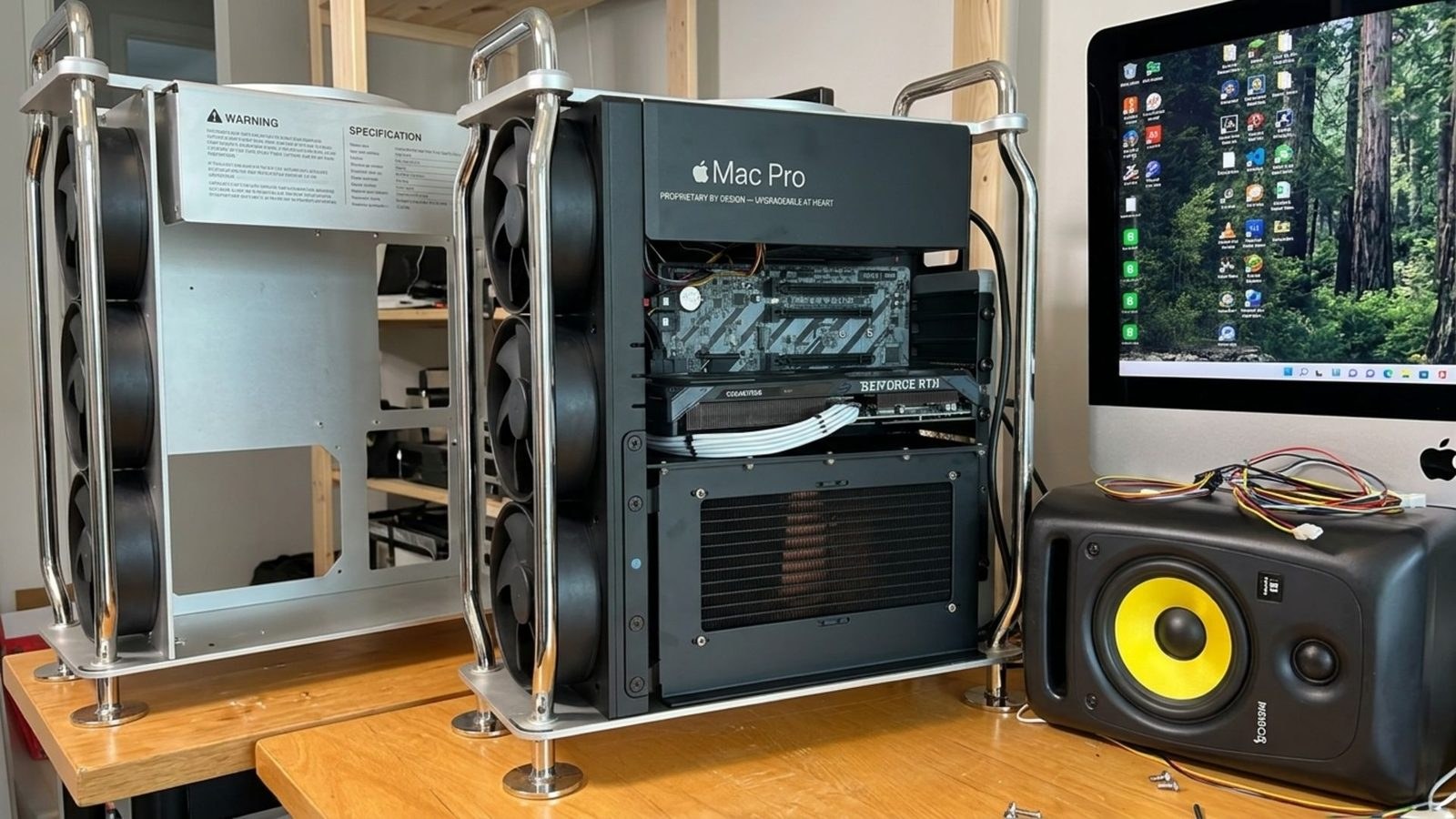
 ow do you turn a famous computer case from Apple into an ordinary desktop system unit when the conversion kit costs around five hundred dollars?
An enthusiast is seeking crowdfunding support for a conversion system that would let owners reuse Apple's 2019 Mac Pro enclosure with conventional desktop PC components.
Instead of buying a brand new enclosure from a typical PC brand, the owner of a dead or obsolete professional workstation gets a chance to keep that premium metal chassis and its factory cooling setup while stuffing modern components inside.
Looking at the wider resale market for the 2019 Mac Pro helps explain why anyone would bother with such an expensive conversion. Fully functioning older configurations with Intel Xeon processors and enterprise graphics cards have dropped sharply in value as Apple shifted its entire professional lineup to custom Apple Silicon chips. Many owners find themselves stuck with an expensive, heavy machine that can no longer run modern software updates efficiently or receive adequate hardware support, yet the exterior aluminium tower remains a masterpiece of industrial design. Buying an intact, second-hand 2019 Mac Pro solely to gut its chassis and rebuild it from scratch might seem counterintuitive when the resale value of a working used machine still sits significantly higher than a standard PC case. However, for studios and power users who already own a retired unit collecting dust in a corner, recycling the iconic shell offers an appealing alternative to letting a several-thousand-dollar piece of hardware gather dust or get sold for pennies.
What actually comes in the box and what parts you still have to buy
The creators plan to ship a custom mounting plate for a standard power supply and motherboard, two storage drive cages, necessary cabling, fasteners, and small printed circuit boards for the front I/O panel. The kit supports standard ATX motherboards, regular power supplies, and graphics cards up to 308 millimetres long and 140 millimetres high. Users can install air coolers up to 140 millimetres tall or liquid cooling loops with radiators up to 240 millimetres long.
The package also keeps three original front cooling fans operational through custom adapter boards, alongside the power button, status indicator, and two USB-C ports with USB 3.1 Gen 1 speeds on the front panel. However, buyers must supply their own motherboard, processor, graphics card, RAM, power supply, storage drives, and cooling system, which will add a hefty sum on top of the kit's price.
Crowdfunding pitfalls and why this project is not for everyone
This highlights the genuine market appetite for complex hardware modifications where buyers must risk their own cash on a crowdfunding platform without retail guarantees.
The installation demands serious hardware skills and the complete removal of all factory internals, meaning the build suits experienced system builders only. Once the process is finished, the original enclosure remains undamaged, allowing a user to put the stock parts back in later if they change their mind, but you will still need to measure your graphics card twice before ordering anything.
Such conversions remain a playground for enthusiasts with a soldering iron and plenty of spare time rather than a practical way to save money on an upgrade. Sinking five hundred dollars into an adapter kit, tracking down compatible parts, and spending hours retrofitting modern hardware inside a legendary Apple machine ultimately demands a heavy commitment of both patience and money.
Editorial analysis
Instead of spending thousands on a brand-new workstation, builders can now turn an old 2019 Mac Pro enclosure into a standard PC using a $500 conversion kit. In late August we noted that Apple's entry-level M6 Mac Mini jumped to $899 while the Mac Studio gained the four-die M5 Ultra powerhouse. The modding package lets owners retain the original aluminum frame and factory cooling setup while filling the interior with off-the-shelf PC parts. Saving a five-year-old aluminum cheese grater from the scrap heap now costs as much as an entire functional entry-level computer.
We covered this: August 25