
 arly pricing for the Arrowspace S1 starts at $119, offering a glimpse into what happens when a toolmaker decides your workbench needs an intelligent upgrade rather than just another motor. For five years, Arrowmax has been building screwdrivers that watch your wrist or stretch output to 10 kgf·cm with a manual fallback for stubborn screws, yet the obvious next question remained why the tool still had no idea what screw it was holding.
As Arrowmax explained, the Arrowspace S1, built by the same team under a new brand name, answers that with a camera on the tail end of the screwdriver, turning the tedious ritual of hunting for matching fasteners into an automated process. The smart case then lights the slot of the matching bit, and Auto mode picks a safe torque for that fastener while keeping the 10 kgf·cm ceiling of the previous generation for everything from earbuds to e-bike parts.
Hardware Solves What Code Cannot
The camera sits at the rear of the S1 right behind a small contact probe, and the two work as a team because you rest the probe on the screw head to lock the lens at one fixed distance so every shot lands sharp. A screw this small turns to mush if the camera drifts even 1mm, and Arrowmax fixed that blur problem with a metal pin instead of more code, which is a very hardware-person way to win an argument and means recognition survives a messy bench and shaky hands.
Once the shot is sharp, the driver sends it to the companion app on your phone, which works out the drive type and exact size through a YOLO object detector trained on tens of thousands of real screw photos covering 12 common head profiles. Everything runs locally with no internet involved, so your screw photos stay on your phone, and the app shows the actual camera image next to the verdict so you can judge the call yourself while motor control, torque, and the displays work on their own.
The Case That Points the Way
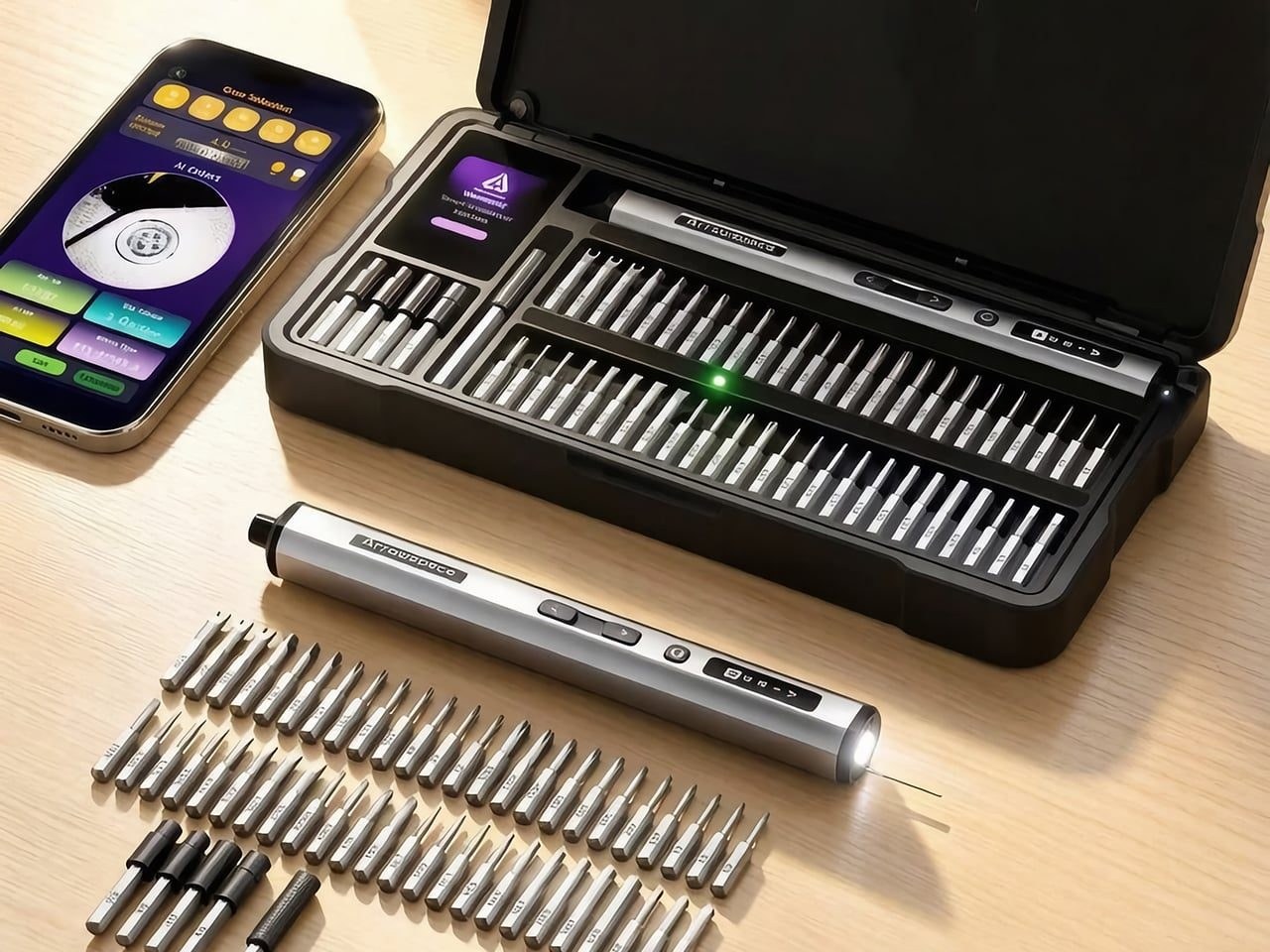
The smart case turns the app's verdict into something you can see across the bench with a 2-inch TFT screen showing the recognized screw type and size while an LED glows under the slot holding the matching bit. The kit includes 52 S2 steel bits hardened to HRC60 to keep tips from rounding off, extended bits to reach screws buried in deep holes, and a magnetic holder to keep everything seated while you work.
A 2-inch TFT screen with Arrowspace’s purple interface shows the recognized screw type and size, while an LED glows under the slot holding the matching bit.
Compare that with the usual ritual of squinting at tiny codes on dozens of near-identical shafts, and the old way starts to look like a part-time job, packed inside a CNC-machined frame in aerospace-grade aluminum with EVA protection.
Torque Control and What Comes Next
Electric torque runs from 1 to 10 kgf·cm, where low settings suit earbuds and smart bands, 3 handles laptops and camera bodies, 6 covers RC cars and game consoles, and the full 10 handles e-bike parts, while Auto mode matches a conservative preset to the identified screw and remembers your last setting. When electric mode runs out of muscle, the S1 switches to manual on its own through a mechanism rated for 30 kgf·cm of hand-twisted force, while a 600mAh LiPo battery covers 900+ screws or 90 minutes of continuous use before refilling via USB-C in roughly 70 minutes.
Why it matters
A simple metal contact probe on the back of the Arrowspace S1 captures the practical difference between deliberate hardware design and software bloat. Instead of overcomplicating camera autofocus algorithms, the engineers used a mechanical stop to guarantee crisp fastener photos for on-device recognition. Linking a vision sensor with a smart lighted case eliminates tedious bit hunting across dozens of slots, while the motor itself retains standard torque ratings. The price premium above ordinary precision drivers buys back the bench time spent guessing screw sizes.