
 f you have ever tried to scroll through a feed or answer an email from the passenger seat of a moving car, you know that immediate wave of nausea. The culprit is a textbook sensory conflict: the fluid in your inner ear signals rapid acceleration, while your eyes remain anchored to a completely static glass panel. Your brain misinterprets this physical mismatch as a toxic disorientation, triggering a visceral urge to throw up.
Rather than forcing commuters to buy acupressure bands or pop dimenhydrinate pills before a rideshare, smartphone makers are turning to software tricks. Apple pioneered the approach with Vehicle Motion Cues in iOS 18, and Google has spent months testing its own Android equivalent, dubbed Motion Assist. Now rolling out, the feature aims to eliminate motion sickness simply by manipulating peripheral vision.
How floating dots fix nausea
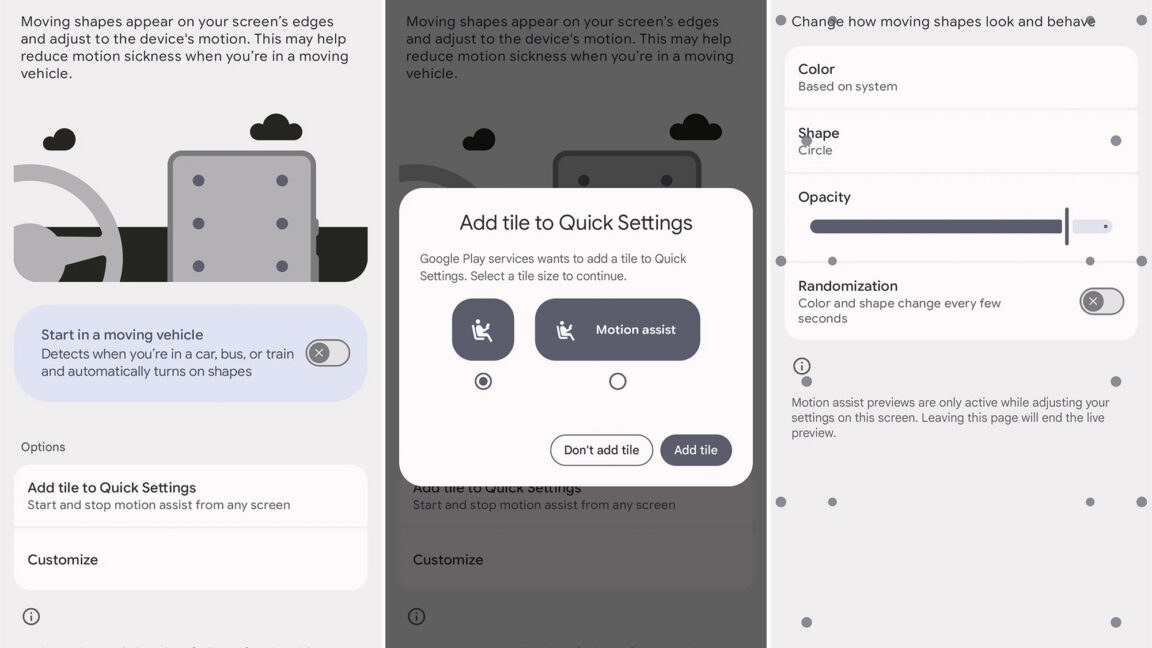
Motion Assist overlays subtle floating markers along the edges of your display. By tapping into your device's built-in accelerometer and gyroscope, the software tracks the vehicle's physical inertia in real time. Accelerate forward, and the dots stream downward; swing around a sharp right turn, and the markers glide left. This simple visual cue feeds the peripheral vision the kinetic reference point it craves, synchronizing what your eyes perceive with what your inner ear feels without demanding your full visual attention.
Google’s version of this feature also includes a few customization options, letting you change the shape, size, color, and opacity of the anti-nausea dots.
You can pin the feature to your Quick Settings panel, configure it from system menus, or configure automated detection that kicks on as soon as vehicle sensors register motion.
Who actually gets the update
According to findings from Android Authority, Motion Assist has surfaced on Google Pixel hardware running Android 17. Because Google is distributing the capability via staged Google Play Services updates rather than a standalone app, users cannot manually force the installation. For eligible devices, the toggle sits under Settings > Google (All services) > Personal & Device safety.
While early testing spanned broader Android test builds, Google has not confirmed whether older releases or third-party brands will get universal access. For daily commuters prone to car sickness, it is one of the rare software additions that delivers immediate physical relief—assuming your handset makes Google's rollout cut.