
 f you were hoping that PC memory prices would drop anytime soon, there is bad news ahead. Memory giant SK hynix has hit an engineering bottleneck with high-bandwidth memory (HBM) for AI servers, postponing its shift to direct die-to-die hybrid bonding until at least the next generation. That decision directly affects anyone looking to build or upgrade a personal PC.
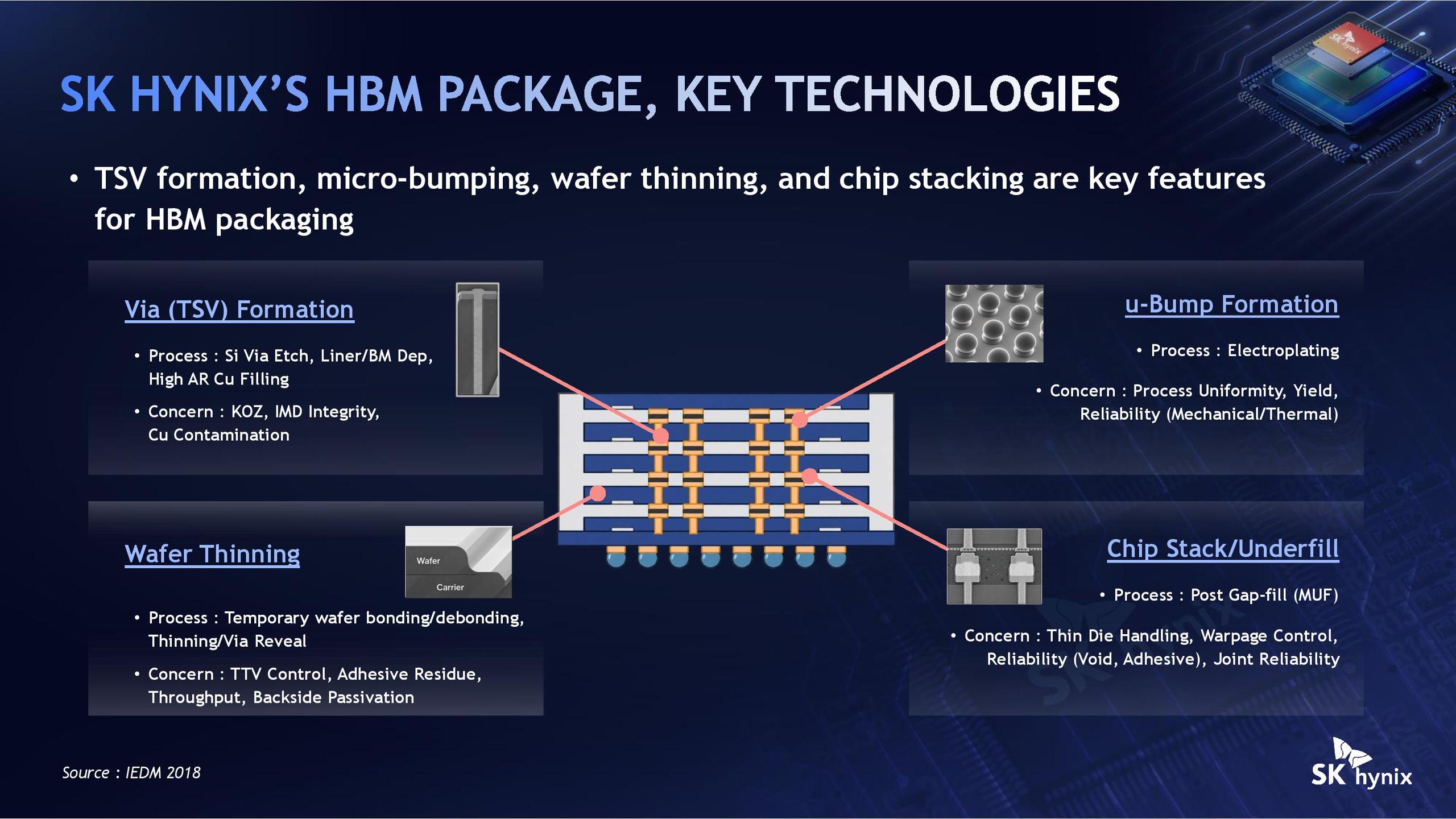
Speaking at the Hot Chips conference, Jesik Lee, VP of SK hynix America, revealed that engineers ran into strict physical limits. The total height of an HBM stack cannot exceed 775 microns—the thickness of a standard silicon wafer. If a module is even a fraction of a millimeter thicker, liquid cooling blocks on enterprise accelerators cannot make uniform contact with the processors, leading to overheating and hardware failure. Squeezing 16 memory layers into this envelope for upcoming Nvidia Rubin-class accelerators requires grinding silicon layers down to a razor-thin 50 microns each.
This extreme thinning introduces severe thermal challenges: insulating materials struggle to dissipate heat, and stack-level thermal output has more than doubled across recent generations. Rather than taking a gamble on fluxless hybrid bonding—the route rival Samsung is pursuing—SK hynix chose to stick with proven soldering methods. However, refined legacy packaging consumes massive amounts of cleanroom space, precision machinery, and production time.
What this means for you
- Pricing: Retail DDR5 RAM kits will remain expensive. Chipmakers are aggressively reallocating silicon wafers, advanced packaging lines, and fab capacity toward lucrative AI server memory. As long as AI chips command massive margins, consumer PC builders will pay a premium for whatever fab capacity is left.
- Timeline: Relief in memory pricing is unlikely before 2026 or 2027, when the semiconductor industry finally stabilizes next-generation HBM5 manufacturing.
- Real-world hardware impact: Your desktop or laptop will not feel the architectural pinch directly, since consumer PCs do not use stacked HBM. The ripple effect hits purely at the checkout counter: everyday consumers are footing the bill for the AI industry's manufacturing bottlenecks.