
 magine a classic stroke of pure luck: you inherit two old mining rigs packed with hardware, and you get the whole lot for next to nothing. That is exactly what happened to a Reddit user who scored two legacy setups loaded with twelve RTX 3070 cards. Inside was a fortune for any gamer, which had spent years sitting in some rather specific conditions.
Here is a simple and cynical thesis: while the market scares us with mining horror stories, reality turns out to be far more boring. The hardware spent several years in a basement — dry and clean, with no extreme nonsense, and in the end, almost all of it held up quite well.
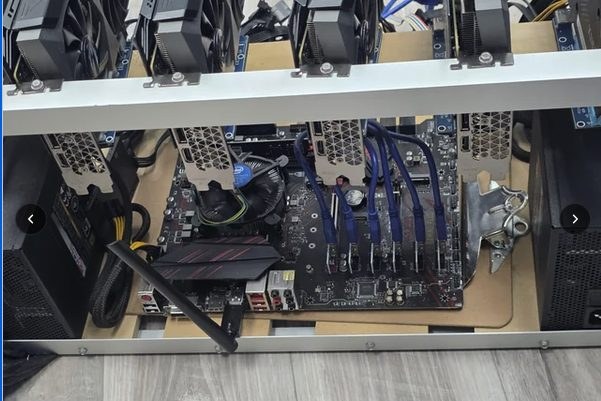
This story reads like a fairy tale for a PC builder. Besides the Zotac RTX 3070 cards, the rigs also packed MSI MPG Z390 Gaming Plus motherboards, a 1000W Rosewill 80 PLUS Gold power supply, two 4GB DDR4 sticks, and a pair of 120GB SSDs. It is a genuine starter kit for a budget optimizer that looks tempting on the secondary market for its price, but makes you think three times before buying.
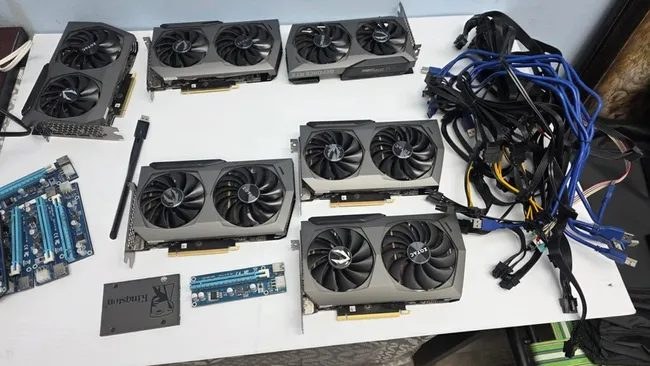
Still, it wasn't without its weirdness. Oily residues turned up on the graphics card circuit boards. As the finder guessed, they were left behind by thermal pads (heat-conducting strips placed between chips and heatsinks) that started leaking over time from constant heat. Otherwise, the tech looked surprisingly decent for its age. The RTX 3070 itself is an Ampere generation gaming graphics card released in 2020. Inside, it packs 5,888 CUDA cores and 8GB of GDDR6 video memory, which is plenty for modern tasks unless you crank graphics settings into the absolute stratosphere.
People are still terrified of buying ex-mining graphics cards, and that fear is understandable. The device ran around the clock, and the buyer has no clue how hard it was pushed. But if you look at the mechanics of the process, things aren't that dramatic. During mining, core clock speeds and voltages were often dialed down while memory got overclocked. The card itself ran in a relatively stable mode without constant temperature swings, which do far more damage to solder and circuit boards in regular gaming PCs where a GPU either roasts to its limit in heavy new releases or idles in a browser.
Of course, hardware wear and tear is real. The most noticeable wear you can spot without extra testing usually involves the cooling fans. The fans spin for years at high RPMs, so rattling, bearing squeal, and play are the first things a second-hand buyer will face.
If you calculate the real cost of owning such a card factoring in inevitable maintenance, the math stops being blindly enthusiastic. Buying a used mining GPU is attractive because of its low price compared to new store alternatives. However, you almost always need to add maintenance costs to that price tag. Buying a set of new, quality cooling fans for a graphics card from China or locally will also require additional expenses. Fresh thermal paste and a set of quality thermal pads to replace the leaked ones will also increase the final bill. If you don't know how to service hardware yourself, shop technician fees add a couple thousand more to the bill.
In the end, the total savings from buying a rig card compared to a brand-new modern GPU of comparable power start to shrink, but still stay noticeable for a tight budget. Testing showed a predictable outcome if the storage conditions were civilized. Every card except one turned out to be operational. A single failure out of a dozen devices is entirely acceptable for hardware that ran round the clock in a clean room.
Who is going to swap out the fans on the remaining eleven cards, and how much will it cost the secondary market buyer? If you are ready to spend an evening cleaning, replacing thermal interfaces, and installing new fans, you get high-performance hardware for way less cash than what new alternatives cost in stores. But if you want a "plug-and-play" option with zero screwdrivers involved, basement treasures will drain your wallet much faster than you think.