
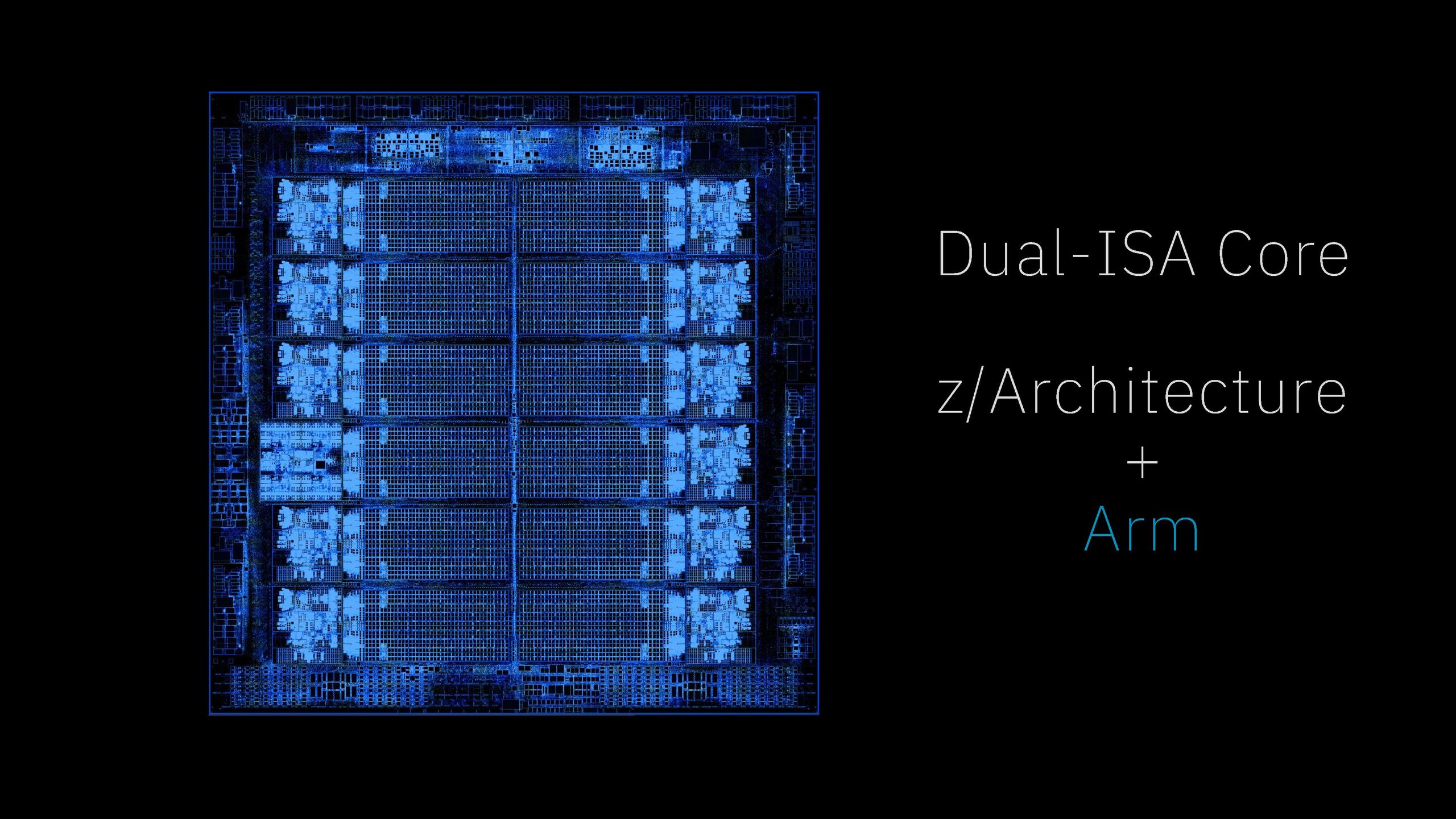
 aintaining parallel server fleets just to keep legacy enterprise software and modern Arm workloads under one roof has always been an expensive operational headache. At Hot Chips 2026, IBM unveiled the industry's first 2nm processor that natively executes both AArch64 and z/Architecture code within the exact same physical core. Rather than slapping disjointed cores onto a multi-chip module, IBM engineered the execution pipeline to flip between both instruction sets dynamically at the hardware level within nanoseconds, completely bypassing the performance tax of software emulation.
Under the hood, the processor packs 11 cores running at a 5.7 GHz clock speed, backed by 36 MB of private L2 cache, 432 MB of virtual L3, and 3.5 GB of virtual L4. Execution safety stays strictly partitioned: IBM routes Arm workloads through a Linux Kernel-based Virtual Machine while native z/Architecture instructions bypass KVM entirely. This hardware separation lets enterprise infrastructure maintain IBM's historic eight-nines reliability benchmark—roughly 0.032 seconds of downtime per year—without isolating modern applications on separate physical boxes.
Modern enterprise software engineering has decisively standardized on x86 and Arm, turning manual codebase ports to proprietary mainframe ISAs into a pointless money pit. By letting commodity Arm virtual machines run untouched alongside mission-critical core banking and transaction layers, IBM effectively eliminates the rack-space, power, and maintenance overhead of dedicated Arm clusters. For infrastructure teams, this is consolidation done right: keeping mainframe-grade isolation and uptime without forcing developers to care about legacy architectures.