
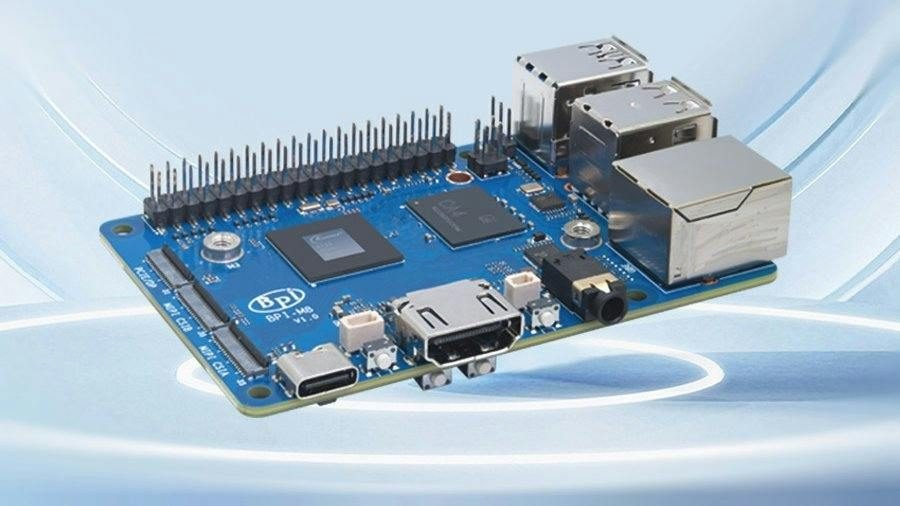
 bare circuit board named the Banana Pi BPI-M8 has hit the market with an opening price tag of $69. Embedded and hobbyist computing specialist Banana Pi designed the machine to borrow the exact physical footprint of the Raspberry Pi 5, positioning it as a direct budget alternative. If you want a small board for personal automation or media tasks, this release puts high-end components into a low entry bracket.
The math is straightforward: you get more modern memory and extra AI hardware for less cash, but you trade away the massive software ecosystem of the market leader. Banana Pi is aiming straight at buyers who refuse to overpay for a competitor's badge. The essential question is whether cheaper silicon can actually replace the established standard in your home setup, and whether software support will let you actually run your projects without wrestling with custom drivers.
Under the Hood of the Allwinner Chip
The BPI-M8 runs on an Allwinner A733 system-on-chip, combining two high-performance Arm Cortex-A76 cores running at up to 2GHz with six lower-power Cortex-A55 cores clocked at up to 1.8GHz. For graphics and machine learning, the platform incorporates an Imagination PowerVR BXM-4-64 MC1 GPU alongside an integrated neural coprocessor.
"The BPI-M8 is built on the high-performance octa-core AI platform chip A733, which combines a dual-core Arm Cortex-A76 and a hexa-core Arm Cortex-A55 processor clusters," as Banana Pi explained in their documentation.
According to Banana Pi's technical documentation, the built-in NPU delivers three TOPS of compute at minimum precision for on-device machine learning and computer vision workloads. While the Allwinner processor supports older LPDDR4 and LPDDR4X standards as well as faster memory, the variants available at launch ship exclusively with 4GB of LPDDR5 DRAM. How does the rest of the board handle everyday physical connections?
The Port Layout and Missing Compromises
It handles them by keeping legacy ports that rivals threw away. Unlike the Raspberry Pi 5, which dropped analog sound completely, the BPI-M8 includes a standard 3.5mm jack for audio out of the box. Storage expands via a microSD slot, an optional 16MB SPI flash chip, or optional eMMC modules ranging from 8GB to 128GB, with 64GB serving as the default configuration.
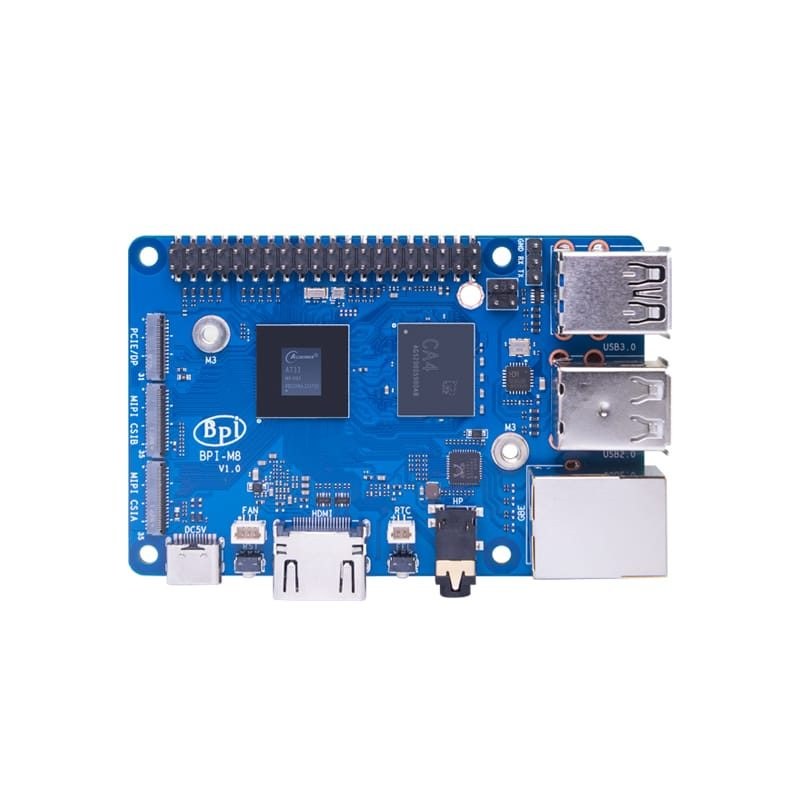
"there's also a 3.5mm jack for analog audio — a feature dropped from the Raspberry Pi 5."
Display connectivity includes a single HDMI 2.0b port supporting up to 4k60 output, alongside a standard 40-pin GPIO header, one USB 3.0 Host port, and two USB 2.0 Host ports. In fact, many buyers assume clone boards cut physical interfaces across the board, but Banana Pi kept both modern wireless connectivity and basic audio without forcing you to buy extra adapters.
The base BPI-M8B model with 4GB of RAM and 16MB SPI flash is listed on the company store for $69, while the upgraded BPI-M8A with 64GB of eMMC storage costs $103. If you need raw processing speed, modern LPDDR5 memory, and on-board audio jacks on a strict budget, this board delivers unbeatable hardware value today. Expect community software tweaks to take time to mature, but as pure silicon per dollar, the BPI-M8 sets a new benchmark for budget DIY builds.
The catch
A $69 price tag for a bare board with a dedicated 3.5 mm audio jack and fast LPDDR5 memory targets the exact vulnerabilities of the market leader. Banana Pi banked on raw silicon advantages by adding a 3 TOPS neural processing unit and preserving essential interfaces without external dongles. The inevitable trade-off for this hardware edge is the burden of manually wrestling with non-standard drivers for the Allwinner A733 chip. Will the initial hardware savings outweigh the extra setup hours required for the Allwinner A733 software stack?